Bitcoin mining is how new bitcoins enter circulation and how transactions get confirmed — but most explanations either skip the math or drown you in it. Here’s the honest version: mining is competitive number-guessing, done by specialized computers, for a reward that halves every four years.
I’ve followed Bitcoin’s mining economics closely since the 2020 halving cycle, and the gap between what beginners think mining is and what it actually involves has only widened. This guide explains the full picture: how the process works, what hardware does the work in 2026, how much it costs, the real profitability math, and the myths that keep tripping people up.
No affiliate pitches. No exaggerated income claims. Just what you need to actually understand it.
What is Bitcoin mining in simple terms?
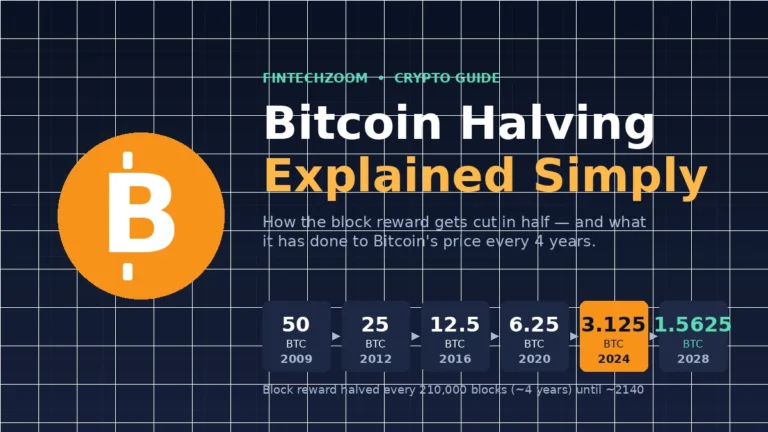
Bitcoin mining is the process where specialized computers compete to guess a random number that produces a valid block. The winner adds the next block of transactions to the blockchain and earns a reward — currently 3.125 BTC plus transaction fees. It’s how Bitcoin issues new coins and secures itself without a central authority.
Think of it as a global lottery that runs every ten minutes. Anyone can buy a ticket (a mining machine), but the more computing power you have, the more tickets you hold. The lottery isn’t random luck alone — it’s a race to find an answer to a cryptographic puzzle that has no shortcut.
That puzzle uses an algorithm called SHA-256. Miners feed in block data plus a changeable number called a nonce, run it through SHA-256, and check if the output starts with enough zeros to be “valid.” If not, they change the nonce and try again. Modern machines do this trillions of times per second.
The result: a system where rewriting Bitcoin’s history would require redoing all that work — which is now physically and economically impossible at scale. This is what people mean when they say Bitcoin is “secured by proof-of-work.”
How does Bitcoin mining actually work step by step?
Mining follows a defined sequence: collect transactions, build a block, hash it billions of times until the output meets the difficulty target, broadcast the winning block, and collect the reward. The network adjusts difficulty every two weeks so a new block is found roughly every ten minutes, regardless of how much computing power joins.
Here’s the full process broken down:
1. Transactions enter the mempool.
When you send Bitcoin, your transaction sits in a waiting room called the mempool. Miners pick transactions from here — usually the ones paying the highest fees — to include in their next attempted block.
2. Miners assemble a candidate block.
A miner bundles selected transactions, adds a reference to the previous block (the “previous block hash”), a timestamp, and a starting nonce. This forms a block header, which is the data they’ll hash.
3. The hashing race begins.
The miner runs the block header through SHA-256 over and over, changing the nonce each time. Each attempt produces a 64-character output. To “win,” that output must be a number lower than the current network target. As of June 2026, network difficulty sits at roughly 124.93 trillion, per CoinWarz data — meaning a valid hash needs to start with an enormous number of leading zeros.
4. A winning hash is found.
Somewhere on the network, one machine stumbles onto a nonce that produces a valid hash. This happens roughly every 9.9 minutes on average right now, very close to the 10-minute target.
5. The block is broadcast and verified.
The winner sends the block to other nodes. They check it, confirm the math, and add it to their copy of the blockchain. Within seconds, the block is part of the permanent record.
6. The miner collects the reward.
The winning miner receives the block subsidy — currently 3.125 BTC, following the April 2024 halving — plus all transaction fees from the included transactions. The next halving, around 2028, will cut this to 1.5625 BTC.
7. Difficulty re-adjusts every 2016 blocks.
Roughly every two weeks, the network checks how fast blocks have been arriving. If they came faster than 10 minutes on average, difficulty increases. If slower, it decreases. In June 2026, the network just saw a 10.09% downward adjustment, per Hashrate Index — the third major cut of the year as some miners shut down due to a price-driven margin squeeze.
This loop has run uninterrupted since January 2009.
What hardware do you need to mine Bitcoin in 2026?
You need an ASIC — Application-Specific Integrated Circuit — designed for SHA-256. General-purpose computers, gaming GPUs, and laptops cannot compete. The network’s total computing power is roughly 894 to 999 exahash per second as of mid-June 2026, per Hashrate Index and CoinWarz, which means a regular PC would take longer than the age of the universe to find one block.
The Bitcoin mining hardware market in 2026 is dominated by three manufacturers: Bitmain (Antminer series), MicroBT (Whatsminer), and Canaan (Avalon). Bitdeer and Auradine are newer entrants pushing efficiency lower.
Here’s how the top machines compare:
| ASIC Model | Hashrate | Efficiency (J/TH) | Power Draw | Best For |
|---|---|---|---|---|
| Antminer S23 Hyd | 580 TH/s | 9.5 | 5,510 W | Industrial farms |
| Antminer S21 XP Hyd | 473 TH/s | 12.0 | 5,676 W | Large-scale ops |
| Antminer S21 XP | 270 TH/s | 13.5 | 3,645 W | Best air-cooled |
| Antminer S21 Pro | 234 TH/s | 15.0 | 3,510 W | Mid-scale balance |
| Antminer S21 (base) | 200 TH/s | 17.5 | 3,500 W | Entry-level pro |
| Bitaxe Gamma | 1.2 TH/s | ~15 | 18 W | Solo-mining hobby |
Specs from manufacturer pages and D-Central, Mineshop EU, and AsicMarketplace 2026 reviews.
The efficiency number — joules per terahash (J/TH) — is what matters most. Lower is better. It tells you how much electricity the machine burns per unit of work. At $0.07/kWh and the June 2026 hashprice of about $32 per petahash per day (Hashrate Index data), machines above 25 J/TH are already running at a loss across most of the network.
For context, Checkonchain’s regression model put Bitcoin’s average network production cost at roughly $84,300 per BTC as of June 13, 2026 — while spot BTC trades around $63,780. Most of the network is mining below breakeven right now. That’s not an exaggeration; it’s the math.
You’ll also need:
- Reliable cheap electricity (under $0.06/kWh is the threshold for sustained profitability)
- Cooling and ventilation (most ASICs run at 72–76 dB, vacuum-cleaner loud)
- A mining pool account (solo mining a single ASIC has near-zero odds of ever finding a block)
- A Bitcoin wallet to receive payouts
This is why home mining at any meaningful scale has effectively died. The economics now favor large facilities with industrial power contracts, often co-located with stranded energy sources like flared gas or grid-balancing renewables.
How do mining pools work, and which are the biggest?
A mining pool combines hashrate from thousands of miners and splits the rewards proportionally. Solo mining a single modern ASIC has a less than 1% chance of finding a block per year. Pools smooth this variance into predictable income, usually paying out daily based on the shares of work each miner contributed.
In 2026, pool concentration is the elephant in the room. According to Hashrate Index’s 2026 pool report and mempool.space data:
- Foundry USA Pool — ~30% of network hashrate
- AntPool (Bitmain) — ~14–25%
- ViaBTC — ~11%
- F2Pool — ~7%
- SpiderPool / Binance Pool — together ~10%
Foundry and AntPool combined have controlled over half of all blocks mined for most of 2026. This raises legitimate decentralization concerns: a pool decides which transactions go into a block, even though individual miners contribute the raw hashpower. If a pool wanted to censor transactions from certain addresses, miners pointed at it would be unknowing accomplices.
Pools use different payout schemes. FPPS (Full Pay-Per-Share) pays a fixed amount per submitted share — predictable but with higher fees (2–4%). PPLNS (Pay Per Last N Shares) only pays when the pool finds a block but has lower fees and rewards consistent miners. TIDES, used by Ocean, sends rewards directly from the coinbase transaction to miners — more decentralized but more variable.
For a hobbyist with one machine, picking a smaller pool like Ocean or Braiins is the more pro-decentralization choice. For institutional operators, Foundry’s compliance and FPPS predictability win out — which is exactly why concentration keeps growing.
What does it actually cost — and is mining still profitable?
Mining profitability in 2026 comes down to four numbers: your electricity price, your machine’s efficiency, the network difficulty, and the BTC price. Right now, the average miner needs power under $0.05/kWh and hardware below 17 J/TH just to break even at current BTC prices.
Let me walk through real numbers using an Antminer S21 Pro (234 TH/s, 3,510 W) as an example:
- Daily power consumption: 3.51 kW × 24 hours = 84.24 kWh per day
- At $0.07/kWh: daily electricity cost = $5.90
- At June 2026 hashprice (~$32/PH/day): daily gross revenue = 234 TH/s × $0.032 = ~$7.49
- Less 2% pool fee: ~$7.34
- Daily net profit: ~$1.44
That’s roughly $43 per month per machine before factoring in hardware depreciation, downtime, cooling overhead, and maintenance. With the S21 Pro retail price around $4,000–5,000 in early 2026, payback under these conditions stretches well beyond three years — and difficulty is expected to keep climbing as new machines like the S23 Hyd come online.
Drop electricity to $0.04/kWh (typical of large facilities with industrial contracts or stranded energy deals) and the same machine clears around $4 per day net — still tight but more sustainable.
This is why the only people running profitable Bitcoin mining at meaningful scale are:
- Industrial operators with sub-$0.05 power, often using flared natural gas or behind-the-meter renewables
- Publicly-listed miners (MARA, Riot, CleanSpark, Core Scientific) with low-cost financing and shareholder patience for long ROI horizons
- Hosted mining customers who pay a third party to run their machines in a low-cost data center
For most beginners reading this, the honest answer is: at home, on grid power, with one machine, you will not make money mining Bitcoin in 2026. You might make a few dollars a month if your power is unusually cheap, but you will not “get rich.” Anyone telling you otherwise is selling something.
What are the biggest myths beginners believe about Bitcoin mining?
Most beginner confusion comes from mixing up mining with trading, misunderstanding energy use, or believing outdated info from 2017-era YouTube tutorials. The five biggest myths I see repeated in comment sections and Telegram groups:
Myth 1: You can mine Bitcoin on your laptop or gaming PC:
You can’t — not meaningfully. A high-end gaming GPU produces around 1 GH/s for Bitcoin’s SHA-256 algorithm. The network is operating at nearly 1 zettahash per second, which is one trillion times more powerful than your GPU. Your odds of finding a block solo are roughly one in 10²¹. The era of CPU and GPU mining for Bitcoin ended around 2013 when the first ASICs shipped.
Myth 2: Mining “creates” Bitcoin out of nothing:
Mining doesn’t create wealth from thin air — it consumes real energy and capital to produce a fixed, schedule-bound issuance. The 21 million cap is hard-coded. New coins enter circulation at a rate that halves every 210,000 blocks. After the 2140 halving, no new coins will be issued and miners will be paid only in transaction fees.
Myth 3: Bitcoin mining is destroying the planet:
The honest picture is more complex. The Cambridge Centre for Alternative Finance estimates Bitcoin’s annualised electricity use at roughly 160–175 TWh as of 2025, less than 0.5% of global electricity. Estimates vary because Cambridge revised its model in 2023 after admitting prior numbers overstated consumption. Around 50–55% of mining is now powered by some mix of renewables, nuclear, or stranded gas, per CCAF and Bitcoin Mining Council data. That doesn’t make it “green” — it does make the headline “Bitcoin uses more electricity than Argentina” misleading without context.
Myth 4: Mining will become unprofitable after the next halving:
This has been predicted before every halving since 2012, and it hasn’t happened yet at the network level. The least efficient miners shut down, difficulty drops, hashprice for surviving miners rises, and the network rebalances. Individual unprofitable operations close, but the network keeps running.
Myth 5: Cloud mining and “mining apps” are a legitimate way to participate:
Almost all cloud mining services and mobile “mining apps” are either outright scams, multi-level marketing schemes, or vastly overpriced compared to buying real hardware. If a service guarantees daily returns, requires referrals to “boost” earnings, or won’t show you the actual ASIC inventory backing your contract — it’s not mining, it’s a Ponzi structure dressed up in crypto vocabulary.
Frequently Asked Questions
How long does it take to mine 1 Bitcoin in 2026?
A single Antminer S21 Pro would take roughly 5 to 6 years to mine 1 BTC solo at current network difficulty — but the variance is so wide it’s almost meaningless. In practice, miners join pools and earn fractional BTC daily. To “mine 1 BTC” reliably in a year, you’d need around 30–40 modern ASICs running 24/7 in a pool.
Can I mine Bitcoin with my phone?
No. Apps that claim to “mine Bitcoin” on phones are not actually mining — they’re either logging your activity for ad revenue, referral schemes, or are outright scams. Real Bitcoin mining requires SHA-256 ASIC hardware. A phone’s processor would produce a negligible hashrate and burn through the battery within hours producing nothing of value.
What happens after all 21 million Bitcoin are mined?
The last new Bitcoin will be mined around the year 2140. After that, miners will earn only transaction fees — no new coin issuance. The system is designed to transition to a fee-based security budget gradually as halvings reduce the subsidy. Whether fee revenue alone will be enough to secure the network at that point is one of Bitcoin’s open long-term questions.
Is Bitcoin mining legal?
Bitcoin mining is legal in most countries including the United States, Canada, most of the EU, the UK, Australia, and much of Latin America. It’s banned or heavily restricted in China, Algeria, Bangladesh, Egypt, Iraq, Morocco, Nepal, and Qatar. Always check your local regulations and electricity-use laws before starting. Tax treatment of mining income also varies widely by jurisdiction.
How is Bitcoin mining different from Ethereum or other crypto?
Bitcoin uses proof-of-work with the SHA-256 algorithm, requiring specialized ASIC hardware. Ethereum switched to proof-of-stake in September 2022 and no longer requires mining at all — validators stake ETH instead. Other proof-of-work coins like Litecoin (Scrypt), Monero (RandomX), and Kaspa (kHeavyHash) use different algorithms and different hardware.
What is the next Bitcoin halving date?
The next halving is expected around April 2028, at block height 1,050,000. It will reduce the block subsidy from 3.125 BTC to 1.5625 BTC. The exact date depends on average block times in the months leading up to it, since blocks don’t always arrive exactly every 10 minutes. Halvings have historically preceded major Bitcoin price cycles, though past patterns don’t guarantee future ones.
Do I need to be a programmer to mine Bitcoin?
No, but basic technical comfort helps. Setting up an ASIC involves connecting it to power and ethernet, accessing its web interface to enter your pool address and wallet address, and monitoring uptime. There’s no coding involved. The harder parts are sourcing cheap electricity, managing heat and noise, and accepting that profitability is tight at small scale.
The bottom line on Bitcoin mining
Bitcoin mining is a real, working system that has secured the network for sixteen years without interruption. The mechanics are elegant: competitive hashing, automatic difficulty adjustment, and a predictable issuance schedule that ends at 21 million coins. As a concept, it’s worth understanding.
As an income opportunity for the average person in 2026, it’s not what the YouTube ads promise. The economics favor large operators with industrial power contracts, and the gap is widening with every halving. If you want exposure to Bitcoin’s upside, buying and holding BTC directly is far more capital-efficient than buying mining hardware.
If you still want to mine — for the technical experience, ideological reasons, or to support network decentralization with a small home rig — start with a low-cost open-source unit like a Bitaxe, join a non-custodial pool like Ocean, and treat it as a learning project rather than an investment.
Next step: Before you buy any hardware, run your specific numbers through a current calculator like Hashrate Index’s profitability tool or NiceHash’s mining calculator. Use your electricity rate, not an average. The answer is usually clearer than you’d expect.
For more honest finance explainers — no hype, no affiliate spin — explore the rest of TheFintechZoom’s crypto and investing guides.