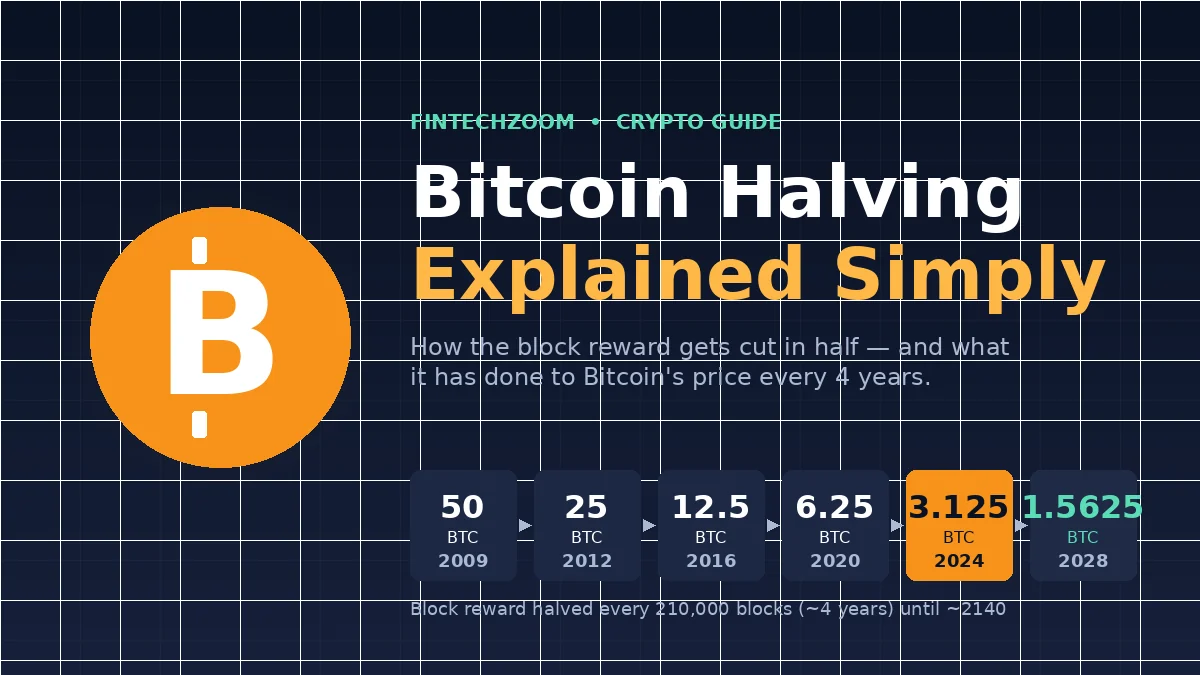
A Bitcoin halving is a scheduled software event that cuts the number of new bitcoins paid to miners in half — roughly every four years. It is the single mechanism that controls how fast new Bitcoin enters circulation, and it is the reason the supply caps at 21 million coins forever. Nothing else in the system has the same long-term effect on price, scarcity, or mining economics.
If you have heard the word “halving” thrown around on crypto Twitter or CNBC and walked away more confused than before, you are not alone. I have written about Bitcoin for years and the explanations out there are usually either too technical or too hype-driven. This guide strips the topic down to plain English — what a halving is, how it works, what it has done to price in the past, and what changed in the most recent 2024 halving.
What Is the Bitcoin Halving in Plain English?
The Bitcoin halving is a built-in rule in Bitcoin’s code that reduces the reward miners earn for adding a new block to the blockchain by 50%, every 210,000 blocks. That works out to roughly once every four years. The halving exists to enforce Bitcoin’s hard supply cap of 21 million coins and to slow new issuance over time.
Think of it like a faucet. When Bitcoin launched in 2009, the faucet dripped 50 new bitcoins every 10 minutes. After the first halving in 2012, it dripped 25. Then 12.5. Then 6.25. After the most recent halving in April 2024, the faucet now drips 3.125 bitcoins per block — roughly 450 new coins per day across the whole network.
The schedule is not a guess or a policy. It is hardcoded into the protocol that every Bitcoin node runs. Nobody can vote to change it, fast-forward it, or pause it without breaking consensus on the network. That predictability is the entire point.
How Does Bitcoin Halving Actually Work?
The halving works through three simple rules baked into Bitcoin’s source code: a fixed block target, a fixed halving interval, and a fixed total supply. Together they create a transparent issuance schedule that anyone can verify. Here is the mechanism step by step.
Step 1 — Miners compete to add a new block. Roughly every 10 minutes, miners around the world race to solve a cryptographic puzzle. The winner gets to add the next block of transactions to the blockchain and collects the block reward in newly created bitcoin.
Step 2 — The network counts blocks, not time. Bitcoin doesn’t actually use a calendar to trigger halvings. It counts blocks. After every 210,000 blocks are added, the next block’s reward is automatically cut in half. Because blocks average 10 minutes each, this lands close to a four-year cycle — but the exact date drifts.
Step 3 — Difficulty adjusts to keep the schedule honest. Every 2,016 blocks (about two weeks), the network recalculates how hard the puzzle should be. If miners are solving blocks too fast, difficulty goes up. Too slow, it goes down. This is why the halving stays roughly on a four-year rhythm even when total mining power swings wildly.
Step 4 — The reward halves automatically. At the exact block where the halving occurs, every honest node on the network expects a smaller reward. Any miner who tries to claim the old reward sees their block rejected by the rest of the network. There is no human decision involved.
Step 5 — Repeat until ~2140. This continues until block rewards become so small they round down to zero. The math works out to the last partial bitcoin being mined around the year 2140. After that, miners will earn only transaction fees.
What Have Past Bitcoin Halvings Done to the Price?
All four Bitcoin halvings have been followed by major price rallies within 12 to 18 months — though the size of each rally has shrunk as Bitcoin’s market cap has grown. The 2024 halving produced a 100% gain to a new all-time high of $126,198 in October 2025, smaller than previous cycles but on a much larger base. The pattern is consistent: the supply shock takes time to filter through.
Here is the full history of every halving, with the price at the halving date and the cycle peak that followed.
Bitcoin Halving Schedule and Price History
| Halving | Date | Block Reward Change | Price at Halving | Cycle Peak (Post-Halving) |
|---|---|---|---|---|
| First | Nov 28, 2012 | 50 → 25 BTC | ~$12 | ~$1,100 (Nov 2013) |
| Second | Jul 9, 2016 | 25 → 12.5 BTC | ~$650 | ~$19,800 (Dec 2017) |
| Third | May 11, 2020 | 12.5 → 6.25 BTC | ~$8,700 | ~$69,000 (Nov 2021) |
| Fourth | Apr 19/20, 2024 | 6.25 → 3.125 BTC | ~$63,800 | ~$126,198 (Oct 2025) |
| Fifth (projected) | ~Apr 17, 2028 | 3.125 → 1.5625 BTC | TBD | TBD |
A few observations from watching these cycles play out in real time:
The rally never starts at the halving itself. In every cycle I have tracked, the price was either flat or slightly negative for several months after the halving. The 2024 cycle was unusual because the spot Bitcoin ETF approvals in January 2024 pulled some of the rally forward — Bitcoin actually hit an all-time high before the halving for the first time in history.
The peak comes 12 to 18 months later. The 2013 peak landed about 12 months post-halving. The 2017 peak came 17 months after the 2016 halving. The 2021 peak was 18 months after the May 2020 halving. The October 2025 peak landed about 18 months after the April 2024 halving — right on schedule.
The percentage gains have been shrinking. The first cycle returned over 9,000%. The second returned around 3,000%. The third returned about 700%. The fourth returned roughly 100% from the halving day price to the cycle peak. This is what mathematicians call diminishing returns — as Bitcoin’s market cap grows, the capital required to double it grows with it.
What Changed With the 2024 Bitcoin Halving?
The fourth halving in April 2024 was structurally different from the three before it because spot Bitcoin ETFs went live in the US three months earlier, in January 2024. That changed the demand side of the equation in ways earlier cycles never saw. For the first time, retirement accounts and traditional asset managers could buy Bitcoin through normal brokerage accounts.
The result: Bitcoin reached its previous cycle high before the halving instead of after. Block 840,000 — the halving block — was mined on April 19, 2024 with Bitcoin trading near $63,800. By October 2025, Bitcoin hit $126,198. That is a 100% return, smaller than past cycles but on a vastly larger market cap.
The other meaningful change is that as of mid-2024, approximately 95% of all bitcoins that will ever exist have already been mined. Bitcoin’s annual supply growth rate has dropped below 1% for the first time — making it scarcer on a flow basis than gold.
The fifth halving is projected to occur around April 17, 2028, at block 1,050,000. The reward will drop from 3.125 BTC to 1.5625 BTC. Daily new issuance will fall from roughly 450 BTC to 225 BTC.
How Does the Halving Affect Bitcoin Miners?
The halving is a 50% pay cut for miners overnight, which forces an immediate shakeout of inefficient operations. Miners with high electricity costs or outdated rigs typically shut down within weeks of a halving, while better-positioned miners absorb their hash rate. The network’s total computing power usually dips briefly, then recovers as difficulty adjusts and rebalances the economics.
For most readers, the miner story matters because it explains the lag in the price response. After a halving, miners earn fewer new bitcoins. The miners still in business sell less Bitcoin into the market to cover the same fiat costs. That reduces sell pressure. Combined with steady or growing demand, this is the supply-shock thesis that historically drives the post-halving rally.
The 2024 halving was unusually mild on miners. Bitcoin’s price had already doubled in the months before the halving, so the dollar value of 3.125 BTC at $65,000+ was actually higher than 6.25 BTC had been just a year earlier at $30,000. Many miners survived without selling their treasuries. By May 2025, the network’s hash rate had crossed one zetta-hash per second for the first time — a sign of how resilient mining has become.
A practical takeaway: when you see headlines about miners “capitulating” after a halving, that usually marks a near-term price bottom, not a reason to panic. Forced selling clears the weak hands and leaves the network in stronger shape.
What Are the Biggest Myths About Bitcoin Halving?
Most halving narratives online fall into one of three traps — either overselling the price impact, ignoring the macro context, or treating past cycles as a guarantee. After watching four halvings unfold, here are the misconceptions worth getting straight.
Myth 1: Bitcoin price doubles the day of the halving: It never has. In every halving, the day-of price move has been small — usually less than 5%. The big moves come months later, not on halving day. Anyone who buys in the final hours before a halving expecting an instant pump is going to be disappointed.
Myth 2: The halving alone causes the bull market:: The halving is the supply trigger, but demand drives the magnitude. The 2017 cycle had retail mania and the ICO boom. The 2021 cycle had pandemic stimulus and corporate treasury buys. The 2024-2025 cycle had spot ETF inflows and a more crypto-friendly US regulatory shift. Halving plus demand catalysts equals a bull market — halving alone is just half the story.
Myth 3: Every cycle will be a 10x: Compounding makes this mathematically harder each round. A 10x from $69,000 (the 2021 top) would be $690,000. A 10x from there would be nearly $7 million. Past percentage returns are not predictive precisely because Bitcoin’s market cap is no longer microscopic. Diminishing returns are baked into the size of the asset.
Myth 4: Miners will quit and Bitcoin will die: This has been predicted before every halving. Every time, difficulty adjusts, less efficient miners exit, and the network keeps running. Bitcoin has never missed a block due to a halving. The protocol is designed to survive miner attrition.
Myth 5: The four-year cycle is broken in 2026: This one is current. Bitcoin’s pullback from $126K in late 2025 has people declaring the cycle dead. But every previous cycle had mid-cycle drawdowns of 30-40% before continuing. It is too early to call the four-year pattern dead based on one mid-cycle correction.
What Happens After the Last Bitcoin Is Mined?
After roughly the year 2140, no new bitcoins will be created. Miners will earn their entire income from transaction fees paid by users. Bitcoin’s monetary policy will become perfectly fixed at 21 million coins, and the only way to acquire bitcoin will be to buy it from someone who already owns it.
This is a long way off — 114 years from now — but the design choice has interesting implications today. Each halving brings Bitcoin closer to a fee-only security model. Transaction fees already make up a meaningful share of miner revenue during periods of high network activity. The 2024 halving briefly pushed daily fee revenue above the block subsidy, mainly due to Runes and Ordinals activity.
For long-term holders, the more relevant question is what happens between now and 2140. The supply curve is asymptotic — we are already past the 95% mined mark, but the last 5% will take well over a century to issue. That extreme back-loaded scarcity is what makes Bitcoin’s monetary properties unique compared to any other asset, digital or physical.
Frequently Asked Questions
What is a Bitcoin halving in simple words?
A Bitcoin halving is when the reward miners get for adding new blocks to the Bitcoin blockchain is cut in half. It happens automatically every 210,000 blocks — roughly every four years — and is hardcoded into Bitcoin’s protocol. The purpose is to slow new supply over time and enforce Bitcoin’s 21 million coin maximum supply.
When is the next Bitcoin halving?
The next Bitcoin halving is projected for around April 17, 2028, at block height 1,050,000. The exact date depends on how quickly miners produce blocks between now and then. At that halving, the block reward will drop from 3.125 BTC to 1.5625 BTC per block, and daily new issuance will fall from about 450 BTC to 225 BTC.
Does Bitcoin always go up after a halving?
Historically, yes — Bitcoin has hit a new all-time high in the 12 to 18 months following every halving. But the gains have been shrinking each cycle, from over 9,000% in 2013 down to roughly 100% in the 2024-2025 cycle. Past performance is not a guarantee, and the price effect can take many months to play out. There is no overnight pump.
How many Bitcoin halvings will there be in total?
There will be approximately 33 halvings before block rewards effectively round down to zero. The last bitcoin is expected to be mined around the year 2140. After that, Bitcoin miners will earn revenue exclusively from transaction fees paid by users sending Bitcoin on the network.
Why does Bitcoin have a halving at all?
Satoshi Nakamoto designed the halving to create predictable scarcity, mimicking the diminishing returns of mining precious metals like gold. By cutting issuance in half on a fixed schedule, the protocol guarantees a maximum supply of 21 million coins and a transparent monetary policy that no government, company, or individual can change.
What was the price of Bitcoin during each halving?
Bitcoin traded around $12 at the 2012 halving, $650 at the 2016 halving, $8,700 at the 2020 halving, and roughly $63,800 at the 2024 halving. Each cycle’s halving-day price was significantly higher than the previous, reflecting Bitcoin’s overall growth as adoption expanded from a niche experiment to a multi-trillion-dollar asset class.
Does the halving affect other cryptocurrencies?
Bitcoin halvings have historically lifted the entire crypto market, because Bitcoin remains the dominant asset and sets the tone for sentiment. Altcoins typically rally with a delay after Bitcoin’s post-halving move. However, the 2024-2025 cycle has seen Bitcoin dominance climb to over 72% — meaning altcoins underperformed Bitcoin for most of this cycle, a break from past patterns.
Can the Bitcoin halving be cancelled or changed?
No, not realistically. The halving is enforced by every node running Bitcoin software. Changing it would require a hard fork that nearly all participants — miners, exchanges, custodians, users — would have to agree on. Since the halving and the 21 million cap are core to Bitcoin’s value proposition, there is no incentive for the network to vote that change through.
The Bottom Line
The Bitcoin halving is the single most important supply mechanism in Bitcoin’s design. It is the only reason the 21 million cap actually holds. Strip away the price speculation, the cycle theories, and the “this time is different” arguments, and what is left is a transparent issuance schedule that has run exactly as designed for 16 years.
If you are new to Bitcoin, the practical takeaway is this: the halving is a long-term supply story, not a short-term trade. Buying the day before a halving expecting an instant pump is a mistake. Understanding the halving cycle helps you contextualize Bitcoin’s volatility — drawdowns of 30-40% inside a bull cycle are normal, and the major rallies historically come months after the halving event itself.
For your next step, watch the data, not the noise. Track Bitcoin’s hash rate, the mining difficulty adjustments, and on-chain supply metrics. These tell you more about where the cycle stands than any pundit’s prediction. And remember — by 2028, 96% of all Bitcoin that will ever exist will already be in circulation. The scarcity story isn’t a forecast. It’s already happening.
This article is for educational purposes only and does not constitute financial advice. Cryptocurrency investments carry significant risk, including the possible loss of principal. Always do your own research and consult a qualified advisor before making investment decisions.