If you own any crypto, the single most important question isn’t which coin to buy — it’s where you store it. A cold wallet is generally safer than a hot wallet because the private keys never touch an internet-connected device, which removes the entire remote attack surface. But “safer” is not the same as “right for you.” In 2025, attackers stole over $3.4 billion in crypto, and a record 23% of that came from personal wallets — not exchanges. This guide breaks down the real differences, the honest tradeoffs, and how I personally split my own holdings between the two.
What Is a Hot Wallet vs a Cold Wallet, Really?
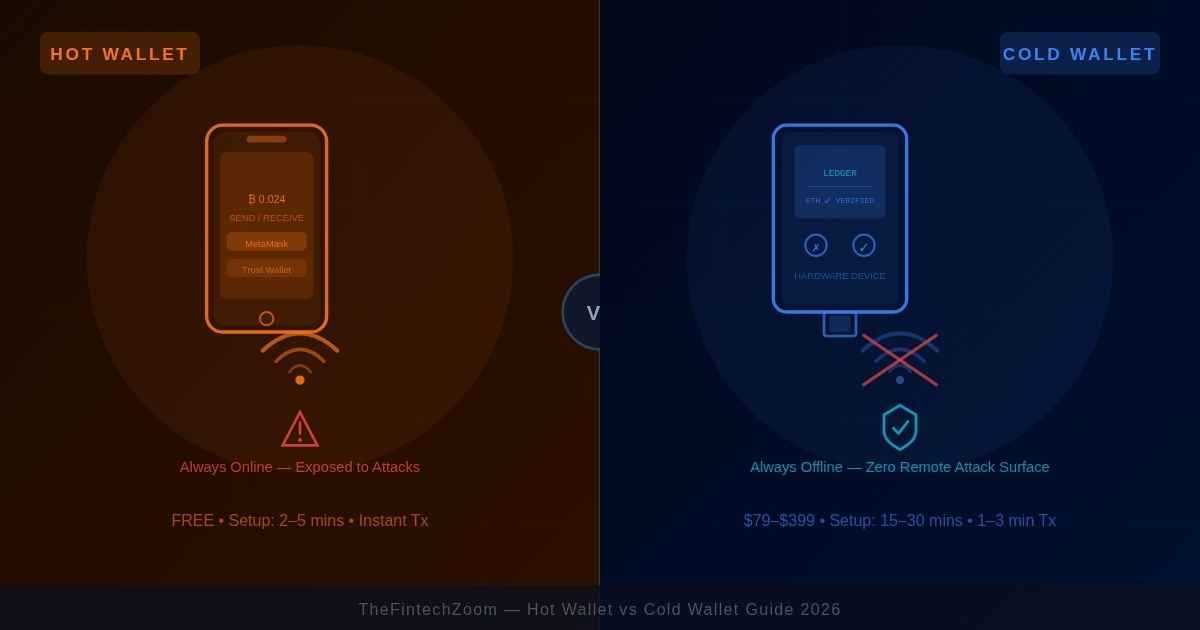
A hot wallet is any crypto wallet whose private keys live on an internet-connected device — your phone, your laptop, a browser extension, or an exchange account. A cold wallet keeps those private keys completely offline on a dedicated hardware device, a piece of paper, or a steel plate. The difference is not the brand. It is whether the key has ever touched the internet.
That single distinction drives everything else.
Common hot wallets: MetaMask, Trust Wallet, Phantom, Coinbase Wallet, Exodus, the wallet section inside Binance or Coinbase exchange accounts.
Common cold wallets: Ledger Nano (the Gen5 is the current flagship), Trezor Safe 5, Coldcard, Keystone, and “paper wallets” generated on an air-gapped computer.
Here is the part most beginner guides skip: an exchange wallet on Binance or Coinbase is technically a hot wallet that you don’t even control. The exchange holds your keys. If they get hacked, frozen, or go bankrupt, your access depends on their solvency — not your seed phrase. That is a third category some experts call “custodial”, and it is the most common storage type for new users.
Hot Wallet vs Cold Wallet: Which One Is Actually Safer in 2026?
Cold wallets are objectively safer for storing crypto because remote attackers cannot reach private keys that have never been online. Hot wallets are exposed to malware, phishing, fake DApp signatures, and clipboard hijacking — all of which happen on the same internet-connected device that signs your transactions. For long-term holdings, cold storage is the standard.
But the 2025 data tells a more nuanced story.
According to blockchain intelligence firm Chainalysis, crypto theft totaled over $3.4 billion in 2025, up from $3.38 billion the year before. The largest single incident was the February 2025 Bybit hack, in which roughly $1.5 billion in Ethereum was drained from one of the exchange’s cold wallets — the biggest crypto theft in history. North Korea’s Lazarus Group has been linked to the attack.
Read that again. A cold wallet got drained.
Here’s what actually happened, because no other guide explains it honestly: the keys themselves were never extracted. Attackers compromised the user-interface layer that Bybit’s signers used to approve transactions. The signers thought they were approving a routine internal transfer. They were actually signing a smart contract change that handed over control of the wallet. The “airgap” held. The humans approving the transaction did not.
This is called a blind signing attack, and it is the dominant attack pattern against well-secured wallets in 2025–2026. Your hardware device shows a hash. You approve it. You never see what you really agreed to.
So the honest 2026 ranking looks like this:
- Cold wallet + clear-signing discipline — safest realistic setup.
- Cold wallet alone — still excellent, but vulnerable to blind-signing and social-engineering attacks.
- Self-custody hot wallet (MetaMask, Trust Wallet, etc.) — convenient, but the attack surface is your entire computer.
- Exchange-held funds — easiest, but you are trusting a third party with your keys.
A widely-cited figure from the hardware wallet industry estimates only around 2% of crypto holders use a hardware wallet, even though personal-wallet attacks have surged. That gap is exactly where most preventable losses happen.
Hot Wallet vs Cold Wallet: Side-by-Side Comparison
| Factor | Hot Wallet | Cold Wallet |
|---|---|---|
| Internet connection | Always online | Always offline |
| Cost | Free | $79–$399 (one-time) |
| Setup time | 2–5 minutes | 15–30 minutes |
| Transaction speed | Instant | 1–3 minutes per transaction |
| Best for | Daily spending, trading, DeFi | Long-term holding, large balances |
| Main risk | Malware, phishing, fake signatures | Physical theft, lost seed phrase, blind signing |
| Recovery if lost | Seed phrase | Seed phrase |
| Examples | MetaMask, Trust Wallet, Phantom | Ledger Nano Gen5, Trezor Safe 5, Coldcard |
| Recommended balance | Under 10% of holdings | 90%+ of holdings (for long-term) |
The price column is where most beginners hesitate. A Ledger Nano starts around $79. If you hold more than $1,000 in crypto, that is a 7.9% one-time fee for permanent peace of mind. I have never met someone who regretted buying one. I have met plenty who regretted not buying one.
How Do You Choose Between a Hot Wallet and a Cold Wallet?
You don’t choose one. You use both, and you allocate your funds by purpose, not by preference. Treat your hot wallet like your physical wallet (small amounts, daily use) and your cold wallet like your bank vault (large amounts, rarely touched). The split protects you in the only scenario that matters: when something goes wrong.
Here is the framework I use myself, and the same one I have recommended to every friend who asked.
Step 1: Decide what each pile of money is for
- Spending money — coins you actively swap, stake, bridge, or use in DeFi every week. Hot wallet.
- Holding money — coins you plan to keep for 6+ months. Cold wallet.
- Emergency money — a small stablecoin reserve you can move quickly. Hot wallet, separate from your main hot wallet.
Step 2: Pick the 90/10 rule as your default
Keep no more than 10% of your total crypto in hot wallets at any time. The other 90% sits in cold storage. This is roughly the ratio professional traders use, and it survives almost every common attack scenario. If your hot wallet gets drained tomorrow, you lose 10%. You sleep tonight.
Adjust the ratio as your holdings grow. At $500 total, 50/50 is fine. At $50,000, you should be closer to 95/5.
Step 3: Buy from the manufacturer, never Amazon
Hardware wallets have a real supply chain attack problem. Tampered devices sold through third-party marketplaces have been documented multiple times. Buy directly from ledger.com, trezor.io, coinkite.com, or keyst.one. Pay the small premium. Skip the resellers.
Step 4: Set up the device offline and write the seed phrase on metal
Paper degrades. Paper burns. Paper gets wet. A $25 steel seed-phrase backup (Cryptosteel, Billfodl, or any equivalent) takes 15 minutes to set up and lasts a lifetime. Never type your seed phrase into anything that has a screen. Never photograph it. Never store it in iCloud, Google Drive, or a password manager. This single rule prevents the most common cold-wallet failure.
Step 5: Test recovery before you fund the wallet
Send a small amount in. Wipe the device. Restore from your written seed phrase. Confirm the same address comes back. Only then do you send the real balance. About one in five recovery failures happens because the seed phrase was written down incorrectly the first time. Catch it now, not later.
Step 6: Practice clear signing for every transaction
When your hardware wallet shows a transaction, read the destination address and the amount on the device’s screen — not your computer screen. If the device shows a hash instead of human-readable text, you are blind signing. Avoid signing whenever the wallet shows only a hex string you cannot verify. Bybit’s $1.5 billion lesson was paid in blind signatures.
Real Examples: What Has Gone Wrong in 2025
The fastest way to understand wallet security is to look at how people actually lost money this year. Three patterns dominate.
The exchange-cold-wallet exploit (Bybit, February 2025)
A cold wallet was drained for $1.5 billion not because cold storage failed, but because the signing interface lied to the human approvers. The takeaway is not “cold wallets are unsafe.” The takeaway is: even cold storage requires reading what you sign.
The personal-wallet phishing explosion
The Block reported, citing Chainalysis data, that personal wallet compromises grew from 7.3% of total stolen value in 2022 to 44% in 2024. Attackers have shifted away from exchanges and toward individuals. The technique is almost always the same: a fake DApp interface, a fake support agent on Telegram or Discord, or a fake “wallet sync” page that asks for your seed phrase. No legitimate service ever asks for your seed phrase. Not Ledger. Not MetaMask. Not Coinbase. Not anyone. If something prompts for it, it is a scam.
Address poisoning and clipboard malware
Reports from security auditors flagged address poisoning attacks compromising over $100 million on Ethereum alone. The attack works by sending you a tiny transaction from an address that looks visually similar to one you have used before. Next time you copy an address from your transaction history, you paste the attacker’s. Always verify the full address — first and last 6 characters at minimum — before approving any transfer.
The Biggest Mistakes People Make With Each Wallet Type
The hot wallet versus cold wallet debate is not where most people lose money. People lose money on the mistakes around the wallet, not the wallet itself. Here are the ones I see repeatedly.
With hot wallets:
- Connecting the wallet to every random DApp that promises an airdrop. Each connection is a potential drain.
- Forgetting to revoke old smart-contract approvals. Use revoke.cash periodically.
- Using the same device for crypto and for general browsing. Separate browser profiles at minimum.
- Storing the seed phrase in a screenshot, a notes app, or an email draft. All four are routinely scraped by malware.
With cold wallets:
- Buying from Amazon or eBay instead of the manufacturer.
- Skipping the recovery test before funding the device.
- Treating the cold wallet like a vault and never updating its firmware. Firmware updates patch real vulnerabilities.
- Connecting the cold wallet to a malicious DApp and approving a “blind signing” transaction without reading what it does.
- Telling family, friends, or anyone else where the seed phrase is stored. The most common physical-theft cases are from people you already know.
There is a sixth mistake that applies to both: assuming the wallet is the security. The wallet is just a tool. Your habits are the security.
Frequently Asked Questions
Can a cold wallet be hacked?
Yes, but not remotely. A cold wallet’s private keys cannot be stolen over the internet. However, cold wallets can be compromised through physical theft, supply chain tampering (buying a pre-configured device), social engineering that tricks the owner into entering their seed phrase on a fake site, or blind-signing attacks like the one used against Bybit in February 2025.
Is Coinbase or Binance a hot wallet or a cold wallet?
Exchange wallets on Coinbase and Binance are custodial hot wallets — the exchange holds your private keys on internet-connected infrastructure. The exchanges themselves use a mix of hot and cold storage internally, but from your perspective as a user, you are trusting a third party with your funds. This is fundamentally different from owning your own self-custody wallet.
What happens if I lose my hardware wallet?
Nothing, as long as you still have your seed phrase. The seed phrase is the actual key — the device is just the secure interface. You can buy a new hardware wallet, enter the same 12 or 24-word seed phrase, and recover full access to your funds. This is exactly why writing the seed phrase on steel and storing it separately is non-negotiable.
Are software wallets like MetaMask safe?
MetaMask is reasonably safe for small amounts and active use, but it is a hot wallet — it stores your keys on a device that browses the web. The most common cause of MetaMask losses is not MetaMask itself but users approving malicious smart contracts on fake DApp sites. For sums above roughly $1,000, pair MetaMask with a hardware wallet so transactions require physical approval.
Do I need a hardware wallet for small amounts of crypto?
If you hold under $200 in crypto and you actively trade, a hot wallet is fine. Once your holdings cross roughly $500–$1,000, the math shifts. A $79 hardware wallet is cheap insurance for thousands of dollars in storage. According to industry estimates, only about 2% of crypto holders use hardware wallets, which is exactly why personal-wallet attacks have surged in 2025.
Can I use my cold wallet for DeFi and staking?
Yes, and you should. Modern hardware wallets connect to MetaMask, Rabby, and similar interfaces, letting you interact with DeFi protocols while the signing still happens on the offline device. You get the security of cold storage with the functionality of a hot wallet. This is the setup most experienced users actually run.
What is the safest crypto wallet overall in 2026?
There is no single “safest” wallet. The safest setup is a hardware wallet from a reputable manufacturer (Ledger Nano Gen5, Trezor Safe 5, or Coldcard) used with clear signing, paired with a separate small hot wallet for daily use, with the seed phrase stored on metal in two separate physical locations. Brand matters less than discipline.
Should I keep my crypto on the exchange where I bought it?
For the long term, no. The phrase “not your keys, not your coins” exists because of years of exchange collapses (Mt. Gox, FTX, Celsius, BlockFi). For short-term trading, exchange storage is acceptable. For anything you plan to hold longer than a few months, move it to a wallet you control — ideally cold storage.
The Verdict: How I’d Set Up My Own Wallet in 2026
A cold wallet is safer than a hot wallet for one simple reason: the keys never go online. But the safest strategy is using both, with the right amount in the right place. Keep 90% of your holdings cold, 10% hot for daily use, your seed phrase stamped on metal, your firmware updated, and your finger off the “approve” button until you have read what you are actually signing.
If you take only one action after reading this, make it this one: if you own more than $500 in crypto and you do not have a hardware wallet, order one this week directly from the manufacturer. The 2025 numbers — $3.4 billion stolen, $1.5 billion in a single hack, 23% of attacks now hitting personal wallets — are not a forecast. They already happened. The next year is unlikely to be quieter.
Cold storage is not paranoia. It is the baseline. Treat it that way.
About this guide: TheFintechZoom is an independent finance education site. We do not sell wallets, take affiliate commissions from hardware manufacturers, or accept sponsored placements in our security guides. All figures cited are from Chainalysis, The Block, and the linked manufacturer reports as of early 2026.