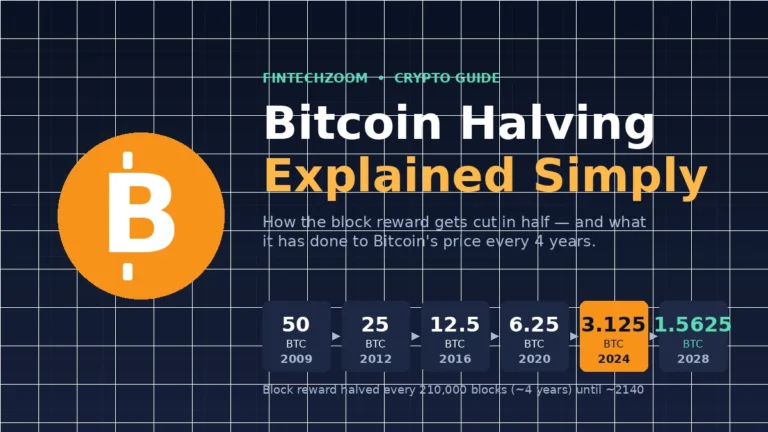
Bitcoin is trading between $74,000 and $80,000 in April 2026 — down nearly 40% from its October 2025 all-time high of $126,287, yet supported by some of the strongest institutional buying this cycle has seen. If you’ve landed on FintechZoom.com looking for clarity on what’s actually moving BTC, you’re not alone.
In this guide, I’ll break down what FintechZoom.com’s Bitcoin coverage actually delivers, how to use it alongside other data sources, and the key market forces driving BTC right now — so you leave with context, not just headlines.
What FintechZoom.com Actually Covers on Bitcoin
FintechZoom.com treats Bitcoin price as informational data that signals changes in market structure and macroeconomic conditions — not as a forecasting tool. That framing matters. The platform isn’t a trading terminal.
FintechZoom.com serves as a one-stop shop for individuals and professionals who need up-to-the-minute reports on global markets, banking innovations, and investment strategies — designed to democratize financial information.
In practice, for Bitcoin specifically, the platform covers five areas:
- Real-time BTC/USD price activity — updated frequently from aggregated market feeds, not a single exchange. This means the price shown reflects broad market sentiment rather than one venue’s liquidity conditions.
- Macro context for price moves — the Bitcoin–USD relationship is analyzed through interest rate decisions, inflation expectations, currency debasement, and capital flows. In periods of monetary expansion or financial uncertainty, Bitcoin is often framed as a hedge or alternative asset.
- Structural news, not noise — FintechZoom.com focuses on structural developments such as regulatory clarity, institutional custody solutions, protocol upgrades, scalability improvements, and global adoption rather than every daily price wiggle.
- ETF and institutional flow coverage — this has become increasingly central as Bitcoin ETFs reshape who sets the marginal price.
- Educational explainers — wallet types, mining mechanics, halving cycles, and on-chain concepts explained accessibly.
FintechZoom.com Crypto News is best understood as a broad crypto information hub rather than a niche institutional research terminal. It is designed for readers who want fast access to market updates, price-focused content, and explainers on major digital asset trends without jumping across multiple websites.
Read More: FintechZoom.com Bitcoin Stock
How to Read FintechZoom.com Bitcoin News Like a Pro
Here’s what I’ve learned from tracking Bitcoin across multiple platforms: the mistake most readers make is treating any single news source as a complete picture. FintechZoom.com is a strong starting point — but it’s most powerful when layered with complementary data.
Step 1: Use FintechZoom.com for narrative context
When BTC drops 5% in a day, FintechZoom.com typically explains why — which macro event, regulatory headline, or institutional flow triggered it. That narrative framing is genuinely useful for non-technical readers. Many readers use FintechZoom.com when they want quick explanations about price drivers rather than deep technical indicators, which is why searches like “fintechzoom bitcoin price today news” tend to peak during periods of volatility or major macro announcements.
Step 2: Verify price signals with on-chain data
If FintechZoom.com highlights renewed Bitcoin momentum, readers can use Glassnode to examine on-chain and market intelligence, including network activity and capital-flow-related context. If the story involves token fundamentals, CoinGecko operates as a large independent crypto data aggregator with broad market coverage.
Step 3: Check ETF flow data daily in 2026
This is the single biggest upgrade to your Bitcoin research routine right now. New research suggests Bitcoin has shifted from lagging to leading global monetary policy, with ETF-driven institutional flows now front-running expected central bank moves rather than reacting to them. Watching daily ETF inflows and outflows — via SoSoValue or CoinGlass — gives you a 24-48 hour leading indicator for price direction.
Step 4: Cross-reference regulatory news
The SEC has scheduled a roundtable for discussing the CLARITY Act, pivotal legislation for determining the regulatory framework and oversight body for digital assets in the United States. Regulatory clarity is a direct price catalyst. Don’t skip these stories when FintechZoom.com surfaces them.
The Bitcoin Story FintechZoom.com Is Covering Right Now
The dominant narrative in April 2026 is institutional re-accumulation after a painful first quarter.
The selloff that set up the current opportunity
After reaching an all-time high of $126,287 in October 2025, Bitcoin retraced sharply, trading near $66,364 as of early April 2026 — a decline of roughly 47% from that peak. The pullback reflected a confluence of factors: persistent macro headwinds including elevated oil prices tied to US–Iran tensions, a reset in spot ETF flows after several strong inflow streaks, and broader risk-off positioning across global markets.
The institutional comeback
Bitcoin has staged a remarkable recovery in April 2026, climbing from around $74,000 to break above $76,000 as institutional capital floods back through spot ETF vehicles — gaining approximately 23% from its February cycle low of around $60,000.
The mechanics driving that recovery are significant. U.S. spot Bitcoin ETFs recorded approximately $996.4 million in net inflows last week alone, marking the largest weekly net inflow since mid-January 2026.
Bitcoin ETF AUM hit $105.28 billion, adding approximately $4 billion in a single week — with consistent buying from these products providing a structural demand bid.
Strategy’s landmark purchase
Strategy (formerly MicroStrategy) acquired 34,164 Bitcoin for approximately $2.54 billion at an average price of $74,395 per coin — its third-largest acquisition on record — bringing total holdings to 815,061 BTC. The company’s Bitcoin holdings generated approximately $3.6 billion in gains in April alone.
The whale accumulation signal
The number of addresses holding over 1,000 BTC increased by 3.2% month-over-month. This whale accumulation, combined with ETF inflows, suggests that the current rally has more substance than previous speculative episodes.
Supply squeeze building
By mid-April 2026, the “free float” of Bitcoin on centralized exchanges hit a 10-year low, creating conditions where institutional demand continues to outpace new supply from miners — and any positive macro catalyst could trigger rapid expansion toward higher price levels.
Common Mistakes When Using FintechZoom.com for Bitcoin Research
Mistake 1: Treating FintechZoom.com price data as exchange-grade execution data
FintechZoom.com aggregates Bitcoin pricing data from multiple market feeds, allowing users to check a near real-time snapshot of BTC trends. While it is not an exchange-based data provider, its blended sources reflect broader market sentiment rather than a single trading venue’s liquidity conditions. If you’re placing a large trade, always verify price on your actual exchange before executing.
Mistake 2: Relying on any single source for 2026 Bitcoin analysis
FintechZoom.com’s crypto coverage is broad enough for everyday readers who want a quick snapshot, but it is usually more media-oriented than deeply research-oriented — better described as readable and directional rather than highly technical. For position-sizing decisions, pair it with on-chain data from Glassnode or Messari.
Mistake 3: Ignoring ETF flows when reading BTC news
Before 2024, retail sentiment and price action were tightly correlated. That relationship has broken. While retail investors are fearful of short-term volatility, BlackRock’s total crypto ETF assets under management surpassed $130 billion — signaling that the “institutional bid” is now so large it effectively mops up any retail panic. Reading headlines without checking ETF flow data means you’re working with half the picture.
Mistake 4: Applying 2021 cycle logic to 2026
Not every pattern from earlier cycles can be projected forward. While supply shocks from halving events and sentiment-driven fear and greed cycles remain relevant, retail-dominated parabolic moves triggered by short-term hype are less relevant in the current market. Institutional dominance changes the playbook.
Mistake 5: Confusing multiple “FintechZoom.com” sites
Search results in 2026 surface several sites with similar names — fintechzoom.com, finetechzoom.com, thefintechzoom.it.com, gofintechzoom.com. These are distinct platforms with varying levels of editorial quality. Bookmark the specific URL you trust and verify authorship before acting on analysis.
Read More: FintechZoom.com Bitcoin ETF
FAQ — FintechZoom.com Bitcoin News
What is FintechZoom.com’s Bitcoin coverage actually about?
FintechZoom.com covers Bitcoin price movements, macro drivers, ETF flows, regulatory news, and blockchain technology updates. It’s designed for accessibility — useful for readers who want market context quickly without needing deep technical knowledge. It’s a starting point for research, not a replacement for specialist data platforms.
Is FintechZoom.com a reliable source for Bitcoin price data?
It’s reliable for narrative context and broad directional trends. FintechZoom.com aggregates data from multiple market feeds, which helps reflect broader market sentiment rather than a single exchange’s liquidity conditions. For precise execution prices, use your actual trading platform. For deep on-chain analysis, supplement with Glassnode or CoinGecko.
What is Bitcoin’s price in April 2026?
Bitcoin entered mid-April 2026 trading at approximately $77,476, with the cryptocurrency establishing a well-defined trading range between $70,000 support and $76,000 resistance, supported by institutional capital flows through spot Bitcoin ETFs. Prices are volatile — always check live data before making any decision.
Why are Bitcoin ETF inflows so important to watch in 2026?
Bitcoin’s relationship with global monetary policy has shifted, with ETF-driven institutional flows now front-running expected central bank moves rather than reacting to them. ETF inflows are now a leading indicator — institutions buy ahead of anticipated macro events, not after. Tracking daily ETF data gives retail investors unusual insight into where institutional money is flowing.
What drove Bitcoin’s 2025 all-time high and 2026 correction?
Bitcoin reached an all-time high of $126,287 in October 2025, then retraced sharply due to elevated oil prices tied to US–Iran tensions, a reset in spot ETF flows, and broader risk-off positioning across global markets. The halving cycle tailwinds faded as macro headwinds intensified.
What is the CLARITY Act and why does it matter for Bitcoin?
The CLARITY Act is pivotal legislation for determining the regulatory framework and oversight body for digital assets in the United States. Regulatory clarity could reduce market uncertainty and potentially unlock further institutional investment — with Bitcoin standing to benefit as a digital commodity with a well-defined regulatory perimeter.
How does FintechZoom.com compare to CoinDesk or Glassnode?
Beginners often get the most value from FintechZoom.com because the content is easier to scan and less intimidating than many crypto-native research platforms — useful for people following broad market sentiment rather than making highly complex trades. CoinDesk offers deeper journalism; Glassnode provides institutional-grade on-chain intelligence. Use FintechZoom.com for accessibility, the others for depth.
What’s the biggest Bitcoin story FintechZoom.com should be covering in 2026?
The structural shift in who controls Bitcoin’s price. The divergence between retail sentiment and institutional action — where the Fear & Greed Index is trapped in “Extreme Fear” while institutional inflows hit multi-week highs — represents the most important dynamic in the market. Understanding this gap is the key to not panic-selling at exactly the wrong moment.
Conclusion
FintechZoom.com Bitcoin news works best when you know what it is: an accessible, narrative-driven platform that explains why Bitcoin moves, not just where it moves. In 2026, that context is more valuable than raw price data — because the mechanics driving BTC have changed fundamentally.
The dominant forces right now are institutional ETF flows, macro policy, and regulatory clarity. Bitcoin spot ETFs have recorded their first monthly gain of 2026, ending a four-month streak of outflows — with BlackRock’s IBIT leading institutional demand. That structural shift doesn’t show up in a headline price number. It shows up in daily flow data.
Your action step: Bookmark FintechZoom.com for daily narrative context. Add a daily check of spot Bitcoin ETF flows from SoSoValue or CoinGlass. Cross-reference any price prediction with on-chain data before you act on it. That three-source habit separates informed decisions from reactive ones.
Bitcoin in 2026 rewards people who understand the full picture — not just whoever posts the loudest headline.
Disclaimer: This article is for informational and educational purposes only and does not constitute financial, investment, or earnings advice. Any references to profits, returns, or income are not guaranteed. Cryptocurrency investments involve substantial risk, including the possible loss of your entire capital. Past performance does not guarantee future results. All opinions expressed are solely the author’s. Always conduct your own research and consult a qualified financial advisor before making any investment decisions.
See what fintech insiders are reading — dive into FintechZoom premium content curated for pros.