You open a brokerage account for the first time. Then it hits you: there are more than 8,000 publicly traded companies on U.S. exchanges alone. How are you supposed to pick even one?
Most beginners either buy something they heard about on social media and lose money fast, or they do nothing and miss years of compounding growth. Both are costly.
This guide gives you a clear, repeatable framework for picking your first stock — built on fundamentals, not hype. You’ll understand what to look for in a company, how to check whether a price makes sense, what red flags to avoid, and how to make a decision you can actually stick with. No filler. No vague advice.
What Does “Picking a Stock” Actually Mean?
Picking a stock means choosing to buy a fractional ownership stake in a real business. When you select a company, you’re not trading a number on a screen — you’re betting that the underlying business will grow in value over time. Your job isn’t to predict tomorrow’s price. It’s to identify a business worth owning for years.
When you buy shares of any publicly traded company, you become a part-owner — entitled to a proportional share of its profits and assets. That sounds abstract until you reframe it: if you own 10 shares of a company that earns $5 per share annually, your ownership generates $50 in annual earnings. What happens to the stock price is secondary to what happens to the business.
This distinction is what separates investors from speculators. Speculators bet on price movements. Investors buy businesses.
What a share price tells you — and what it doesn’t
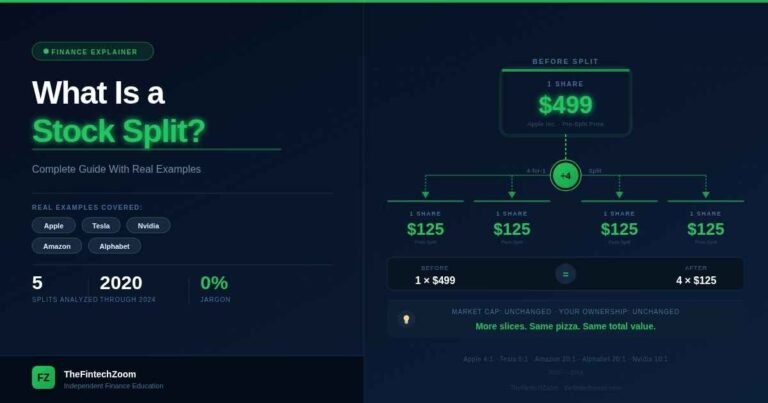
A $5 stock is not automatically cheaper than a $500 stock. Price per share tells you almost nothing about value. What matters is the relationship between price and what you’re getting for it.
The metric that ties these together is market capitalization — share price multiplied by total shares outstanding. Two companies with dramatically different share prices can be identical in total size. Always look beyond the number on the screen, or you’ll consistently confuse “cheap” with “low-priced.”
Peter Lynch, who managed the Magellan Fund to an annualized 29.2% return between 1977 and 1990, made this the foundation of his philosophy: understand the business first. If you can’t explain in two minutes how a company makes money, you’re not ready to own it.
How to Pick Your First Stock: A 6-Step Process
To pick your first stock, start by defining your investment goal, then choose an industry you understand, screen for financially healthy companies, check whether the price is reasonable, read at least one earnings report or annual summary, and start with a position small enough to hold through volatility without panicking.
Here’s what each step actually looks like in practice.
Step 1: Define your goal and time horizon
Before you look at a single company, answer this: why are you investing, and when might you need the money back?
Are you building retirement savings with a 30-year horizon? Saving for a home purchase in four years? Testing the markets with a small amount you can afford to lose?
Your timeline determines how much volatility you can absorb. A stock that falls 25% over 12 months is a normal fluctuation for a long-term investor — and often a buying opportunity. For someone who needs the money in 18 months, that same drop is a real loss they may never recover before needing to withdraw.
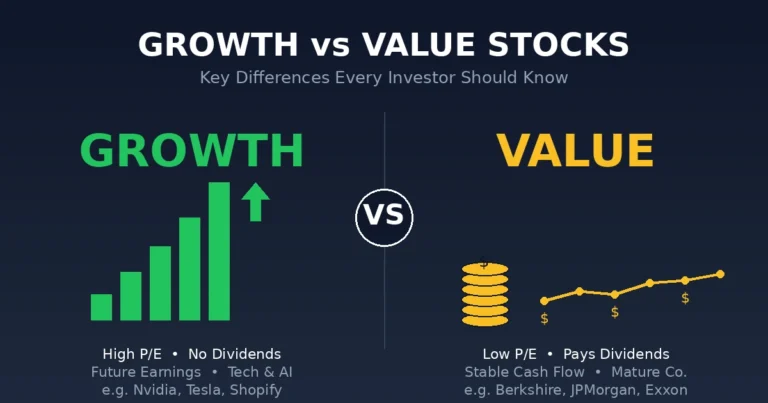
Long-term goals (five-plus years) open the door to growth stocks and higher-volatility picks. Short-term goals demand more conservative, cash-stable holdings. Get this clear before you look at a single ticker.
Step 2: Invest in industries you actually understand
Warren Buffett has called this his most important investment principle, and it’s the one beginners most reliably ignore.
If you work in healthcare, you understand drug approval timelines, hospital billing dynamics, and what drives patient demand. That operational context is a genuine edge. If you’re a software engineer, you can evaluate whether a SaaS product is genuinely sticky or easily replaceable better than most Wall Street analysts can from a spreadsheet.
Start by listing three industries you work in, use heavily, or follow closely. Your first stock should come from one of those areas — not because familiarity guarantees success, but because you’ll make better decisions under pressure when you understand the underlying business.
When a stock you follow drops 15% because of a quarterly revenue miss, understanding whether that matters requires knowing whether the miss reflects a temporary disruption or a structural problem. That judgment call is much easier when you know the industry.
Step 3: Screen for financial health
Once you have an industry, filter it down to companies that pass three basic financial health checks. Free screeners on Finviz, Yahoo Finance, and most major brokerage platforms make this straightforward.
Revenue growth: Is the company growing sales year over year? Consistent revenue growth — even a modest 5–10% annually — signals that customers keep returning. A business losing revenue is fighting a structural headwind, not just a bad quarter.
Profitability: Look for positive net income or, at minimum, positive free cash flow. Unprofitable companies can be compelling long-term investments, but they carry more risk and require deeper analysis. For your first stock, profitability is a meaningful safety filter.
Debt levels: A high debt-to-equity ratio means the company owes significantly more than it owns. Use 1.5 as a rough ceiling for your initial screen — it eliminates the most leveraged companies while leaving a wide enough range of options.
These three filters alone will reduce thousands of options to a manageable shortlist in minutes.
Step 4: Check valuation — is the price fair?
A great company at the wrong price is a bad investment. Beginners often focus so much on finding a good business that they skip asking whether the current stock price already reflects everything good about it.
The most widely used valuation metric is the price-to-earnings ratio (P/E): the stock price divided by earnings per share. A P/E of 20 means you’re paying $20 for every $1 of annual earnings the company generates.
Historical context matters here. The S&P 500’s long-run average P/E is roughly 16–18. A company at a P/E of 12 may be undervalued — or struggling. One at 50+ requires aggressive growth assumptions to justify the price. During the 2021 tech boom, many software companies traded at P/E ratios above 100. By 2022, many of those same stocks had fallen 60–80%.
Valuation isn’t about finding the cheapest stock. It’s about finding reasonable price-to-value alignment. If a company you like is trading at twice its historical average P/E and twice its sector average, the upside is already priced in.
Step 5: Read one earnings report or annual letter
This step is where most beginners skip ahead — and where most of the real information lives.
Every U.S. public company files a 10-K annual report with the SEC. Earnings call transcripts are freely available on company investor relations pages and on platforms like Seeking Alpha. These documents tell you how management thinks about the business, where they see risks, and what their growth assumptions look like.
You don’t need to read every page. Focus on three things: the letter to shareholders (or CEO remarks), the revenue and earnings trend over three to five years, and — critically — the “Risk Factors” section. Companies are legally required to disclose what could go wrong. Reading this section tells you more about a business in 10 minutes than most social media coverage does in a year.
If you spend 20 minutes with this material and still feel confident in the company, that’s a meaningful signal. If you finish more confused about how the business makes money, move on.
Step 6: Start small and hold
Invest an amount that lets you hold through a 30–40% decline without losing sleep.
This is not pessimism — it’s market history. The S&P 500 has experienced corrections of 20% or more approximately every 3–5 years on average. Individual stocks are significantly more volatile than the index. First-time investors who overcommit financially are the ones who panic-sell at exactly the wrong moment.
Starting with $200–$500 in your first stock gives you real market exposure and genuine learning. You’ll feel the emotional weight of a bad week in ways no simulation replicates. That experience is more valuable than any amount of paper trading.
Add to the position over time as your conviction grows.
What Beginner-Friendly Stocks Actually Look Like
A beginner-friendly stock belongs to a business whose product or service you use and understand, with consistent earnings, manageable debt, and at least five years of operating history. It doesn’t need to be exciting. It needs to be understandable, financially stable, and reasonably priced.
To make the criteria concrete, here’s how three stocks that frequently appear on beginner investor lists compare across the filters covered above:
| Company | Sector | 5-Yr Revenue Trend | Approx. P/E Range | Debt-to-Equity | Dividend? |
|---|---|---|---|---|---|
| Apple (AAPL) | Consumer Tech | ~8% annualized | 28–33x | ~1.5 | Yes (small yield) |
| Coca-Cola (KO) | Consumer Staples | ~4–6% annualized | 22–26x | ~1.7 | Yes (strong yield) |
| Johnson & Johnson (JNJ) | Healthcare | ~5–6% annualized | 16–22x | ~0.5 | Yes (strong yield) |
Data approximated for educational illustration. Verify current figures through your brokerage or SEC filings before making any investment decision.
Apple (AAPL) is the most common first stock beginners buy, and the business logic is clear: hundreds of millions of people pay for Apple hardware, software, and services repeatedly. But it trades at a premium valuation. At current P/E levels, you’re paying for expectations of continued growth — meaning the stock is priced for a strong future, not just a solid present.
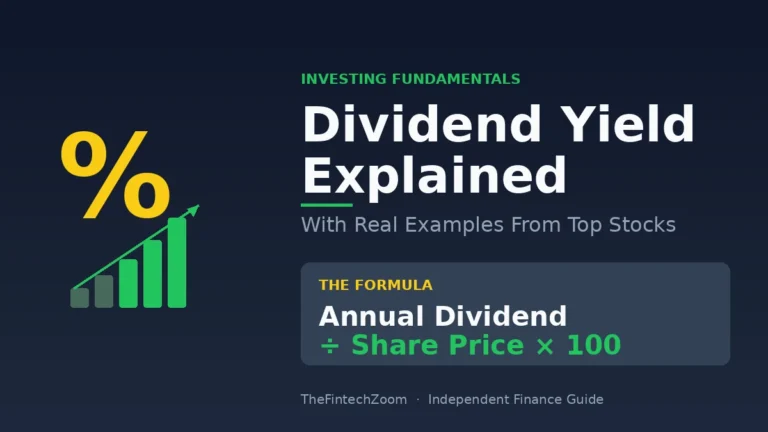
Coca-Cola (KO) is the classic “boring” choice — and boring is often exactly right for a first investment. Revenue is predictable across economic cycles, the dividend has grown for more than six consecutive decades, and the product doesn’t go out of style. Growth is slow by tech standards. That’s the trade-off you’re making for stability.
Johnson & Johnson (JNJ) operates in healthcare, where demand is structurally non-discretionary. It carries low debt relative to its size and pays a dividend that has grown annually for over 60 years. For beginners who want a conservative, defensive first position, it passes most filters cleanly.
These are not buy recommendations. They are examples of the type of stock that passes beginner-friendly filters — not because the names are well known, but because they meet objective criteria for understandability, financial health, and reasonable valuation.
The Biggest Mistakes First-Time Stock Pickers Make
The most damaging beginner mistakes are chasing hype-driven stocks, evaluating stocks by share price rather than value, holding too few positions, selling into short-term declines, and buying without any fundamental research. Each of these is avoidable with the framework above.
Chasing social media tips
Reddit, TikTok, and YouTube have created entire communities around stock picks — and a parallel wave of beginner losses.
The DALBAR Quantitative Analysis of Investor Behavior, which tracks how real individual investors perform against market benchmarks, consistently finds that the average equity investor underperforms the S&P 500 by 2–4 percentage points per year. The primary culprit is emotional, news-driven decision-making.
The GameStop and AMC rallies of 2021 became defining case studies. Thousands of retail investors bought at the peak, driven by social momentum rather than any business fundamentals. GameStop hit $483 per share in January 2021. Many who bought near that peak are still waiting to break even years later.
Confusing a low share price with a cheap stock
A $4 stock is not automatically better value than a $400 stock. As covered earlier, share price without context is meaningless.
What matters is price relative to earnings, growth potential, and asset value. A $4 stock from a company with no revenue, rising losses, and a shrinking customer base is far more “expensive” — in the only sense that matters for long-term investing — than a $400 stock from a company compounding earnings at 15% annually.
Always evaluate price relative to fundamentals.
Putting all your capital in one company
Concentrating your entire starting portfolio in a single stock is one of the highest-risk moves available in public markets. Even well-run, financially strong companies encounter unpredictable crises.
Johnson & Johnson faced years of talc litigation that created significant uncertainty around liabilities. Boeing’s two fatal 737 MAX crashes grounded its best-selling aircraft for nearly 20 months and cost the company tens of billions. These were blue-chip companies with strong fundamentals — and neither outcome was predictable in advance.
Financial research consistently supports holding at least 10–15 positions across different sectors as a minimum for meaningful diversification. If you’re just starting out and want a single purchase that builds in diversification automatically, a broad-market ETF like the Vanguard S&P 500 ETF (VOO) covers over 500 companies in one transaction.
Selling after the first bad week
The average market drawdown of 20% or more has historically lasted about 11 months, based on S&P 500 data going back to 1950. The recovery that followed each of those drawdowns — every single one — produced positive returns for investors who stayed invested.
The most common pattern I’ve found among first-time investors is selling during the first significant downturn they experience, locking in losses before the recovery. The antidote is straightforward: only invest money you won’t need for at least three years. If you need it sooner, it shouldn’t be in stocks.
Skipping the fundamentals entirely
Buying a stock because someone in a group chat said it was “about to pop” isn’t investing. It’s speculation with an extra step.
Every purchase decision should trace back to a documented rationale: you understand the business, the financials pass basic health checks, and the price is reasonable relative to earnings. If you can’t state your reason for owning a stock in two clear sentences, you don’t have a position — you have a lottery ticket.
Frequently Asked Questions About Picking Your First Stock
How much money do I need to buy my first stock?
Most major brokerages now offer fractional shares, meaning you can invest in a company like Apple or Amazon for as little as $1. Practically speaking, starting with $200–$500 gives you enough exposure to observe how your investment moves with real market conditions, without risking capital you need for living expenses.
Is it better to buy ETFs or individual stocks as a beginner?
For most beginners, a broad-market ETF like VOO or the iShares Core S&P 500 ETF (IVV) is a stronger starting point than individual stocks. ETFs give you immediate diversification across hundreds of companies with one purchase and very low fees. Once you understand how markets work, adding individual stock positions makes strategic sense.
How do I know if a stock is overpriced?
Compare the stock’s current P/E ratio against its own five-year average P/E, the sector average, and the S&P 500’s historical average (roughly 16–18). A stock significantly above all three reference points carries more valuation risk. Also check the price-to-free-cash-flow ratio, which is harder to manipulate than earnings.
What platform should I use to buy my first stock?
Fidelity, Charles Schwab, and TD Ameritrade are the most established platforms for beginners, offering research tools, educational content, customer support, and zero-commission trades. Robinhood’s interface is simpler but offers less analytical depth. Choose based on what features you’ll actually use, not on which app has the best marketing.
Should I pick individual stocks or invest in index funds?
Both serve a purpose. Index funds are statistically the better choice for most beginners because they eliminate company-specific risk and require minimal ongoing research. A common and rational approach: allocate 80–90% of your investment capital to diversified index funds, then dedicate a smaller portion — only what you’re prepared to lose — to individual stocks you’ve researched.
How long should I hold my first stock?
Plan to hold for a minimum of three to five years. Short-term price movements are essentially unpredictable, even for professional analysts. Over 20-year periods, the S&P 500 has never produced a negative return. Your first stock should be something you’d be comfortable holding through a 30% drawdown without flinching.
What P/E ratio should I look for as a beginner?
There’s no universal answer because P/E ratios vary significantly by sector. Technology companies typically trade at higher multiples than utilities or consumer staples. As a starting filter, look for established companies in mature industries with P/E ratios between 10 and 25. Anything above 40 requires strong, sustained earnings growth to justify — a harder bet for a first investment.
Can I lose all my money in stocks?
If you invest everything in a single company that goes bankrupt, yes — you can lose 100% of that investment. This is why concentration risk matters. With a broad-market ETF, losing all your money would require every major U.S. company to collapse simultaneously — a near-impossible scenario. Diversification is the single most effective tool against catastrophic loss.
The Bottom Line
Picking your first stock doesn’t have to be complicated — but it does require a process.
Start with an industry you understand. Screen for financial health using revenue growth, profitability, and debt levels. Check whether the price is fair relative to earnings. Read enough about the business to explain it clearly in two sentences. Then invest an amount small enough that a 30% decline doesn’t force you to sell.
The goal of your first stock isn’t to generate spectacular returns. It’s to build a repeatable investing framework and experience how markets work with real money on the line. The habits you form in the first year — how you research, how you respond to volatility, how you make buy and hold decisions — will have more impact on your long-term wealth than the specific stock you pick.
One concrete action step: Open a free account on Finviz.com and run a stock screen with these filters: market cap above $5 billion, P/E between 10 and 30, positive net income, and debt-to-equity below 1.5. Browse what comes up. Cross-reference it with industries you already know. That’s how a real first investment idea starts.
Disclaimerr: This article is produced by TheFintechZoom for educational purposes only. It does not constitute financial advice, and nothing here should be interpreted as a recommendation to buy or sell any security. All investment decisions involve risk. Consult a licensed financial advisor before making investment decisions.