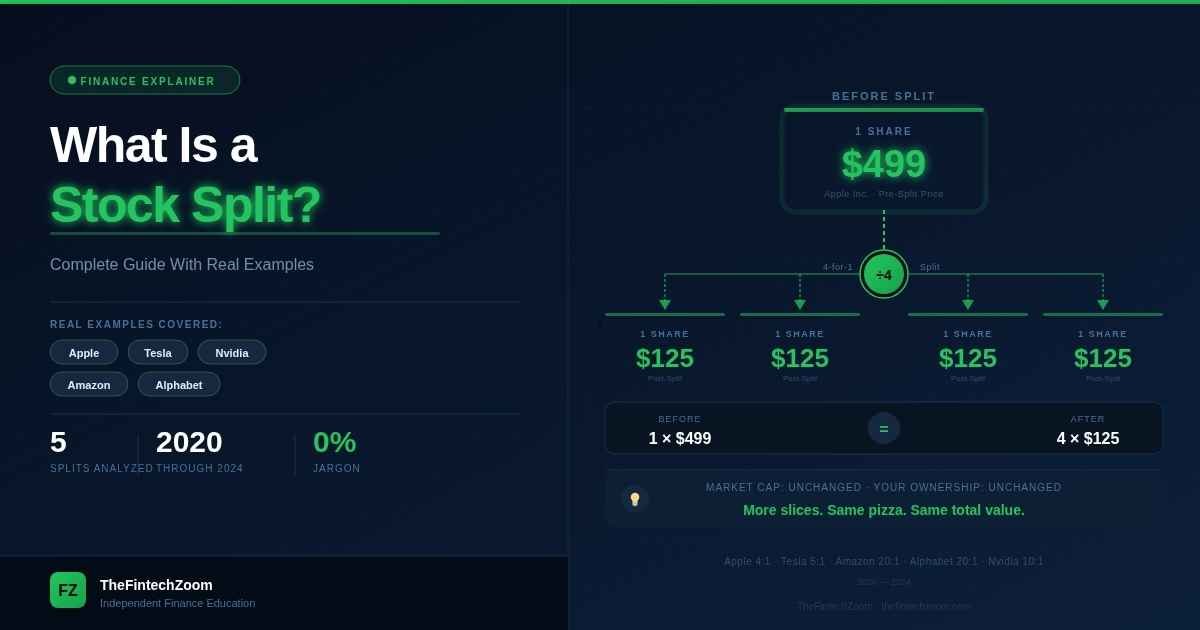
When Apple’s stock hit $499 per share in 2020, millions of retail investors on platforms without fractional trading were completely priced out. Then Apple announced a 4-for-1 stock split. The price fell to $125. The company’s total value didn’t change by a single dollar.
That’s what a stock split is: more shares, lower price, same company. The mechanics are simple. The misunderstanding around them isn’t.
This guide covers exactly how stock splits work, why companies do them, what actually happened when Apple, Tesla, Nvidia, Alphabet, and Amazon all split their shares — and the one thing that determines whether any of it benefits your portfolio.
What Is a Stock Split?
A stock split is a corporate action that increases the total number of shares outstanding by dividing each existing share into multiple new ones. The share price falls proportionally, but the company’s total market capitalization — and every shareholder’s ownership percentage — stays exactly the same.
The simplest analogy: imagine cutting a pizza into more slices. You have more pieces, but the same amount of pizza. The split changes the denominations. It doesn’t change what you own.
How the Math Works
Suppose a company has 1 million shares outstanding, each trading at $1,000. Its market cap is $1 billion.
In a 2-for-1 stock split:
- Each share becomes 2 shares
- Each new share is priced at $500
- Total shares outstanding: 2 million
- Market cap: still $1 billion
If you owned 10 shares worth $10,000 before the split, you own 20 shares worth $10,000 after it. Your wealth hasn’t moved.
The split ratio tells you how many new shares replace each old one. Common ratios include 2-for-1, 3-for-1, 4-for-1, 5-for-1, and — for stocks with extreme price run-ups — 10-for-1 and 20-for-1.
What Actually Changes (and What Doesn’t)
| Factor | Before Split | After Split |
|---|---|---|
| Share price | Higher | Lower (proportional) |
| Shares outstanding | Fewer | More |
| Market capitalization | — | Unchanged |
| Your ownership percentage | — | Unchanged |
| Your total investment value | — | Unchanged |
| Dividend per share | Higher | Adjusted downward |
| Total dividend income | — | Unchanged |
The dividend per share adjusts to the split ratio, but your total payout stays the same because you hold proportionally more shares. Nothing in that right column changes — and that’s the whole point.
Why Do Companies Split Their Stock?
Companies split shares primarily to lower the price per share and make the stock accessible to a wider pool of investors. When a single share costs $1,200 or $2,800, it creates real friction — particularly for retail investors on platforms that don’t support fractional share purchases.
The Four Reasons Boards Vote to Split
1. Accessibility A prohibitively priced stock effectively excludes smaller investors. When Nvidia’s shares climbed past $1,200 in 2024, a meaningful portion of retail traders couldn’t participate without fractional investing tools. A 10-for-1 split brought the price to approximately $121, removing that barrier entirely.
2. Liquidity More affordable shares attract more buyers and sellers into the market at any given time. Higher trading volume reduces the bid-ask spread and generally dampens the short-term price volatility common in thinly traded stocks.
3. Signaling Confidence When a board votes to split, they’re implicitly communicating that they expect the share price to remain elevated — or keep climbing. It makes no strategic sense to split a $500 stock if you expect it to fall back to $200. Markets pick up on that signal.
4. Index Management Price-weighted indices like the Dow Jones Industrial Average can be distorted by extremely high-priced stocks. Alphabet’s 20-for-1 split in 2022 brought its share price into a range that made Dow inclusion discussion more practical.
What a Split Is Not
It’s worth being direct about what a split doesn’t mean:
- It’s not evidence that the company is performing well
- It’s not a dividend, bonus, or free money
- It’s not a buy signal on its own
- It does not make the stock better value — only cheaper per share
Companies almost always split their stock after sustained price appreciation, because that’s when prices climb high enough to warrant splitting. The rising business performance comes first. The split is the administrative consequence.
Real Stock Split Examples With Actual Numbers
The mechanics become concrete when you see what happened with five companies most investors recognize.
Apple: 4-for-1 Split — August 31, 2020
Apple announced its fourth stock split in company history on July 30, 2020, with the split effective August 31. At announcement, shares were trading near $499.
Result:
- Each share became 4 shares
- Price dropped from ~$499 to ~$125
- Shares outstanding rose from approximately 4.3 billion to 17.2 billion
- Market cap held steady near $2.1 trillion
An investor holding 25 Apple shares worth approximately $12,475 before the split walked away with 100 shares worth the same $12,475 — no wealth created or destroyed. Apple’s split history traces a clear pattern: it split in 1987, 2000, 2005, then 7-for-1 in 2014 (when shares hit $645), and again in 2020. Each split followed a prolonged period of strong share price appreciation.
Tesla: 5-for-1 Split — August 31, 2020
Tesla executed its first split on the exact same date as Apple — August 31, 2020 — an unusual market coincidence. Tesla shares had surged above $2,200, representing gains of over 400% in the preceding 12 months.
Result:
- Each share became 5 shares
- Price fell from ~$2,213 to ~$443
- Market cap remained near $412 billion
- Tesla subsequently split again — 3-for-1 in August 2022
The August 2020 split gave retail investors who had watched Tesla’s run-up from the sidelines a more accessible entry price. It didn’t make Tesla cheaper in valuation terms — only in nominal price per share.
Nvidia: 10-for-1 Split — June 10, 2024
Nvidia’s June 2024 split stands as the most dramatic recent example. By early 2024, Nvidia had become one of the most valuable companies on earth, driven by AI chip demand that sent shares past $1,200. The 10-for-1 ratio was a clear signal of how far the stock had climbed.
Result:
- Each share became 10 shares
- Price dropped from approximately $1,208 to ~$121
- Shares outstanding increased tenfold
- Market cap held near $3 trillion
Post-split, Nvidia remained among the most actively traded stocks on US exchanges. The split expanded its retail shareholder base substantially without altering what the company actually was.
Alphabet and Amazon: 20-for-1 Splits — Summer 2022
Both tech giants executed 20-for-1 splits in mid-2022, making for a remarkable few months in market history:
- Amazon: June 6, 2022 — shares fell from ~$2,785 to ~$139
- Alphabet (Google): July 18, 2022 — shares fell from ~$2,808 to ~$140
The 20-for-1 ratio was a direct statement: both companies recognized their per-share prices had climbed so far beyond comfortable retail territory that only an unusually large split ratio could bring them back to a practical range. Total market caps remained unchanged for both.
Major Recent Stock Splits: Quick Reference
| Apple | Aug 31, 2020 | 4-for-1 | ~$499 | ~$125 |
| Tesla | Aug 31, 2020 | 5-for-1 | ~$2,213 | ~$443 |
| Amazon | Jun 6, 2022 | 20-for-1 | ~$2,785 | ~$139 |
| Alphabet | Jul 18, 2022 | 20-for-1 | ~$2,808 | ~$140 |
| Nvidia | Jun 10, 2024 | 10-for-1 | ~$1,208 | ~$121 |
What Is a Reverse Stock Split — And Why It’s a Different Story?
A reverse stock split is the opposite of a forward split: the company reduces its total shares outstanding while raising the price per share proportionally. Market capitalization stays the same. Ownership percentage stays the same. But shareholders end up with fewer shares at a higher price.
How a Reverse Split Works
In a 1-for-10 reverse split:
- Every 10 shares you own become 1 share
- Price per share rises tenfold
- Total shares outstanding fall by 90%
- Market cap: unchanged
So if you held 1,000 shares at $0.50 each (worth $500), after a 1-for-10 reverse split you’d hold 100 shares at $5.00 each — still $500.
Why Reverse Splits Are a Warning Sign
Most reverse splits serve one primary purpose: keeping the stock listed on a major exchange. The NYSE and Nasdaq both require minimum average closing prices (generally $1 over 30 consecutive trading days). When a stock falls below that threshold, the exchange issues a notice. A reverse split artificially raises the price to meet the requirement.
The problem is structural. The reverse split addresses the price — it doesn’t address whatever caused the price to collapse in the first place. Academic research tracking post-reverse-split performance consistently shows these stocks underperform the broader market in the years that follow.
The contrast between forward and reverse splits is stark: one is a routine administrative event following success; the other is frequently a financial distress signal dressed up in corporate action language. When you see a reverse split announcement, the correct response is to research the underlying business thoroughly — not to treat the higher price as a recovery.
Does a Stock Split Actually Make You Richer?
No — not at the moment of the split. This is the most consequential misconception to get right, and it’s worth being blunt about it.
A stock split is a neutral mechanical event. It doesn’t change earnings, cash flows, competitive position, or intrinsic value. Your wealth immediately before and immediately after a split is identical. What made shareholders wealthy in Apple, Tesla, Nvidia, Alphabet, and Amazon wasn’t the split — it was the years of compounding business growth that drove the share price high enough to require splitting.
The Post-Announcement Return Pattern
That said, academic research has consistently documented that stocks announcing forward splits tend to outperform the broader market over the following 12 months. The pattern has held across multiple market cycles and multiple countries.
The explanation isn’t that the split creates value. It’s that boards announce splits when they’re confident about near-term prospects — and that confidence, when well-founded, shows up in subsequent earnings. The split functions as a credibility signal.
Investors should treat that pattern carefully. It reflects average behavior across hundreds of splits. Individual companies still disappoint after split announcements.
Fractional Shares Have Shifted the Calculus
The strongest traditional argument for stock splits — “retail investors can’t afford a $1,200 share” — has softened significantly. Platforms including Fidelity, Charles Schwab, and Robinhood now offer fractional share investing, meaning an investor with $50 can buy a proportional slice of a $1,200 stock.
Fractional shares don’t make splits obsolete. Liquidity, signaling, and index management still matter. But the accessibility case that once made splits essential is no longer absolute. Companies increasingly split for reasons beyond price accessibility alone.
Common Stock Split Myths That Trip Up New Investors
Looking at how splits are discussed in investing forums and social media, a few specific misconceptions keep appearing. These are worth naming directly.
Myth 1: “The Price Is Lower, So It’s a Better Deal
Price per share and value per share are different things. If a stock was expensive at $1,200 — trading at 60 times earnings, for example — it’s still expensive at $120 after a 10-for-1 split. The valuation ratios don’t change. A stock that was overpriced before the split is equally overpriced after it.
Myth 2: A Split Announcement Is a Buy Signal
The split announcement tells you the price has already risen substantially. In many cases, the sharpest gains are already behind the stock by the time the split is announced. Buying based on the announcement itself, rather than the company’s current fundamentals and growth trajectory, is speculation — not investing.
Myth 3: I’m More Diversified After a Split
Owning 40 Apple shares instead of 10 doesn’t diversify your portfolio. You still have 100% of that investment in one company. Diversification comes from owning different assets — different companies, sectors, asset classes. More shares of the same stock provides none of it.
Myth 4: Berkshire Hathaway’s Refusal to Split Is Weird
Warren Buffett has deliberately never split Berkshire Hathaway’s Class A shares, which now trade above $600,000 per share. His rationale is intentional: an extremely high share price filters out short-term speculators and self-selects for long-term, patient investors — the type of shareholder Buffett wants. When retail demand for affordable access became too strong to ignore, Berkshire created Class B shares in 1996 as an alternative. The Class A shares remained unsplit by design. It’s arguably the most successful counter-example to the standard split argument in modern market history.
Frequently Asked Questions About Stock Splits
What is a stock split in simple terms?
A stock split divides a company’s existing shares into more shares at a proportionally lower price. The company’s total value doesn’t change. Think of it as exchanging a $100 bill for five $20 bills — more pieces, same amount of money. Shareholders get more shares; each share is worth less; nothing else changes.
Does a stock split affect the value of my investment?
No. Your total investment value stays identical immediately after a split. You hold more shares at a lower price — the math produces the same total. Your ownership percentage in the company also stays exactly the same. Splits are value-neutral events in the moment they occur.
Why would a company do a stock split?
Companies split primarily to lower the share price and widen access to retail investors. Very high share prices create friction on platforms without fractional investing, reduce trading volume, and can complicate index management. A split fixes the price accessibility problem without touching the company’s actual fundamentals or value.
What is a 2-for-1 stock split with an example?
In a 2-for-1 split, every share you own becomes two shares at half the original price. If you hold 50 shares at $200 each ($10,000 total), after the split you hold 100 shares at $100 each — still $10,000 total. The price halved. Your share count doubled. Your wealth is unchanged.
What’s the difference between a stock split and a reverse stock split?
A forward split increases share count and lowers price — typically following strong performance. A reverse split reduces share count and raises price — typically to avoid exchange delisting after significant price declines. Forward splits are neutral with positive signaling. Reverse splits are frequently a financial distress indicator.
Do dividends change after a stock split?
The dividend per share is adjusted proportionally to the split ratio. If a company paid $4 per share annually before a 4-for-1 split, it pays $1 per share after. Your total annual dividend income stays the same because you now hold four times as many shares. The income doesn’t disappear — it’s spread across the new share count.
What was the largest stock split by a major company in recent history?
Amazon and Alphabet both completed 20-for-1 splits in summer 2022, making them among the highest-ratio splits by major public companies in modern market history. Amazon shares dropped from approximately $2,785 to ~$139; Alphabet from ~$2,808 to ~$140. Both companies’ market capitalizations remained unchanged.
Can a stock split hurt investors?
A forward split itself is mechanically neutral — it can’t directly harm you. The behavioral risk is real, though: investors who buy after a split announcement purely on sentiment may overpay if the stock was already richly valued. Reverse splits carry a different risk — they often signal underlying business distress that may continue causing losses for shareholders.
Conclusion
A stock split divides shares, lowers the price, and leaves the company’s total value exactly unchanged. That’s the mechanical fact — and once it’s genuinely understood, it cuts through most of the noise that surrounds split announcements.
The pattern across Apple, Tesla, Nvidia, Alphabet, and Amazon is consistent: each company split after a prolonged period of business growth and share price appreciation. The growth created wealth for shareholders. The split was the administrative event that followed — not the cause of anything.
When a company you own or follow announces a split, the right question isn’t “should I buy because it’s cheaper?” It’s “why has this company performed well enough that a split became necessary, and is the underlying growth durable from here?” The split tells you about the past. Fundamentals tell you about the future.
For more on how to evaluate the companies behind the splits, see our guides on how to pick your first stock, understanding price-to-earnings ratios in growth vs value stocks, and reading the price charts behind these splits.
This article is produced for educational purposes by TheFintechZoom. It does not constitute investment advice or a recommendation to buy or sell any security. Prices cited are approximate historical figures used for illustrative purposes. Always conduct your own research before making investment decisions.