Most beginner investors get told to “diversify” without ever being explained the single split that actually shapes their long-term returns: growth versus value. Pick the wrong side at the wrong time and you can underperform the S&P 500 by a wide margin for years. This guide breaks down what growth and value stocks really are, how they behave in different markets, the exact metrics professional investors use to classify them, and a practical framework to decide what belongs in your portfolio today. No jargon, no hype — just the differences that actually move your returns.
What Are Growth Stocks vs Value Stocks?
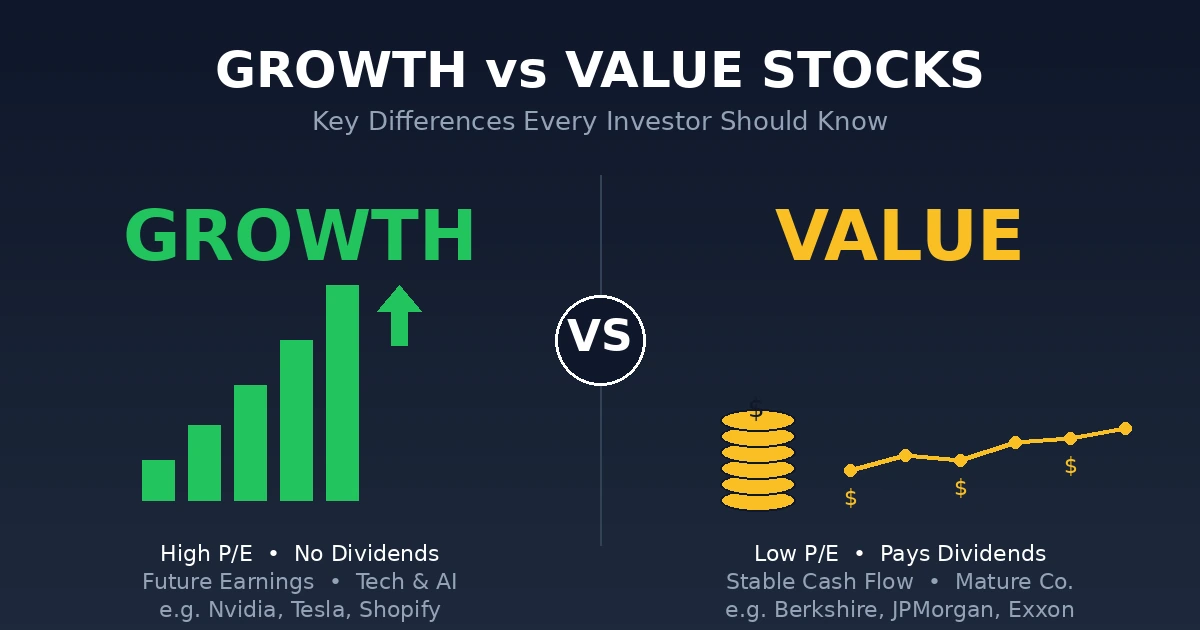
Growth stocks are shares of companies expected to grow revenue and earnings faster than the market average, usually reinvesting profits instead of paying dividends. Value stocks are shares of established companies trading below their estimated intrinsic worth, often with steady earnings, dividends, and lower price-to-earnings ratios. The core difference is what you’re paying for: future growth or current value.
A growth stock is a bet on what a company will become. Investors accept a high price today because they expect earnings to expand quickly enough to justify it. Think of companies like Nvidia, Tesla, or Shopify during their high-growth phases — high P/E ratios, low or no dividends, aggressive reinvestment.
A value stock is a bet on what a company is already worth but the market hasn’t priced correctly. These are typically mature, profitable businesses in banking, energy, industrials, or consumer staples — names like JPMorgan Chase, ExxonMobil, or Berkshire Hathaway. Lower P/E, steady cash flow, often a real dividend.
The label isn’t permanent. Microsoft was a classic value stock from 2003–2013 before becoming a growth stock again. Meta has flipped between both categories. Style is about price and expectations at a given moment — not about the company forever.
How Do You Identify a Growth Stock vs a Value Stock?
You identify a growth stock by high P/E ratio, strong revenue and earnings growth (often above 15% annually), low or zero dividend yield, and high price-to-book multiples. You identify a value stock by low P/E (typically under the market average), low price-to-book, higher dividend yield, stable earnings, and trading below intrinsic value estimates. Professional index providers like MSCI and FTSE use these exact metrics to classify stocks.
When I screen portfolios, these are the five metrics I look at first. They’re imperfect alone, but together they almost always tell the truth about a stock’s style.
1. Price-to-Earnings (P/E) ratio
Growth stocks usually trade at P/E ratios well above the S&P 500 average (which historically hovers around 18–22). A P/E of 40, 60, or even 100+ is common — investors are pricing in years of future earnings. Value stocks typically trade at P/E ratios below the market average, often in the 8–15 range.
2. Price-to-Book (P/B) ratio
Value investors love P/B because it compares stock price to what the company’s assets are actually worth on paper. Value stocks often trade near or below their book value (P/B under 1.5). Growth stocks frequently trade at 5x, 10x, or more — because their value is in future earnings, not current assets.
3. Dividend yield
Value stocks pay dividends. That’s almost a rule. Yields of 2–5% are normal. Growth stocks usually pay nothing or a token amount — every dollar of profit goes back into R&D, acquisitions, or expansion.
4. Revenue and earnings growth rate
A genuine growth stock should be growing revenue at 15%+ per year, often much faster in early stages. Value stocks grow at single-digit rates — sometimes flat — but they’re consistent.
5. Profit margins and free cash flow
Mature value companies generate strong free cash flow today. Growth companies often burn cash or run thin margins while scaling. This is the metric that separates real growth from speculative hype.
Growth vs Value: Side-by-Side Comparison
| Feature | Growth Stocks | Value Stocks |
|---|---|---|
| Typical P/E ratio | High (25–100+) | Low (under 15) |
| Price-to-Book | High (often 5x+) | Low (often under 2x) |
| Dividend yield | Low or zero | Moderate to high (2–5%+) |
| Revenue growth | 15%+ annually | 0–8% annually |
| Volatility | High | Moderate to low |
| Best market environment | Low interest rates, expansion | Rising rates, recovery, value rotations |
| Investor profile | Higher risk tolerance, longer horizon | Income-focused, lower risk tolerance |
| Example sectors | Tech, biotech, EVs, AI, cloud | Banking, energy, utilities, consumer staples |
| Famous examples | Nvidia, Tesla, Shopify, Amazon (historically) | Berkshire Hathaway, JPMorgan, ExxonMobil, Coca-Cola |
If a stock checks 4 out of 5 boxes on either side, you’ve got your answer.
How Do Growth and Value Stocks Actually Perform?
Historically, value stocks have outperformed growth stocks over very long periods — research by Eugene Fama and Kenneth French (Nobel-winning work) documented a “value premium” lasting nearly a century. However, growth stocks have crushed value during specific eras: the late 1990s dot-com boom and the 2010–2021 zero-interest-rate decade. Performance depends heavily on interest rates, economic cycles, and where we are in market sentiment.
Here’s what the data actually shows when I look at the Russell 1000 Growth Index versus the Russell 1000 Value Index:
The 2010–2021 era: Growth dominated
For more than a decade, growth stocks delivered roughly double the returns of value stocks. Cheap money (near-zero Fed rates), the rise of FAANG, and the assumption that tech would eat every industry made growth the obvious winner. Investors who tilted heavily toward value during this period underperformed badly.
2022: The reversal
When the Federal Reserve started raising interest rates aggressively in 2022, growth stocks got hammered. Higher rates make future earnings worth less today (because the discount rate goes up). The Russell 1000 Growth Index fell roughly 29% that year, while value held up significantly better.
2023–2025: AI brings growth back
The AI boom — led by Nvidia, Microsoft, and a handful of mega-cap tech names — pulled growth back into leadership through 2024 and into 2025. But it was concentrated. A small group of stocks did the work; most growth stocks didn’t keep pace.
The honest takeaway
No style wins forever. Anyone telling you growth or value is permanently better is selling something. The smartest long-term portfolios I’ve reviewed don’t pick a side — they hold both and rebalance.
Real examples that illustrate the difference
Growth example: Nvidia (NVDA)
Nvidia traded at a P/E above 50 through most of 2023–2024 as AI demand exploded. No meaningful dividend. Revenue grew over 100% year-over-year at peaks. Pure growth profile.
Value example: Berkshire Hathaway (BRK.B)
Warren Buffett’s holding company is the textbook value investment — owns boring, cash-generating businesses (insurance, railroads, utilities), trades at a reasonable P/E, and grows steadily. No dividend, but the underlying holdings throw off massive cash flow.
Value example: JPMorgan Chase (JPM)
P/E typically in the 10–13 range, dividend yield around 2–3%, predictable earnings tied to interest rates and the economy. The opposite of speculative.
Growth example: Tesla (TSLA)
For most of its public life, Tesla traded at P/E ratios that only make sense if you believe in massive future expansion. Volatile, no dividend, story stock. The classic growth profile — for better and worse.
What Are the Most Common Mistakes Investors Make with Growth and Value?
The most common mistake is picking a style based on recent performance instead of valuations and personal goals. Investors pile into growth after a five-year growth bull run, then panic-rotate to value at the bottom. Other frequent errors include confusing “cheap” with “value,” ignoring quality, and concentrating too heavily in one style during peak euphoria.
After looking at hundreds of real investor portfolios, the same mistakes show up again and again. Avoid these and you’re already ahead of most retail investors.
Mistake 1: Chasing the style that just won
Performance chasing is the most expensive habit in investing. If growth has crushed value for five years, the temptation is to load up on growth. That’s usually exactly when valuations are stretched and the next rotation is brewing.
Mistake 2: Confusing cheap with value
A stock trading at a P/E of 5 isn’t a value stock if the business is dying. That’s a value trap. Real value investing means finding good companies trading below intrinsic worth, not bad companies trading at any price. Sears, Bed Bath & Beyond, and many regional banks looked “cheap” right before going to zero.
Mistake 3: Buying growth without understanding the price
High-growth companies can still be terrible investments if you overpay. Cisco grew massively after 2000, but anyone who bought at the dot-com peak waited 17 years just to break even. Growth doesn’t excuse paying any price.
Mistake 4: Treating “growth” and “value” as personality traits
You don’t have to be a “growth investor” or a “value investor.” Most successful long-term portfolios mix both. The labels are categories of stocks, not religions.
Mistake 5: Ignoring sector concentration
A 100% growth portfolio is usually 60%+ technology. A 100% value portfolio is heavy in financials and energy. Either extreme is undiversified — even if the number of stocks looks high.
Mistake 6: Forgetting that style classifications change
Apple was once growth, then briefly value, now growth again. Microsoft, Walmart, McDonald’s — all have flipped. Don’t assume a stock stays in its category forever.
How Should You Choose Between Growth and Value Stocks?
You don’t have to choose one. Most evidence-backed portfolios hold both styles, weighted based on your age, risk tolerance, time horizon, and current market conditions. Younger investors with long horizons can lean toward growth; investors near retirement typically benefit from more value exposure. Rebalancing once or twice a year prevents either side from dominating.
Here’s a practical step-by-step framework I recommend when investors ask me how to decide:
Step 1: Define your time horizon
If you’re investing for 20+ years, you can absorb growth-stock volatility. If you need the money in 3–5 years, value’s stability and dividend income matter more.
Step 2: Match style to your risk tolerance honestly
Don’t lie to yourself. If a 30% drawdown would make you sell at the bottom, you don’t have a “high risk tolerance” — you have a stomach. Tilt more value.
Step 3: Look at current valuations, not past performance
If growth has just had a five-year bull run and trades at extreme multiples, lean into value. If value has been outperforming and growth looks beaten down, the opposite. Buy what’s reasonably priced, not what’s been winning.
Step 4: Use ETFs to simplify
Most retail investors are better off using broad ETFs than picking individual stocks. For growth exposure: VUG (Vanguard Growth ETF) or QQQ. For value: VTV (Vanguard Value ETF) or VYM for dividend-focused value. A 50/50 split is a reasonable starting point if you don’t want to think hard about it.
Step 5: Rebalance once or twice a year
Whichever side outperformed will become overweight in your portfolio. Rebalancing forces you to sell high and buy low — automatically. This single habit beats most “stock picking” strategies.
Step 6: Hold core index exposure underneath
Whatever your growth/value tilt, a base of broad-market index funds (like VTI or VOO) keeps you from drifting too far either way. The S&P 500 itself is roughly half growth, half value at any given moment.
Frequently Asked Questions
Are growth stocks riskier than value stocks?
Generally yes. Growth stocks have higher volatility, larger drawdowns in bear markets, and more dependence on future expectations. Value stocks tend to be more stable, often paying dividends that cushion returns. However, low-quality value stocks (value traps) can be riskier than blue-chip growth names. Risk depends on the specific company, not just the label.
Can a stock be both growth and value?
Yes — these are called “GARP” stocks (Growth at a Reasonable Price). Companies like Microsoft and Apple have spent periods qualifying as both: growing earnings meaningfully while trading at reasonable valuations. Many institutional investors specifically target GARP stocks because they offer growth potential without paying speculative prices.
Do value stocks always pay dividends?
Most do, but not all. Berkshire Hathaway is the famous exception — it’s a textbook value stock that pays no dividend because Warren Buffett believes he can reinvest the cash better than shareholders can. However, around 80% of stocks classified as value by major index providers do pay regular dividends.
Which performed better in 2024 and 2025, growth or value?
Growth outperformed in 2024, largely driven by AI-related mega-cap technology stocks. The gap narrowed in 2025 as the rally broadened and value sectors like financials and industrials picked up. Concentration in a handful of growth names — rather than across-the-board growth strength — defined this period.
Should beginners invest in growth or value stocks first?
Beginners are usually best served by broad-market index funds that include both, like VTI or VOO. Once comfortable, a slight tilt toward whichever side is currently undervalued is sensible. Avoid going 100% into either style as a beginner — concentration risk is the most common reason new investors lose money in their first few years.
Do growth stocks pay any dividends at all?
Some do, but small ones. Microsoft and Apple both pay dividends now despite being classified as growth stocks, with yields under 1%. Most pure growth companies — Nvidia, Tesla, Shopify, Snowflake — pay nothing. They reinvest everything into expansion, R&D, or acquisitions instead.
How do interest rates affect growth vs value stocks?
Rising interest rates hurt growth stocks more because their value depends on future earnings, which are discounted at higher rates. Value stocks, especially banks and energy, often benefit from higher rates. Falling rates do the opposite — they typically boost growth stocks and pressure value sectors that rely on stable rate environments.
What percentage of my portfolio should be growth vs value?
There’s no universal answer, but common starting points are 60/40 growth/value for investors under 40, 50/50 for middle-aged investors, and 40/60 growth/value for those nearing retirement. Adjust based on your risk tolerance, time horizon, and current market valuations rather than copying any fixed rule blindly.
The Bottom Line
Growth and value stocks aren’t opposing teams — they’re two ways the market prices companies, and both have made investors wealthy across different decades. Growth rewards patience and conviction when you can stomach volatility. Value rewards discipline and steadiness when you want cash flow and lower drawdowns. The investors who do best long-term don’t religiously pick one side — they understand both, hold both, and rebalance.
The smartest next step isn’t picking growth or value today. It’s pulling up your current portfolio and honestly asking: how much of each do I actually own, and is that balance matching my goals? If you don’t know the answer, that’s where to start — before adding a single new dollar.
This article is for educational purposes only and does not constitute financial advice. All investments carry risk, including potential loss of principal. Consider consulting a licensed financial advisor before making investment decisions.