Bitcoin’s latest closing price sits at $80,879 as of, 2026 — roughly 36 months after the most anticipated supply event in crypto history. The April 2024 halving cut miner rewards from 6.25 BTC to 3.125 BTC per block. And yet, if you bought expecting a repeat of 2020’s 7x returns, you’re probably still waiting.
This guide covers exactly what Bitcoin halving is, how FintechZoom.com frames its coverage, what the 2024 cycle actually delivered versus expectations, and what the current market data means for the April 2028 halving — which is now less than two years away.
No hype. Just numbers and what they actually say.
What Is Bitcoin Halving — And Why Does It Happen?
Halving is not a market event. It’s a protocol rule. Satoshi Nakamoto hardcoded it into Bitcoin from day one: every 210,000 blocks mined — roughly every four years — the reward miners receive for securing the network gets cut in half.
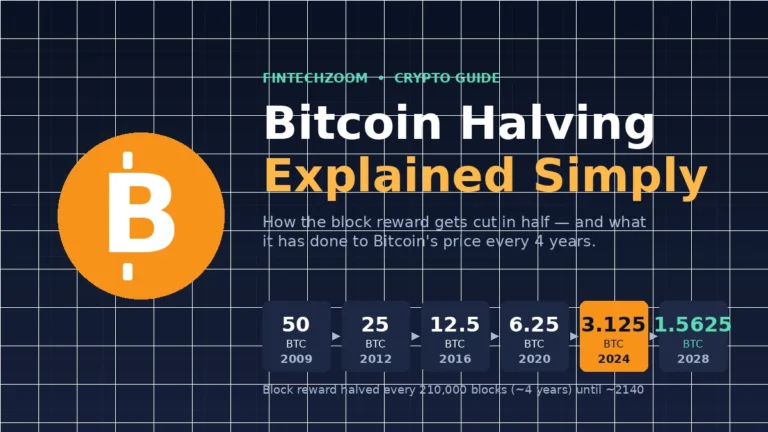
Here is the complete issuance history:
- 2009 — Launch: 50 BTC per block
- 2012 — First halving: 25 BTC per block
- 2016 — Second halving: 12.5 BTC per block
- 2020 — Third halving: 6.25 BTC per block
- 2024 — Fourth halving: 3.125 BTC per block
- 2028 — Fifth halving (projected April 12): 1.5625 BTC per block
The supply logic is simple. Fewer new coins entering circulation, with constant or growing demand, creates upward price pressure. But the absolute numbers matter. Over 96.875% of all Bitcoin has already been mined. Each halving now cuts an ever-smaller slice of remaining supply.
📊 KEY STAT: Post-2024, approximately 450 new BTC are mined each day. After the 2028 halving, that number drops to roughly 225 BTC — in a market with a $1.6 trillion market cap and $32 billion in daily trading volume.
The next Bitcoin halving is estimated around April 12, 2028, at block height 1,050,000 — approximately 708 days away. That clock is ticking. And understanding the current cycle’s midpoint data is the best preparation for it.
How FintechZoom.com Covers Bitcoin Halving
FintechZoom.com positions itself as a financial intelligence platform — not a crypto hype blog. Their halving coverage runs across three distinct content types, and each serves a different purpose for investors.
1. Pre-Halving Education
FintechZoom.com typically publishes in-depth explainers months before a halving, covering mining economics, historical price patterns, and institutional positioning. Their tone stays deliberately measured — framing halvings as supply-side catalysts that interact with demand variables like ETF flows, regulatory shifts, and macro liquidity. No “BTC to $1M tomorrow” energy.
2. Live On-Chain Dashboards
The platform pulls live Bitcoin price feeds, hash rate metrics, and exchange reserve data into a single view. Hash rate data is particularly valuable — it shows whether miners are expanding infrastructure (confidence signal) or shutting down rigs (stress signal). According to CryptoQuant, exchange reserves are currently at their lowest since 2018, meaning coins are moving off exchanges into long-term storage — a signal FintechZoom.com’s dashboards capture in real time.
3. Institutional Flow Analysis
This is FintechZoom’s real differentiator. Spot Bitcoin ETFs have pulled in over $87 billion in net inflows since launch, and FintechZoom tracks how those flows interact with halving supply dynamics. Over $50 billion went into spot Bitcoin ETFs in the past year, and most of that capital has not left — allocators are treating BTC like an asset, not a trade.
PRO TIP: When using FintechZoom.com for halving research, skip the price prediction articles. The real signal is in the hash rate tracker, exchange reserve charts, and ETF flow data. Those metrics show what large players are actually doing — not what analysts think they’ll do.
What the 2024 Halving Actually Delivered
Every halving comes with a story. Here is the full data picture as of today.
The Historical Comparison
- 2012 Halving: BTC at ~$12. Surged past $1,000 within 12 months. Return: ~8,000%. 2016 Halving: BTC at ~$650. Peaked near $20,000 in 2017. Return: ~30x over 18 months. 2020 Halving: BTC under $9,000. Peaked above $60,000 within 18 months. Return: ~7x. 2024 Halving: Bitcoin was at roughly $64,000 at the April 2024 halving. It previously reached an all-time high of around $126,000 in October 2025, before falling roughly 50% to $60,000 in early February 2026.
The 2026 Midpoint Reality
Bitcoin is now more than 50% through its current halving cycle, with issuance at 3.125 BTC per block and an inflation rate below 1%. Price performance is more muted this cycle — up around 15% since the April 2024 halving — highlighting diminishing returns as adoption grows and volatility declines.
For the first time in history, the year following a halving finished in the red, with prices declining approximately 6% from the January 2025 open. That broke a pattern that had held across every previous cycle.
Why? With the Bitcoin total market cap holding steady above $1.5 trillion, moving the price now requires a scale of capital far larger than in 2016 or 2020. This “weight” naturally leads to subdued volatility and more elongated cycles.
2024–2026 Cycle Snapshot
- April 2024: Halving, BTC at ~$64,000
- October 2025: All-time high of ~$126,000
- February 2026: Sharp correction to ~$60,000
- May 2026: Recovery, BTC trading around $80,000
- Next halving: April 12, 2028 (~708 days away)
The New Driver: Macro > Mining
Bitcoin is no longer just watching a halving clock — it is watching the Fed’s dot plot. Skeptics of the quadrennial model argue that the 4-year cycle was always a consequence of the post-2008 monetary reset, not purely mining mechanics.
The Federal Reserve delivered three interest-rate cuts in 2025, and CME FedWatch data shows bond traders pricing in up to two additional cuts in 2026. That liquidity backdrop — more than the halving itself — is now the primary price driver.
5 Halving Myths the 2024 Cycle Officially Buried
Myth 1: “Post-halving year is always the bull market year”
2025 shattered this script. For the first time in history, the year following a halving finished in the red. The “golden window” thesis no longer holds as a guarantee.
Myth 2: “Historical percentage returns will repeat”
A $12 Bitcoin 8,000x-ing and a $64,000 Bitcoin doing the same are mathematically incomparable. Bitcoin has underperformed previous cycles over the same post-halving period, continuing the trend of diminishing returns, as greater adoption and a larger market cap require more capital to drive outsized gains.
Myth 3: “Miners will capitulate after the reward cut”
Large mining operations prepared years in advance with hardware upgrades and cheap energy contracts. Many diversified into AI computing. Transaction fees peaked at 1,257.71 BTC on April 20, 2024 — accounting for over 75% of miner revenue that day — partially replacing the reward reduction. Capitulation was far smaller than predicted.
Myth 4: “Stock-to-flow predicts price accurately”
The stock-to-flow model projected $500,000+ average BTC price for the 2024–2028 cycle. Bitcoin traded far below that in early 2026. The model ignores demand, liquidity, regulation, and macro — which together proved more powerful than supply mechanics alone this cycle.
Myth 5: “The four-year cycle is dead”
Not dead — just mutated. Post-halving supply is tight, with exchange reserves at 2018 lows and most ETF capital still locked in. Most serious 2026 forecasts sit in the 120Kto170K range, based on ETF flows, constrained supply, and improved liquidity conditions. The cycle hasn’t ended — it’s just running slower and on a bigger engine.
Frequently Asked Questions
Q1: What is Bitcoin halving in simple terms?
Every ~4 years, Bitcoin’s code automatically cuts miner rewards in half. This slows the creation of new Bitcoin. The April 2024 halving reduced daily new supply from ~900 BTC to ~450 BTC per day. It is Bitcoin’s built-in inflation control — no central bank, no vote, just code.
Q2: How does FintechZoom.com cover Bitcoin halving?
FintechZoom.com covers halving through pre-event explainers on mining economics, live dashboards tracking price and hash rate, and institutional analysis connecting supply mechanics to ETF flows and macro liquidity. Their strength is the cross-market context — connecting crypto supply data to global financial conditions.
Q3: Did the 2024 Bitcoin halving cause a price increase?
Yes, but muted compared to history. Bitcoin hit an all-time high of ~$126,000 in October 2025, up from ~$64,000 at halving — roughly a 2x move over 18 months. Previous cycles delivered 7x to 30x over the same window. Diminishing returns are real as the market matures.
Q4: Where is Bitcoin in the current halving cycle right now?
Bitcoin is more than 50% through its current halving cycle as of April 2026, with approximately 105,000 blocks remaining before the next halving, expected around April 12, 2028. Current price: ~$80,000.
Q5: Is Bitcoin mining still profitable in 2026?
Depends heavily on electricity cost and hardware generation. Miners with modern ASICs and cheap renewable energy remain profitable. Many top operations diversified into AI computing to offset reduced block rewards. Transaction fee revenue — boosted by Ordinals and Runes activity — has become a meaningful secondary income stream.
Q6: When is the next Bitcoin halving?
The next halving is estimated around April 12, 2028, at block height 1,050,000 — approximately 708 days away. The block subsidy will drop from 3.125 BTC to 1.5625 BTC.
Q7: Is the Bitcoin 4-year cycle still valid?
Partially. The cycle has mutated — Bitcoin’s price is now more correlated with global liquidity and Federal Reserve policy than with mining rewards alone. Supply mechanics still matter, but macro conditions have become the dominant variable in this cycle.
Q8: What metrics should I track before the 2028 halving?
Focus on: Bitcoin exchange reserves (low = bullish), hash rate direction (rising = miner confidence), spot ETF weekly flows, and Fed rate expectations. Price alone is the last signal — these on-chain and institutional metrics lead price by weeks or months.
Conclusion
Bitcoin’s price performance is more muted this cycle, up around 15% since the April 2024 halving, highlighting diminishing returns as adoption grows and volatility declines. That is not failure — it is maturation.
FintechZoom.com’s halving coverage remains most valuable for its institutional flow tracking and on-chain dashboards — not its price forecasts. Use their data tools, not their headline numbers.
For the 2028 cycle, the setup is structurally different from 2020. A lot of BTC is now effectively out of circulation — locked in long-term wallets, ETFs, and corporate treasuries. Active supply is thin. Strategy alone holds 430,000+ BTC and recently raised $1.4 billion in cash. That institutional lock-up changes the supply shock equation significantly.
Disclaimer: This article is for informational and educational purposes only and does not constitute financial, investment, or earnings advice. Any references to profits, returns, or income are not guaranteed. Cryptocurrency investments involve substantial risk, including the possible loss of your entire capital. Past performance does not guarantee future results. All opinions expressed are solely the author’s. Always conduct your own research and consult a qualified financial advisor before making any investment decisions.
Compare credit cards, loans, and more — find FintechZoom product reviews that save you money.