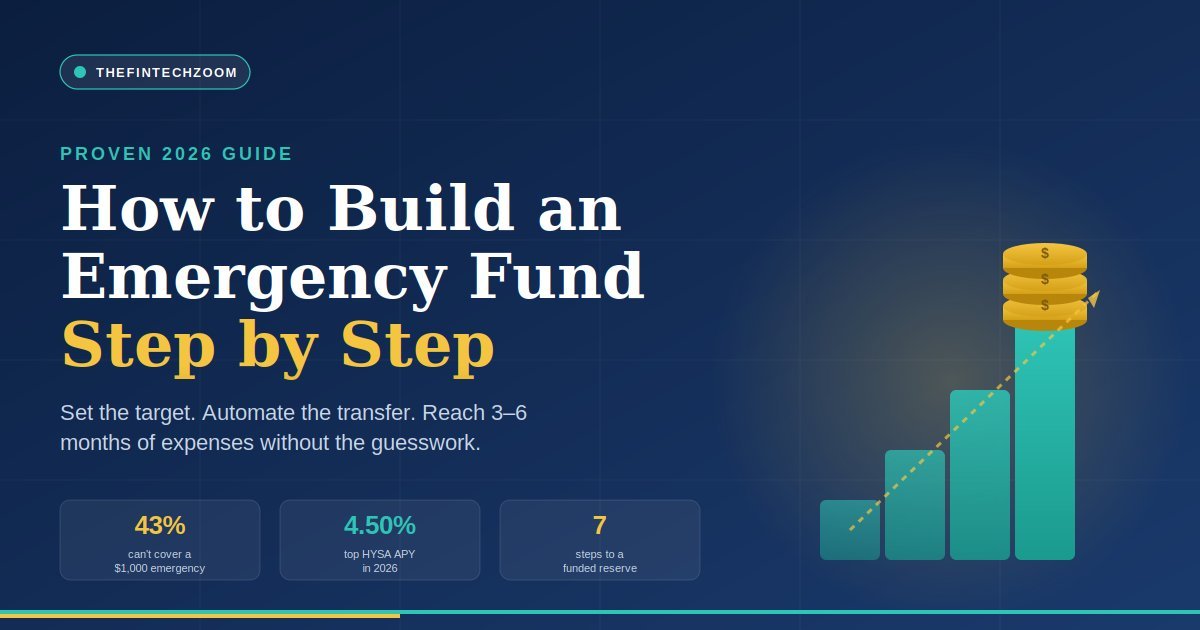
Forty-three percent of Americans cannot cover a $1,000 emergency from savings, and the median emergency fund balance dropped to $5,000 in early 2026 — half of what it was a year earlier, according to a U.S. News survey of 1,216 adults. That gap is the entire reason credit card debt detonates household budgets the moment a car breaks down or a paycheck disappears.
This guide is the version we wish someone had handed us the first time we tried to save: a clear target, a real account, an automated transfer, and a way to keep going when life pushes back. No motivational fluff, no “just spend less on coffee.” You will learn exactly how to build an emergency fund step by step, how much to aim for, where to park it, and the five mistakes that quietly drain most people’s progress.
What Is an Emergency Fund and Why It Matters in 2026
An emergency fund is a dedicated cash reserve held in a liquid, FDIC-insured account that exists only to cover essential living expenses during an income shock — job loss, medical bills, urgent home or car repairs. It is not a vacation fund, not an investment, and not the buffer in your checking account.
The reason it matters more in 2026 is mechanical, not emotional. Baseline costs have reset upward — the Bureau of Labor Statistics’ 2024 Consumer Expenditure Survey reports average household spending of $78,535 per year, a 1.8% rise from 2023. Three months of that is roughly $19,634. Six months is roughly $39,268.
At the same time, the Federal Reserve’s 2026 SHED report (covering 2025 data) found 63% of Americans could cover a $400 emergency with cash or a credit card paid in full — meaning more than one in three could not. Bankrate’s December 2025 survey added that 29% of Americans now carry more credit card debt than emergency savings, with average APRs near 24%.
An emergency fund breaks that loop. It buys you time to think instead of borrow, which is the single most underrated financial advantage a household can hold.
Emergency Fund vs. Sinking Fund vs. Investment Account
People mix these up constantly. They are not interchangeable, and putting money in the wrong one is why “I was saving” still ends with a credit card balance.
| Account Type | Purpose | Where It Lives | Liquidity | Typical Return (2026) |
|---|---|---|---|---|
| Emergency Fund | Unplanned income shocks | High-yield savings account (HYSA) | 1–2 business days | 3.5%–4.5% APY |
| Sinking Fund | Known future expenses (taxes, gifts, car registration) | HYSA or sub-account | Same as HYSA | 3.5%–4.5% APY |
| Investment Account | Long-term growth (5+ years) | Brokerage, 401(k), IRA | Days, with market risk | Variable; S&P 500 ~12.39% 10-yr avg |
| Checking Account | Monthly bills and spending | Bank checking | Instant | ~0.01%–0.39% |
The emergency fund is the only one of these that does not get a job until something goes wrong. Once it is fully funded, the next layer is a long-term investment account — and we cover how to diversify a portfolio with little money for readers ready to take that step.
How Do You Build an Emergency Fund Step by Step?
You build an emergency fund step by step by setting a $1,000 starter target, opening a separate high-yield savings account, automating a fixed transfer on payday, redirecting every windfall, and increasing the contribution by 1% with each raise until you hit 3–6 months of essential expenses. Consistency beats size at every stage.
Here is the exact seven-step sequence we recommend, in the order that actually works.
Step 1: Calculate Your Real Essential Monthly Expenses
Most people overshoot or undershoot because they confuse total spending with essential spending. The number you need is the floor — what it costs to keep the lights on, food on the table, and the roof over your head if income disappears tomorrow.
Add only these categories: rent or mortgage, utilities, groceries, insurance premiums, transportation (gas or transit), minimum debt payments, and any childcare you cannot pause. Strip out subscriptions, dining out, travel, and discretionary shopping. That stripped number is your monthly survival cost. Multiply it by 3 and by 6 to bracket your full target.
For a household spending the BLS-average $78,535 a year, essentials usually land around 60%–70% — roughly $3,900 to $4,600 per month. That makes a realistic 3-month target around $13,000 and a 6-month target around $26,000.
Step 2: Set a $1,000 Starter Goal Before Anything Else
The $1,000 starter fund is the most important psychological milestone in personal finance. It handles roughly 70% of common financial surprises — a car repair, an appliance failure, an urgent vet visit, a medical copay — without forcing you onto a credit card.
In our experience helping readers map out their first savings plan, the people who hit $1,000 in the first 60–90 days almost always reach their full 3-month target. The people who try to leap straight to $20,000 stall at $400 and quit. Treat $1,000 as level one. Do not skip it.
Step 3: Open a Separate High-Yield Savings Account
Your emergency fund needs to be close enough to access in two business days and far enough away that you cannot tap it for a Friday-night dinner. A high-yield savings account at a different bank than your checking account is the standard setup.
The FDIC’s national savings rate sat at 0.38% as of April 2026, while top HYSAs are publishing 3.85%–4.50% APY. On a $25,000 emergency fund, the gap between a traditional 0.01% account and a 4.00% HYSA is roughly $1,000 per year of free interest — a direct example of compound interest vs simple interest working in your favor. Reliable picks in mid-2026 include Ally Bank (3.85% APY, no minimums), Marcus by Goldman Sachs (3.90% APY), American Express HYSA, Capital One 360, and SoFi or Wealthfront for higher tiers — all FDIC-insured up to $250,000 per depositor. Verify the current APY before opening, since rates move with the Fed.
Name the account “Emergency Fund.” It sounds trivial. It is not. Naming the account makes you 10x less likely to raid it for non-emergencies.
Step 4: Automate a Transfer on Payday
Saving what is “left over” at the end of the month is the single most reliable way to save nothing. Automation is what separates the people who build an emergency fund from the people who plan to.
Set a recurring transfer from checking to your new HYSA on the same day your paycheck lands. Even $50 every two weeks compounds to $1,300 a year before interest. $200 every two weeks hits $1,000 in roughly 10 weeks and a 3-month fund inside 18 months. Pick a number you will not cancel after a hard week — a small automated transfer that survives is worth more than a heroic one that gets paused.
If your income is irregular (freelance, commission, tips), set the automation to fire on the day deposits clear instead of a fixed calendar date, and use a percentage rule — 10% of every deposit — instead of a flat dollar amount.
Step 5: Redirect 100% of Windfalls Until You Hit Your First Milestone
This is the step that separates a 24-month plan from a 7-month plan. Until your $1,000 starter is funded, every dollar of unexpected money goes straight to the emergency fund:
- Tax refund (the IRS average was just under $3,000 in recent years)
- Work bonus or commission spike
- Birthday or holiday cash
- Side income from a one-off gig
- Cash from selling unused items
- Insurance refund or rebate
After the $1,000 starter, drop the rule to 50% — still aggressive, still leaves you room to enjoy a win. Bankrate found that 27% of Gen Zers and 27% of Millennials who pulled from their emergency savings in the past year used the money for vacations or shopping. The “100% of windfalls” rule is the cleanest defense against that pattern.
Step 6: Increase Contributions by 1% with Every Raise
When your income goes up, your savings rate should quietly go up with it. Most people absorb raises into lifestyle within 90 days — bigger apartment, nicer car, more dining out — and the emergency fund target keeps drifting away.
The fix is mechanical. The day your raise hits, increase your automated transfer by 1% of gross income. You will not feel it. Over five years, even modest raises compound this into a meaningful additional cushion without a single budgeting decision. We have watched readers go from $50 biweekly to $400 biweekly using nothing but this rule.
Step 7: Review the Target Every 90 Days
Your essential expenses are not static. Rent renewals, insurance changes, a new dependent, a paid-off car — all of these move your real target by hundreds of dollars a month. A 6-month fund built around 2023 expenses is closer to a 4-month fund today.
Set a quarterly calendar reminder. Recalculate Step 1. Adjust the goal. Either raise the transfer or, if your essentials dropped, redirect the surplus to investing or debt payoff. This is the step almost every guide skips, and it is the difference between a fund that keeps up with your life and one that quietly falls behind it.
How Much Should You Save? Real Targets by Household Type
A 3-month emergency fund is the right floor for dual-income households with stable employment. Six months is the right floor for single earners, parents, freelancers, and anyone in a cyclical industry. Twelve months is sensible for self-employed households without disability insurance. The right number is the one that matches your real income volatility, not a generic rule.
Here is how the math lands across realistic 2026 households, using essentials of 60% of total monthly spending:
| Household Type | Recommended Target | Typical Essentials/Month | Dollar Target | Time at $400/Month |
|---|---|---|---|---|
| Dual income, no kids, stable jobs | 3 months | $3,500 | $10,500 | ~26 months |
| Single income, renter | 4 months | $3,000 | $12,000 | ~30 months |
| Single income, mortgage + kids | 6 months | $4,500 | $27,000 | ~50+ months |
| Freelancer or commission-based | 6–9 months | $4,000 | $24,000–$36,000 | ~50–75 months |
| Self-employed, no disability coverage | 9–12 months | $4,500 | $40,500–$54,000 | 80+ months |
The columns on the right are humbling on purpose. They are also why Step 5 (windfalls) and Step 6 (1% raise rule) matter so much — a flat monthly transfer alone will not get most households to a 6-month fund inside three years. The acceleration comes from the layered system, not the base contribution.
A Quick Worked Example: From $0 to $1,000 in 90 Days
A reader earning $4,200 net per month with $3,400 in essentials had no savings cushion. We set a $1,000 starter goal. The plan:
- $150 automated transfer every payday (twice monthly = $300/month)
- $600 expected tax refund directed 100% to the fund
- One $100 rebate from a canceled subscription audit
Result on day 90: $300 + $300 + $600 + $100 = $1,300. The starter was fully funded with $300 of margin for the next surprise. No new income. No dramatic lifestyle change. Just the system running in the background.
Common Mistakes That Quietly Drain Emergency Funds
Five mistakes show up repeatedly when readers send us their setups for review. Each one looks small. Together they cost households years of progress.
Mistake 1: Keeping the Fund in a Regular Checking Account
If the money lives in the same account you swipe a debit card from, it is not an emergency fund — it is a buffer that disappears the first time a sale catches your eye. Combine that with the 0.01%–0.39% interest most checking accounts pay versus 4%+ in an HYSA, and you are losing on both the behavioral and the math side.
Mistake 2: Investing the Emergency Fund in the Stock Market
We see this almost weekly. Someone reads about the S&P 500’s long-term returns and parks their emergency fund in a brokerage account. Then the market drops 20% the same quarter they lose their job. The point of an emergency fund is that its value is guaranteed when you need it. Equities cannot guarantee that. Keep this money in cash, in an FDIC-insured account, full stop — and put your long-term money in the market separately, the way our guide on how to start investing in your 20s lays out.
Mistake 3: Defining “Emergency” Too Loosely
A wedding you knew about for 14 months is not an emergency. A vacation deal is not an emergency. A new phone is not an emergency. Real emergencies share three traits: they are unexpected, they are necessary, and they are urgent. If a charge fails any of those tests, it belongs in a sinking fund or a discretionary budget — not your safety net.
Mistake 4: Stopping Contributions Once the Target Is Hit
Your essential expenses creep up every year. A fund that was “fully funded” at $18,000 in 2023 is closer to 4 months than 6 months today. After you hit the target, drop the contribution — do not stop it. A small ongoing transfer keeps the fund pegged to real costs.
Mistake 5: Building the Fund While Carrying 24% APR Credit Card Debt
The standard advice — get to $1,000, then attack high-interest debt aggressively, then return to building the full 3–6 months — exists because of pure math. Credit card APRs near 24% are guaranteed to outrun any savings rate. The exception is the $1,000 starter, which is the only thing standing between you and another emergency that lands on the same card. Build the starter. Crush the debt. Then finish the fund.
Frequently Asked Questions
How long does it take to build an emergency fund?
Building a $1,000 starter fund typically takes 60–120 days for most households using automated transfers plus a redirected tax refund. Reaching a full 3-month fund averages 12–24 months at a $300–$500 monthly contribution rate. Six months takes most households 24–48 months. Speed depends almost entirely on consistency and how aggressively you redirect windfalls.
Should I pay off debt or build an emergency fund first?
Build a $1,000 starter emergency fund first, then prioritize high-interest debt (anything above 8%–10% APR), then return to finishing the full 3–6 month fund. The starter prevents new emergencies from landing on the same credit card you are trying to pay off. With average credit card APRs near 24% in 2026, paying down debt outranks growing savings on pure math.
Where should I keep my emergency fund in 2026?
Keep your emergency fund in a high-yield savings account at an FDIC-insured bank, separate from your checking account. Top accounts in 2026 pay 3.85%–4.50% APY versus the FDIC national average of 0.38%. Money market accounts and short-term Treasury bills also work, but HYSAs offer the best mix of liquidity, safety, and yield without lock-up periods or market risk.
Is $1,000 enough for an emergency fund?
$1,000 is enough as a starter buffer that handles about 70% of common financial surprises — minor car repairs, medical copays, appliance replacements. It is not enough to absorb a job loss, a major medical event, or a multi-month income gap. Treat $1,000 as the first milestone, not the destination, and continue building toward 3–6 months of essential expenses.
Can I invest part of my emergency fund?
The first 3 months of essentials should stay in cash in an FDIC-insured account, period. For households with a fully funded 6-month emergency fund and stable income, some financial planners suggest holding the additional 3–6 months in short-term Treasury bills or a money market fund for slightly higher yield. The base layer never goes into equities, regardless of market conditions.
How do I rebuild an emergency fund after using it?
Restart Step 4 immediately — re-enable the automated transfer the same day the emergency expense clears. Then re-apply the 100% windfall rule until you are back to your previous target. Most households rebuild a depleted fund 30%–40% faster than the original build, because the systems and accounts are already in place. The hardest part is psychological, not mechanical.
What counts as a real emergency?
A real emergency is an expense that is unexpected, necessary, and urgent — all three. Job loss, medical bills, urgent car repairs needed to keep working, emergency home repairs (a burst pipe, a failing furnace in winter), and sudden income gaps qualify. Predictable expenses like annual insurance premiums, holidays, or planned travel do not qualify and belong in separate sinking funds.
Conclusion: Start the System Today
An emergency fund is not built by motivation. It is built by a system that runs on autopilot for two to three years while you live the rest of your life. Calculate your essentials, set the $1,000 starter, open the separate HYSA, automate the transfer, redirect windfalls, raise the contribution with every raise, and review the target every 90 days. That is the whole framework.
The reason most households do not have an emergency fund is not income. The Federal Reserve’s data shows the gap stretches across every income bracket. The reason is that the system was never set up. Yours can be set up before you close this tab.
Your next action, today: open one high-yield savings account, name it “Emergency Fund,” and schedule the first automated transfer for your next payday — even if it is $25. The number matters less than the existence of the system. Everything in this guide compounds on top of that one decision.
This guide is published by TheFintechZoom as independent financial education. It is informational and not personalized financial advice. Figures cited are sourced from the Federal Reserve’s 2026 SHED report, BLS 2024 Consumer Expenditure Survey, Bankrate’s December 2025 Emergency Savings Report, U.S. News January 2026 Financial Wellness Survey, FDIC published rates as of April 2026, and Empower’s 2025 emergency savings research. Verify current APYs and product terms directly with banks before opening an account.
Unlock the power of knowledge—explore timely articles that break down today’s biggest issues.