Bitcoin halving affects price by cutting the daily supply of new bitcoins in half, which reduces sell pressure from miners and tightens the supply-demand balance. Historically, every halving has been followed by a major price rally — but the gains arrive months later, not on halving day, and the size of each cycle’s rally has been shrinking as Bitcoin’s market cap grows.
If you have heard “halving makes Bitcoin go up” and want to know whether that is actually true — and how the mechanism works — this guide walks through the data. I have tracked all four halvings as they happened. The pattern is real, but the way it shows up in price is more nuanced than the simple “halving = pump” narrative on crypto Twitter.
We will cover the supply-shock mechanism, what each halving did to price in dollar and percentage terms, why the rally takes 12 to 18 months, and what changed structurally in the 2024-2025 cycle when spot Bitcoin ETFs entered the equation.
How Does Bitcoin Halving Affect Price Mechanically?
Bitcoin halving affects price through a supply-shock mechanism: every 210,000 blocks (about every four years), the new bitcoin issued per block is cut in half. This reduces the daily flow of new supply hitting the market — and with miners selling fewer coins to cover costs, demand needed to absorb that supply drops sharply. When demand stays steady or grows, the result is upward price pressure.
The mechanism has three working parts that move together.
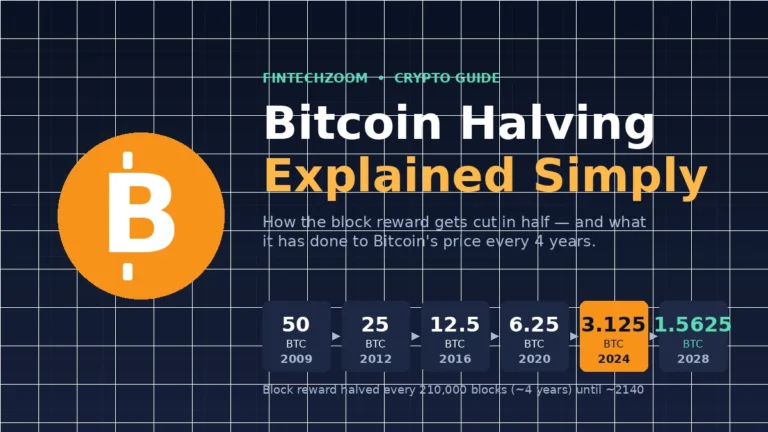
First, daily issuance drops by exactly 50% overnight: Before the April 2024 halving, miners earned 6.25 BTC per block — roughly 900 new bitcoins per day across the network. After the halving, that fell to 3.125 BTC per block, or roughly 450 new bitcoins per day. That is 164,000 fewer coins per year flowing into circulation.
Second, miners are forced sellers: Mining is a fiat-cost business. Miners pay for electricity, hardware, and staff in dollars. To meet payroll, they sell a portion of mined bitcoin into the market. After a halving, miners earn half as many coins for the same operating costs. Either they sell at a higher price, or they sell fewer coins, or they go bankrupt — all three reduce sell pressure on the market.
Third, scarcity becomes more visible: Each halving cuts Bitcoin’s inflation rate. Before April 2024, the annual supply growth rate was about 1.7%. After the halving, it fell below 1% for the first time — making Bitcoin technically scarcer on a flow basis than gold. That narrative attracts new demand, especially from investors who view Bitcoin as digital hard money.
Combine reduced supply with steady or growing demand, and you get the conditions for a price rally. That is the textbook mechanism. The real-world price action is messier because demand is volatile too.
What Has the Halving Done to Bitcoin Price in Every Past Cycle?
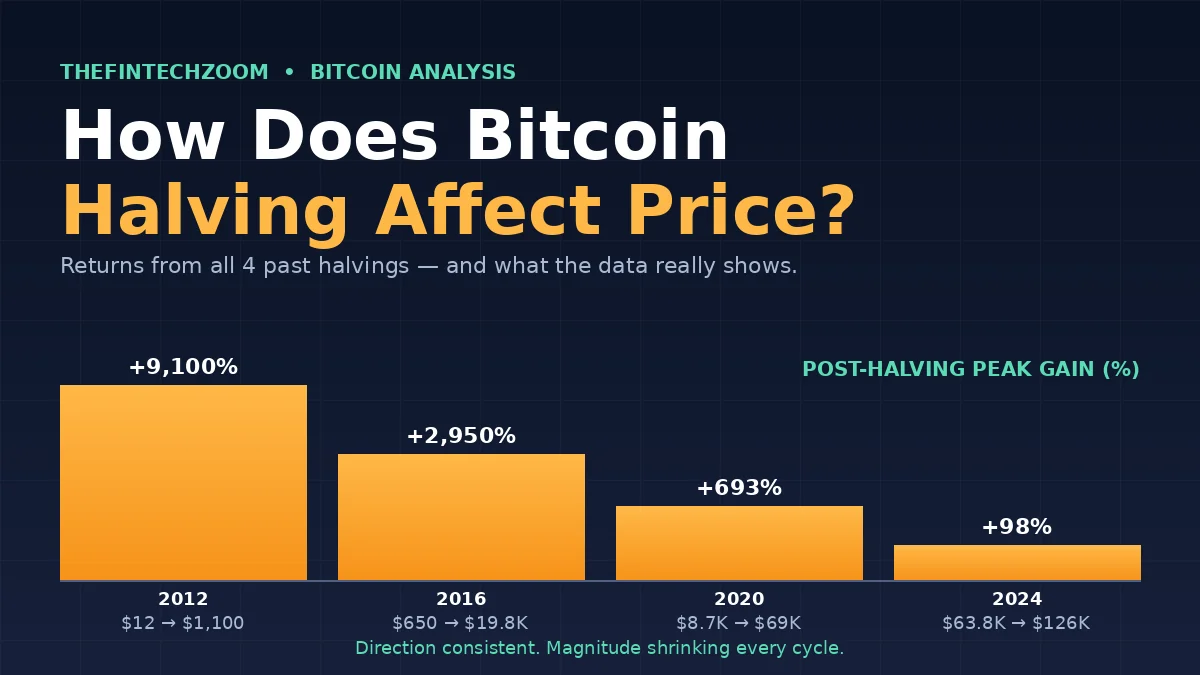
Every Bitcoin halving has been followed by a new all-time high within 12 to 18 months, but the percentage gains have shrunk dramatically each cycle. The first halving cycle returned over 9,000%. The most recent 2024 cycle returned about 100% from halving day to the October 2025 peak. The direction is consistent, but the magnitude reflects Bitcoin’s massive market cap growth.
Here is the data from all four completed halvings.
Bitcoin Price Around Each Halving — Full History
| Halving | Date | Price at Halving | Cycle Peak | Time to Peak | % Gain |
|---|---|---|---|---|---|
| #1 | Nov 28, 2012 | ~$12 | ~$1,100 | ~12 months | +9,100% |
| #2 | Jul 9, 2016 | ~$650 | ~$19,800 | ~17 months | +2,950% |
| #3 | May 11, 2020 | ~$8,700 | ~$69,000 | ~18 months | +693% |
| #4 | Apr 19, 2024 | ~$63,800 | ~$126,198 | ~18 months | +98% |
A few things stand out from this data when you look at it in real terms instead of just percentages.
The dollar gains per cycle have actually grown. The 2024-2025 cycle added more than $62,000 per coin from the halving to the peak — more than the total dollar gain of every prior cycle combined. Percentages shrink because the base is bigger, but the actual money moving into Bitcoin keeps expanding.
The time-to-peak has stabilized around 17-18 months. After the second halving, the lag became remarkably consistent. This is not coincidence — it roughly tracks how long it takes the supply shock to filter through miner reserves, market makers, and into spot demand.
Every cycle has bottomed at a higher price than the previous cycle’s halving price. The 2018 bear market low was around $3,200 — far above the 2016 halving price of $650. The 2022 low was around $15,500 — above the 2020 halving price of $8,700. This staircase pattern is one of the strongest visual signals in Bitcoin’s history.
Why Does the Halving Take Months to Move Price?
The price impact of a halving takes 12 to 18 months because the supply shock is gradual, not instant. On day one, the daily new supply drops, but exchanges and miners hold inventory that masks the effect for weeks or months. The market only “feels” the squeeze once the cumulative supply reduction becomes material relative to demand — and that takes time.
Think of it like turning down a tap that fills a swimming pool. The water level doesn’t drop the moment you turn the tap — it stops rising as fast. Only after months do you notice the pool is meaningfully lower than it would have been.
Here is what happens during the lag period, step by step.
Months 0-3: Post-halving consolidation. Miners burn through existing BTC reserves rather than selling at lower prices. Sentiment is mixed because the “halving event” itself was already priced in. Price often goes sideways or slightly down. After the 2024 halving, Bitcoin actually fell from $63,800 to around $55,000 within four months.
Months 3-9: Miner shakeout. Inefficient miners run out of runway. They either sell their treasuries or shut down. The network’s hash rate dips temporarily, then recovers as surviving miners absorb the dropped capacity. Spot demand starts building quietly.
Months 9-18: Supply-demand imbalance accelerates. The cumulative supply reduction starts to bite. New narratives attract capital — institutional adoption, macro factors, scarcity headlines. This is where the parabolic moves historically happen. Price goes from “boring” to making headlines in 8-12 weeks.
Months 18-24: Cycle peak and reversal. Euphoria peaks. Late buyers enter. The market overshoots fair value. Then comes the correction — historically 50-80% drawdowns over the following 12 months. This is the bear market that resets the next cycle.
That last point matters for anyone buying near a halving: the rally is followed by a deep drawdown. Bitcoin has corrected by more than 50% from every prior cycle peak. The post-halving rally is real, but so is the post-rally crash.
What Changed in the 2024-2025 Cycle?
The 2024 halving was the first that played out alongside US spot Bitcoin ETFs, which launched in January 2024. Those ETFs changed the demand side of the equation by giving traditional investors access to Bitcoin through brokerage accounts and retirement plans. The result: Bitcoin reached a new all-time high before the halving for the first time in history, and the cycle’s rally was more compressed and more institutional than previous ones.
Spot Bitcoin ETFs absorbed an enormous amount of supply in their first year. By late 2024, US-listed Bitcoin ETFs collectively held over 1 million BTC — more than 5% of total supply. That demand came from a category of buyer that didn’t meaningfully exist in 2020 or 2016: financial advisors, pension funds, and retirement account holders.
The price action reflected this institutional presence in three ways.
The pre-halving rally was larger than usual. Bitcoin moved from around $42,000 in late 2023 to over $73,000 by March 2024 — before the halving even happened. Past cycles had no pre-halving rally of that magnitude.
Volatility was lower on a percentage basis. The 2024-2025 cycle ran from $63,800 to $126,198 — a 98% gain. The 2020-2021 cycle ran from $8,700 to $69,000 — a 693% gain. Larger market caps with institutional flows damp percentage volatility, just like in any maturing market.
Bitcoin dominance climbed rather than falling. In every prior cycle, altcoins outperformed Bitcoin in the late stages of the rally. In the 2024-2025 cycle, Bitcoin dominance excluding stablecoins rose above 72% — an eight-year high. ETF money flowed to Bitcoin specifically, not the broader crypto market.
The fifth halving is projected for around April 17, 2028. Whether the four-year cycle continues as before is now a real debate. The institutional layer is structural, not a one-time event. The next cycle’s price action will be shaped as much by ETF flows, corporate treasury policies, and Fed liquidity conditions as by the supply shock from halving itself.
What Other Factors Move Bitcoin’s Price Around a Halving?
The halving sets the supply side, but demand drives the magnitude of every rally. Historically, the biggest post-halving moves have coincided with major demand catalysts — and the absence of those catalysts has produced smaller rallies even with the same supply shock. Understanding what else is happening matters as much as the halving itself.
The 2013 rally was driven by retail mania and the Cyprus banking crisis pulling money into Bitcoin as a banking alternative. The 2017 rally was driven by the ICO boom and mainstream retail FOMO. The 2021 rally was driven by COVID-era stimulus, corporate treasury purchases (MicroStrategy, Tesla), and the DeFi explosion. The 2025 rally was driven by spot ETF inflows, a more crypto-friendly US regulatory shift, and Federal Reserve easing.
Each cycle’s catalyst was different. The halving was constant. That tells you the halving is necessary but not sufficient for a major rally.
A few demand factors worth watching in any halving cycle:
Macro liquidity conditions. Bitcoin trades like a long-duration risk asset. Rising global money supply, falling real interest rates, and risk-on sentiment fuel rallies. Quantitative tightening and high real rates produce headwinds even with a halving in the background.
Regulatory environment. Clarity attracts capital; uncertainty repels it. The 2024-2025 cycle benefited enormously from clearer US regulations and the ETF approvals. Regulatory crackdowns or uncertainty can mute even a strong supply-side setup.
Institutional adoption pace. Corporate treasury allocations, pension fund mandates, and ETF inflows are the marginal buyers now. Their pace dictates how fast the supply shortage shows up in price.
Mining economics. When mining is profitable, miners hold. When margins compress, they sell. Hash rate trends, electricity costs, and mining difficulty all affect how much supply hits the market post-halving.
If you are trying to forecast a halving cycle, the supply side is the easy part — it is mathematically fixed. The demand side is where the work actually is.
Will Future Halvings Have Less Price Impact?
Yes, future halvings will likely have proportionally smaller price impacts because the supply shock matters less as Bitcoin’s market cap and float grow. After the 2024 halving, over 95% of all bitcoins that will ever exist had already been mined. The marginal effect of cutting issuance in half on an already-tiny new supply is mathematically smaller each cycle.
The math is straightforward. In 2012, Bitcoin’s daily issuance dropped from 7,200 BTC to 3,600 BTC — a reduction of 3,600 coins per day on a circulating supply of around 10 million. That was a meaningful supply shock relative to market depth at the time.
In 2024, the daily issuance dropped from 900 BTC to 450 BTC — a reduction of 450 coins per day on a circulating supply of about 19.7 million. Daily exchange volume is in the tens of thousands of BTC. The supply reduction is now a rounding error against the daily trade flow.
This is why analysts increasingly argue that halvings are becoming psychological events rather than mechanical ones. The narrative still matters. The headlines still drive sentiment. But the actual flow impact is shrinking with every cycle.
By the 2028 halving, daily issuance will drop from 450 BTC to 225 BTC. By 2032, it will drop to 112.5 BTC. By 2036, the daily issuance will be below 60 BTC per day — less than a single large ETF inflow on a busy day. At some point, halvings will become trivia rather than market-moving events.
The implication for investors: don’t expect future halvings to repeat the 100% cycles. Bitcoin’s price will increasingly be driven by demand catalysts, macro conditions, and adoption trends rather than the four-year supply schedule. The halving is becoming background noise as Bitcoin matures into a global asset class.
Frequently Asked Questions
Does Bitcoin price always go up after a halving?
Historically, yes — Bitcoin has reached a new all-time high in the 12 to 18 months following every halving. But the percentage gains have shrunk each cycle, from over 9,000% in 2013 to roughly 100% in 2024-2025. Past patterns are not guaranteed to repeat, and short-term price action right after a halving has often been flat or negative.
How long after a halving does Bitcoin price peak?
The cycle peak has historically arrived 12 to 18 months after each halving. The 2013 peak came roughly 12 months later, the 2017 peak about 17 months later, the 2021 peak about 18 months later, and the October 2025 peak landed about 18 months after the April 2024 halving. The lag is consistent because the supply shock takes time to filter through the market.
Why doesn’t Bitcoin pump on halving day?
Halving days have historically produced small price moves — usually under 5%. The supply reduction is gradual, and the event itself is fully priced in months in advance. Markets are forward-looking, so by the time the actual block reward halves, traders have already positioned for it. The real moves come months later as the cumulative supply shock builds.
How does the halving affect Bitcoin’s inflation rate?
Each halving cuts Bitcoin’s annual supply growth rate roughly in half. Before April 2024, the annual issuance was about 1.7% of supply. After the halving, it dropped below 1% for the first time. By the 2028 halving, the annual issuance rate will fall to about 0.4%, making Bitcoin one of the lowest-inflation assets in existence.
What was Bitcoin’s price during the most recent halving?
Bitcoin traded around $63,800 on April 19, 2024, when block 840,000 was mined and the reward dropped from 6.25 BTC to 3.125 BTC. The price then consolidated for several months before rallying to a new all-time high of $126,198 on October 6, 2025 — roughly 18 months after the halving, in line with historical timing.
Can the halving cause a Bitcoin bear market?
Not directly, but the post-halving cycle has always ended in a major bear market. After every cycle peak, Bitcoin has corrected by 50% to 80% over the following 12 to 18 months. The bear market is technically a separate event from the halving, but the cycle pattern is consistent enough that investors should expect significant drawdowns after each post-halving rally.
Will the 2028 halving move Bitcoin’s price?
It probably will, but likely less than past halvings on a percentage basis. The 2028 halving will cut daily issuance from 450 BTC to 225 BTC — a small flow change relative to Bitcoin’s expected market size by then. The narrative effect may still drive a rally, but the mechanical supply shock will be smaller than in any previous cycle.
Does the halving affect altcoin prices?
Yes, indirectly. Bitcoin halvings have historically lifted the entire crypto market because Bitcoin’s rally sets bullish sentiment for altcoins. Altcoins typically rally with a delay after Bitcoin’s post-halving move. However, the 2024-2025 cycle was unusual — Bitcoin dominance rose to 72%, meaning altcoins underperformed Bitcoin throughout most of the cycle. ETF flows went to Bitcoin specifically, not the broader crypto market.
The Bottom Line
Bitcoin halving affects price through a real but slow mechanism: less new supply, fewer miner sales, and growing scarcity narrative. The pattern has held across all four completed halvings — every one was followed by a new all-time high within 18 months. But the percentage gains have shrunk every cycle, and the 2024-2025 rally was structurally different because of spot ETF demand.
If you are using the halving as a reason to buy Bitcoin, understand what you are actually buying into. You are not buying an event that pumps price on day one. You are buying a multi-year supply mechanism that, combined with the right demand environment, has historically produced major rallies followed by deep corrections. The cycle works on years, not days.
For the next step, watch the data that actually matters: miner reserves, ETF inflows, hash rate, and global liquidity conditions. These tell you where the cycle stands more than any headline about a halving countdown. And if you are still in the current 2024-2028 cycle, remember that the cycle has historically peaked, then corrected hard. Position size accordingly.
This article is for educational purposes only and does not constitute financial advice. Cryptocurrency investments carry significant risk, including the possible loss of principal. Always do your own research and consult a qualified advisor before making investment decisions.