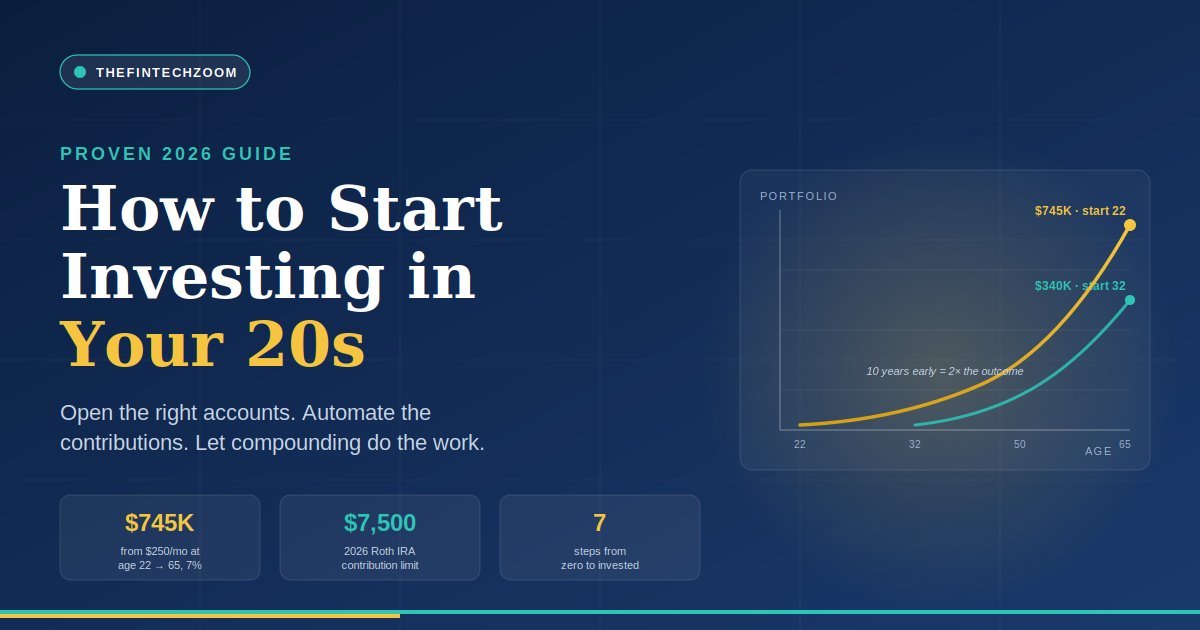
A 22-year-old who invests $250 a month at a 7% average return reaches roughly $745,000 by age 65. A 32-year-old who invests the same $250 a month at the same return reaches only about $340,000. Same dollar amount, same rate — a 10-year head start more than doubles the outcome. That gap is the single most important reason to start investing in your 20s, and it is also the reason most generic finance guides bury the lead.
This guide is the version we wish someone had handed us at 22. You will learn exactly which accounts to open first, how much to contribute, what to invest in, and the five mistakes that quietly cost early investors years of compounding. No “timing the market,” no individual stock picks, no FOMO-driven crypto advice — just the framework that has worked for every generation of long-term investors and is still working in 2026.
Why Do Your 20s Matter So Much for Investing?
Your 20s matter because of compound growth, which rewards time more than any other variable in the formula. Every dollar invested at age 22 has 43 years to compound before traditional retirement age — three to four times longer than the same dollar invested in your late 30s. That length of runway turns small monthly contributions into life-changing balances without requiring high income, expert stock-picking, or perfect timing.
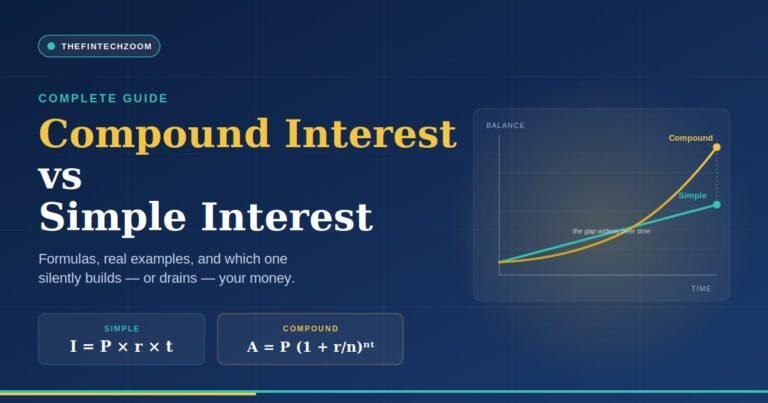
The math is mechanical. At a 7% annual return (slightly below the S&P 500’s long-term average), money roughly doubles every 10 years — a rule of thumb known as the Rule of 72 explained in our compound interest guide. A 22-year-old’s contribution doubles four times by age 62. A 32-year-old’s contribution only doubles three times. Each missed doubling cycle costs you more than the previous one, because the largest gains happen in the final decade — when the balance is at its highest.
There is also a quieter benefit: your 20s are usually when your essential expenses are at their lowest. No mortgage, no kids, no aging parents to support. The same $300/month that feels impossible at 38 often feels manageable at 24, even on an entry-level salary. The window does not stay open forever.
The Two Variables You Actually Control
You cannot control market returns. You cannot reliably control whether 2027 is a good year for stocks. You can control these two things, and they decide more than 90% of your long-term outcome:
| Variable | What It Means | Why It Matters |
|---|---|---|
| Time in the market | How early and how consistently you invest | Each extra year of compounding has outsized impact |
| Contribution rate | What % of income you invest | A 15% rate at $40k beats a 10% rate at $60k over time |
Notice what is missing: stock picks, market timing, and which app you use. Those decisions matter at the margins. The two variables above decide the order of magnitude.
How Do You Start Investing in Your 20s Step by Step?
You start investing in your 20s by building a 1–3 month emergency fund first, then capturing your full employer 401(k) match, opening a Roth IRA, automating contributions to low-cost index funds, increasing the rate by 1% with each raise, and reviewing the allocation once a year. Consistency over a decade beats every clever strategy. Here is the exact seven-step sequence.
Step 1: Lock Down a Starter Emergency Fund First
Investing on top of zero savings is a setup for selling at the worst time. The first surprise expense — a car repair, a medical bill, a lost job — will force you to liquidate investments at whatever the market price is that week. That is exactly how new investors lock in losses.
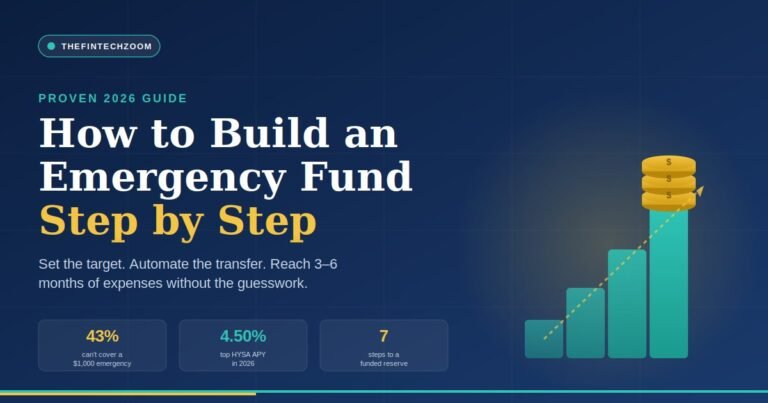
Before you put a dollar in the market, build a $1,000 starter emergency fund step by step in a high-yield savings account paying 3.85%–4.50% APY. Then work toward 1–3 months of essential expenses. This is your shock absorber. With it, market dips become buying opportunities instead of forced sales.
Step 2: Capture Your Full Employer 401(k) Match
If your employer offers a 401(k) match, contributing enough to capture the full match is the highest-return move available to a 20-something — full stop. A typical 50% match on the first 6% of salary is an instant 50% return on those dollars, before the market does anything. No index fund will ever beat that.
For 2026, the IRS has raised the 401(k) employee deferral limit to $24,500, with a total combined employee + employer cap of $72,000. You almost certainly will not hit either limit in your first job. What you need to hit is the match threshold — typically 3%–6% of salary — every paycheck, automatically.
Step 3: Open a Roth IRA
After the match, the next dollar belongs in a Roth IRA. You contribute after-tax money, it grows tax-free for the rest of your life, and qualified withdrawals in retirement are 100% tax-free. For most people in their 20s — whose tax rate is lower now than it will be at peak earning years — that is mathematically the best deal in personal finance.
The 2026 IRA contribution limit is $7,500 combined across all your traditional and Roth IRAs. The Roth IRA income phase-out for single filers begins at $153,000 and ends at $168,000; for married couples filing jointly it begins at $242,000. Open the account at a major brokerage with no account minimums and no maintenance fees — Fidelity, Schwab, and Vanguard are the standard low-cost options. Funding takes about 10 minutes online.
Step 4: Automate Contributions on Payday
Every behavioral finance study points the same direction: the dollar you never see is the dollar you do not spend. Set automatic transfers from your checking account to your Roth IRA on the same day your paycheck lands.
Even $200/month — $50 a week — into a Roth IRA from age 22 to 65 at 7% compounds to roughly $590,000. The same $200/month started at age 30 reaches only about $295,000. Half the outcome for the same dollar effort, simply because eight years of compounding got skipped. Automation is what makes early-decade investing survive the years when life gets noisy.
Step 5: Invest in Low-Cost Index Funds, Not Individual Stocks
This is the step where most new investors quietly go wrong. They open the account, then sit in cash for months while they try to figure out “what to buy.” The boring answer is also the right one: a broad, low-cost index fund.
A total-market or S&P 500 index fund gives you instant diversification across 500+ companies for an expense ratio under 0.10%. Over 30+ years, the difference between a 0.05% index fund and a 1% actively managed fund on a $300,000 balance is roughly $2,800 per year in fees alone. Standard low-cost picks in 2026 include VTI (Vanguard Total Stock Market), VOO (Vanguard S&P 500), FXAIX (Fidelity 500 Index), and SCHB (Schwab US Broad Market). Pick one, set the contribution to auto-invest, and stop checking it daily.
Step 6: Raise the Contribution by 1% with Every Pay Increase
Most people absorb raises into lifestyle inside 90 days — a nicer apartment, more dining out, a newer car. The fix is mechanical: the day a raise hits, increase your 401(k) or Roth IRA contribution by 1% of gross income before the lifestyle creep kicks in.
You will not feel a 1% cut on a 5% raise. Over a decade of normal salary growth, this single habit takes most workers from a 5% savings rate at 22 to a 15%+ rate by their early 30s — without ever consciously cutting expenses. It is the rare financial move that costs nothing and changes everything.
Step 7: Review the Allocation Once a Year, Not Once a Week
The biggest threat to a 20-something’s portfolio is not the market — it is the investor. Checking daily, panic-selling during a 15% pullback, and chasing whatever stock or coin is trending that month destroys more wealth than any bad index fund ever has.
Set one calendar reminder per year. Review your allocation, rebalance if anything has drifted more than 5%–10% from target, increase contributions if you got a raise, and close the tab. Studies from Fidelity have repeatedly found that the highest-performing retail accounts are the ones the investor forgot about. That is not a joke — that is the playbook.
Where Should You Invest First? Account Types and Allocation
The order matters. Each account type has a specific job, a contribution limit, and a tax treatment, and using them in the wrong order leaves real money on the table. Here is the standard 2026 sequence for a 20-something with a normal job.
| Order | Account | 2026 Limit | Why You Use It |
|---|---|---|---|
| 1 | Emergency fund (HYSA) | No IRS limit | Shock absorber so you don’t sell investments at a loss |
| 2 | 401(k) up to employer match | $24,500 employee cap | Instant 50%–100% return from the match |
| 3 | Roth IRA | $7,500 (combined trad + Roth) | Tax-free growth and withdrawals in retirement |
| 4 | Max out the 401(k) | $24,500 employee cap | Lower current taxable income, more compounding space |
| 5 | Taxable brokerage account | No limit | Long-term goals, early retirement, flexibility |
Most 20-somethings will spend their first 3–5 working years getting through steps 1–3. That is completely normal and completely sufficient. Steps 4–5 become realistic as income grows.
A Simple Long-Term Allocation by Age
The classic rule — “100 minus your age in stocks” — is too conservative for most 20-somethings. With 40+ years of runway, a heavy equity tilt is appropriate because you have the one thing that lets you ride out volatility: time.
| Age Range | Stocks (Equities) | Bonds | Cash | Logic |
|---|---|---|---|---|
| 20–24 | 90% | 5% | 5% | Maximum compounding window |
| 25–29 | 85% | 10% | 5% | Slight bond tilt as life expenses rise |
| 30+ | 80% | 15% | 5% | Gradual de-risking toward middle age |
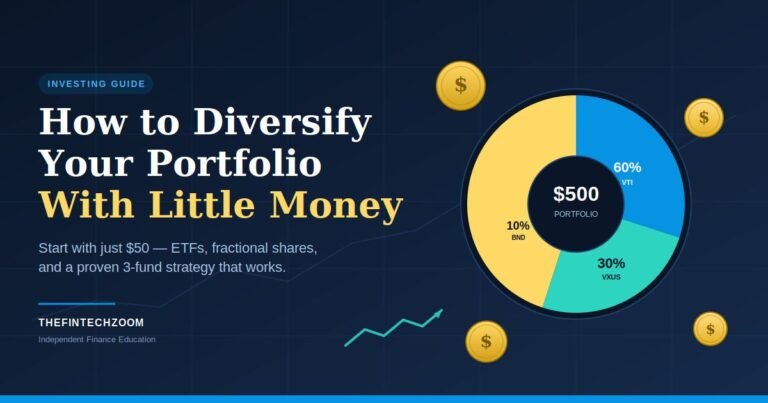
Inside the stock portion, splitting roughly 70% US (VTI or VOO) and 30% international (VXUS or similar) is the simple, defensible default — the same three-fund logic we use when showing readers how to diversify a portfolio with little money. This is the allocation most fee-only financial planners recommend privately to friends and family.
The 10-Year Snapshot: Why $250/Month Becomes $40,000+
To make the math concrete — here is what a $250/month contribution starting at age 22 looks like at a 7% return:
- Year 5 (age 27): ~$17,800
- Year 10 (age 32): ~$43,500
- Year 20 (age 42): ~$130,000
- Year 30 (age 52): ~$306,000
- Year 43 (age 65): ~$745,000
You contributed roughly $129,000 of your own money across those 43 years. The other $616,000+ came from compounding. That is the entire pitch for starting in your 20s — and it does not require a single hot stock pick.
Common Mistakes 20-Somethings Make When Investing
Five mistakes show up repeatedly when readers ask us to review their first-year setups. Each one looks small. Together they cost most new investors years of progress.
Mistake 1: Waiting Until You “Have More Money” to Start
This is the most expensive sentence in personal finance. Every year you wait costs more than the previous one because you are removing a doubling cycle from the end of the curve — where the largest dollar gains happen. Starting with $50/month at 22 beats starting with $500/month at 32, both in years invested and in final balance.
Mistake 2: Skipping the 401(k) Match to “Pay Off Debt First”
Aggressively paying down debt is smart — but skipping the employer match to do it is not. The match is an instant 50%–100% return. No realistic debt has an APR high enough to justify walking away from that. Capture the full match, then attack the high-interest debt with everything else.
Mistake 3: Picking Individual Stocks Instead of Index Funds
A 2022 SPIVA report found that roughly 79% of actively managed US large-cap funds underperformed the S&P 500 over a 5-year period. Professional fund managers, with full-time research teams, cannot consistently beat the index. The odds of a 24-year-old beating it with hot tips from Reddit are not great. Buy the index, save the energy.
Mistake 4: Panic-Selling the First Time the Market Drops
The S&P 500 has had at least one drop of 10% or more in most calendar years on record — and has still returned roughly 10% annualized over the long term. Selling during a pullback locks in losses; the recovery happens to the people who stayed. The first 15% drop you experience as an investor in your 20s is a test. The right answer is almost always: keep contributing.
Mistake 5: Not Increasing Contributions as Income Grows
Starting at 5% and staying at 5% for a decade is the silent killer of long-term portfolios. The 1% raise rule (Step 6) exists for exactly this reason. The investors who finish in great shape are not the ones who started rich — they are the ones whose contribution rate grew with their paycheck instead of getting eaten by lifestyle inflation.
Frequently Asked Questions
How much money do I need to start investing in my 20s?
You can start with as little as $1 at most major brokerages — Fidelity, Schwab, and Vanguard all allow fractional share purchases of index funds with no minimums. The real answer is whatever amount you can contribute consistently without canceling. Many successful long-term investors started with $25–$50 per paycheck and grew the rate from there.
Should I pay off student loans or start investing first?
Capture your full 401(k) match first — it is a guaranteed instant return no debt payoff can match. Then split focus based on interest rate: aggressively pay off any debt above 7%–8% APR while still contributing enough to keep the match. For federal student loans at lower rates, paying the minimum and directing extra money to a Roth IRA usually wins long-term.
What is the best account for a 20-something to invest in?
A Roth IRA is the single best long-term account for most 20-somethings because contributions and growth come out tax-free in retirement. The 2026 contribution limit is $7,500. If you also have access to a 401(k) with an employer match, capture the match first, then fund the Roth IRA, then return to the 401(k).
How much should I invest in my 20s?
A common target is 15% of gross income across retirement accounts, but starting at 5%–10% and using the 1% raise rule to climb toward 15% is realistic for most early-career workers. The number matters less than consistency. A 10% rate sustained for 40 years beats a 20% rate that gets paused after three.
Is investing in my 20s worth it if I only have a little money?
Yes — more than at any other age. Time, not dollar amount, is what powers compounding. A 22-year-old contributing $100/month reaches roughly $300,000 by 65 at a 7% return. The same monthly amount started at 32 ends near $145,000. Small amounts started early outperform large amounts started later. This is the single biggest mathematical advantage of your decade.
What if the market crashes right after I start investing?
A crash in the first few years of investing is actually a long-term benefit — you are buying the same shares at lower prices, and those shares have decades to recover. Investors who continued contributing through the 2008 and 2020 crashes ended ahead of those who paused. The risk is not the crash. The risk is selling during the crash.
Do I need a financial advisor to start investing in my 20s?
Not for the early years. The plan in this guide — emergency fund, 401(k) match, Roth IRA in a low-cost index fund, automated contributions, annual review — covers what most 20-somethings actually need. A fee-only fiduciary advisor becomes useful later, when income, tax complexity, or major life decisions (home purchase, marriage, business equity) raise the stakes.
Conclusion: The Decade That Decides the Rest
Investing in your 20s is not about being smart. It is about being early. Every dollar you put into a Roth IRA at 24 has more than 40 years to compound, and the math of that runway is the closest thing to a guarantee that personal finance offers. The hard part is not picking the right fund. The hard part is starting before you feel ready.
Your next action, today: open a Roth IRA at Fidelity, Schwab, or Vanguard, set up an automatic $100/month transfer into a low-cost total-market or S&P 500 index fund, and confirm you are contributing at least up to your employer’s full 401(k) match. That is the entire opening move. Everything in this guide compounds on top of those three decisions.
The 22-year-old who reads this and acts inside 30 days is on a fundamentally different trajectory than the 22-year-old who waits until next year. The decade is the asset. Spend it.
This guide is published by TheFintechZoom as independent financial education. It is informational and not personalized investment, tax, or legal advice. All projections are illustrative and assume hypothetical average returns; actual returns vary and past performance does not guarantee future results. 2026 IRS contribution limits cited are based on IRS Notice 2025 announcements; verify current limits and income phase-outs at IRS.gov before contributing. Consult a qualified fee-only fiduciary for guidance specific to your situation.
Explore fresh content that brings value—start reading our top recommendations and keep growing.