The single sentence Albert Einstein is often (loosely) credited with — that compound interest is the eighth wonder of the world — is only half the story. The other half is that the same force becomes the eighth disaster when it is working against you on a credit card balance averaging 24% APR in 2026.
This guide cuts through the textbook definitions and shows you exactly how compound interest vs simple interest play out in real money: the formulas, the side-by-side math, which financial products use which, and the one rule of thumb that lets you estimate your returns without a calculator. By the end, you will be able to look at any loan, savings account, or investment and know — before you sign — whether the interest math is quietly working for you or against you.
What Is the Difference Between Compound Interest and Simple Interest?
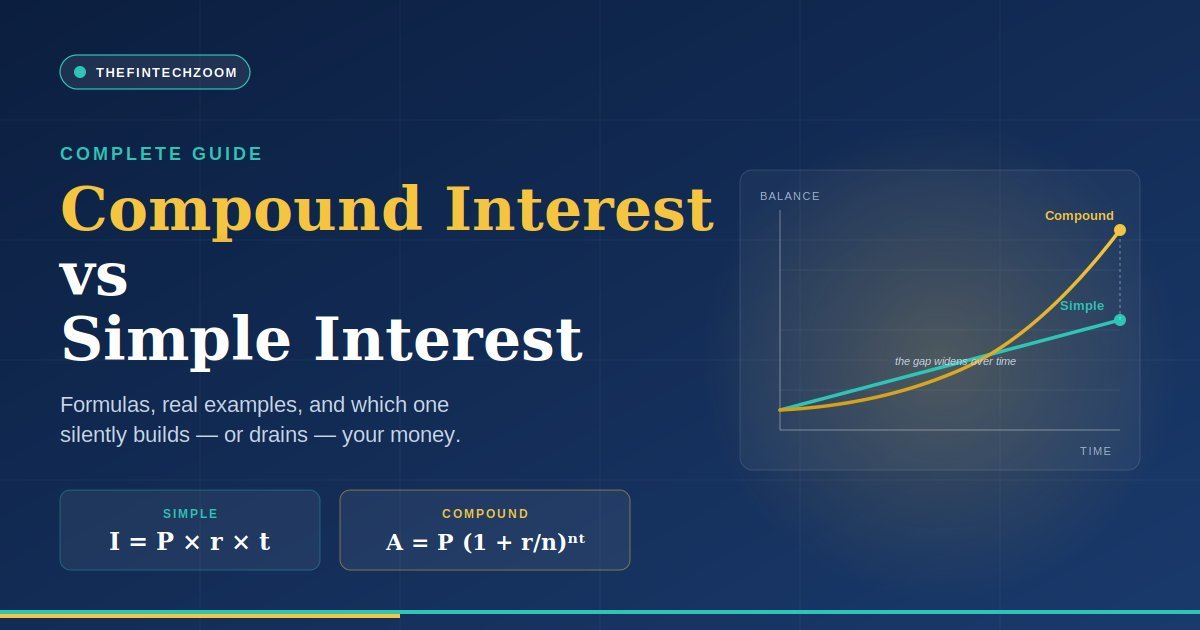
Simple interest is calculated only on the original principal amount. Compound interest is calculated on the principal plus all previously accumulated interest. That single distinction is why a $10,000 deposit growing at 5% for 30 years ends at $25,000 under simple interest but $43,219 under annual compound interest — a $18,219 swing from one design choice.
The deeper difference is about direction. Simple interest grows in a straight line. Compound interest grows on a curve — slowly at first, then sharply — because each interest payment becomes part of the base that earns the next one. Financial planners call this the “snowball effect.” Mathematicians call it exponential growth. Borrowers call it the reason their credit card balance keeps climbing even after they make the minimum payment.
Side-by-Side: The 30-Second Comparison
| Feature | Simple Interest | Compound Interest |
|---|---|---|
| Calculated on | Principal only | Principal + accumulated interest |
| Growth pattern | Linear (straight line) | Exponential (curve) |
| Formula | I = P × r × t | A = P (1 + r/n)^(nt) |
| Predictability | Highly predictable | Depends on compounding frequency |
| Best for borrowers | Yes — cheaper | No — more expensive |
| Best for savers/investors | No — slower growth | Yes — faster growth |
| Common products | Mortgages, auto loans, most personal loans, some bonds | Savings accounts, credit cards, CDs, retirement accounts |
| Long-term impact | Limited | Massive |
The headline rule: if you are paying it, you want simple interest. If you are earning it, you want compound interest — and you want it compounded as frequently as possible.
How Do You Calculate Compound Interest and Simple Interest?
You calculate simple interest with the formula I = P × r × t, where P is principal, r is the annual interest rate as a decimal, and t is time in years. You calculate compound interest with A = P (1 + r/n)^(nt), where n is the number of compounding periods per year. The compound formula gives you the final balance; subtract P to get the interest earned alone.
Here is each one broken down step by step with real numbers.
The Simple Interest Formula, Step by Step
The simple interest formula is straightforward enough that you can do it in your head for most everyday cases.
Formula: I = P × r × t
Where:
- I = total interest earned or paid
- P = principal (the starting amount)
- r = annual interest rate as a decimal (5% = 0.05)
- t = time in years
Worked example. You take out a $20,000 auto loan at a 6% simple interest rate for 5 years.
- P = $20,000
- r = 0.06
- t = 5
- I = 20,000 × 0.06 × 5 = $6,000
Total repaid: $26,000. Interest charged: $6,000. The rate is fixed, the time is fixed, and the interest never compounds — so the math never gets more complicated than that single line.
The Compound Interest Formula, Step by Step
Compound interest looks more intimidating because of the exponent, but it follows the same logic — you just compound interest on top of interest every period.
Formula: A = P (1 + r/n)^(nt)
Where:
- A = final amount (principal + interest)
- P = principal
- r = annual interest rate as a decimal
- n = number of times interest is compounded per year
- t = time in years
Worked example. You deposit $20,000 in a high-yield savings account earning 4% APY, compounded monthly, for 5 years.
- P = $20,000
- r = 0.04
- n = 12 (monthly compounding)
- t = 5
- A = 20,000 × (1 + 0.04/12)^(12 × 5)
- A = 20,000 × (1.003333)^60
- A = 20,000 × 1.22099
- A = $24,419.86
Interest earned: $4,419.86. If the same $20,000 had earned 4% simple interest for 5 years, you would have earned only $4,000 — a $420 gap from compounding alone. Stretch that to 30 years and the gap widens dramatically (we will get there in a moment).
Why Compounding Frequency Matters
The “n” in the compound formula is the quiet variable that changes outcomes more than people expect. The more often interest is compounded, the more interest you earn (or owe).
| $10,000 at 5% for 10 Years | Compounding Frequency | Final Balance |
|---|---|---|
| Simple interest (baseline) | — | $15,000.00 |
| Compound annually | 1× per year | $16,288.95 |
| Compound quarterly | 4× per year | $16,436.19 |
| Compound monthly | 12× per year | $16,470.09 |
| Compound daily | 365× per year | $16,486.65 |
The jump from simple to annual compounding is the biggest. After that, each step up in frequency adds less. Daily compounding sounds far better than annual — in practice, on a 5% account over a decade, it adds only about $200 versus annual compounding. The rate matters more than the frequency, but frequency is not nothing.
Real Examples: How the Gap Widens Over Time
The most important thing to understand about compound interest vs simple interest is that the difference between them is small in year one and enormous in year thirty. Time is the variable that does the heavy lifting, which is why every retirement planner repeats the same advice: start early, even with small amounts.
The 30-Year Comparison That Changes Minds
A $10,000 lump sum at 7% (a reasonable long-term equity return) shows the gap clearly.
| Time Horizon | Simple Interest (7%) | Compound Interest (7%, annual) | Extra from Compounding |
|---|---|---|---|
| Year 1 | $10,700 | $10,700 | $0 |
| Year 5 | $13,500 | $14,026 | $526 |
| Year 10 | $17,000 | $19,672 | $2,672 |
| Year 20 | $24,000 | $38,697 | $14,697 |
| Year 30 | $31,000 | $76,123 | $45,123 |
| Year 40 | $38,000 | $149,745 | $111,745 |
By year 40, compounding has turned a $10,000 deposit into nearly 15 times the original principal. Simple interest at the same rate produced less than 4 times. The same engine is what lets you build a diversified portfolio with little money and watch small monthly contributions snowball. This is the engine behind every “start investing in your 20s” argument — it is not motivation, it is multiplication.
The Rule of 72 — Estimate Doubling Without a Calculator
The Rule of 72 is the single most useful mental shortcut in personal finance. To estimate how long it takes for a compound-growing investment to double, divide 72 by the annual interest rate.
- At 3% APY: 72 ÷ 3 = 24 years to double
- At 6% APY: 72 ÷ 6 = 12 years to double
- At 8% APY: 72 ÷ 8 = 9 years to double
- At 12% APY: 72 ÷ 12 = 6 years to double
The same rule works against you on debt. A credit card balance at 24% APR doubles itself in roughly 3 years if you do not pay it down. That is not a typo — that is exactly why financial advisors call high-interest credit card debt the most dangerous everyday product in personal finance.
The Borrowing Side: When Compounding Hurts
The compound formula does not care which direction the money is moving. On a savings account, it grows your balance. On unpaid credit card debt, it grows what you owe.
Bankrate’s 2026 reporting puts average credit card APRs near 24%, with interest typically compounded daily and billed monthly. Carry a $5,000 balance for one year while making no payments and the math gives you roughly $6,360 owed — $1,360 in interest in 12 months, more than half of which is interest on interest.
Mortgages, by contrast, almost always use simple interest calculated on the outstanding balance. That is why making extra principal payments early in a mortgage saves so much more than the same payment late — you are knocking down the principal that simple interest is calculated against.
Common Mistakes and Myths About Compound vs Simple Interest
Six misconceptions show up repeatedly when readers ask us to explain why their loan or savings is behaving differently than they expected. Each one is fixable in a sentence — but only once you know it is wrong.
Myth 1: “All Loans Use Simple Interest”
False. Most US mortgages, auto loans, and personal loans use simple interest calculated on the outstanding principal balance — but credit cards, payday loans, and many revolving lines of credit use compound interest. Student loans are a hybrid: federal direct loans accrue simple interest daily on the principal, but unpaid interest can capitalize (be added to the principal) at certain trigger events, which is functionally compounding. Always read the disclosure.
Myth 2: “Compound Interest Is Always Better”
Only if you are the one earning it. On the borrowing side, compound interest is mathematically the worst design — it accelerates the cost of debt every period. The exact same force that makes a Roth IRA powerful makes a credit card balance dangerous. Direction matters.
Myth 3: “APR and APY Are the Same Thing”
They are not. APR (Annual Percentage Rate) is typically a simple interest representation of yearly cost. APY (Annual Percentage Yield) accounts for compounding within the year. A 5% APR with monthly compounding is roughly a 5.12% APY. On savings products, banks usually advertise APY because it looks higher. On loans, they advertise APR because it looks lower. Both can be technically accurate and tell you very different things.
Myth 4: “Daily Compounding Is Massively Better Than Monthly”
The marketing language exaggerates the gap. On a 4% savings account, the difference between daily and monthly compounding over 10 years is roughly 0.1% of the final balance. The interest rate and the time horizon matter far more than the compounding interval. Pick the higher APY, not the more aggressive compounding label.
Myth 5: “Making Minimum Payments Stops the Damage”
On a compound interest product, the minimum payment is calibrated to keep you in debt — not get you out of it. On a $5,000 credit card balance at 24% APR, paying only the 2% minimum can stretch the payoff to over 20 years and triple the original balance in total interest. The way out of compound interest debt is paying more than the minimum, ideally targeting the highest-APR balance first.
Myth 6: “You Need a Lot of Money for Compounding to Matter”
The most powerful variable in the compound formula is not P (principal) or r (rate) — it is t (time). A 22-year-old contributing $200/month at 7% compounded monthly reaches roughly $525,000 by age 65. A 35-year-old contributing the same $200/month at the same rate reaches only about $245,000. The 13-year head start doubles the outcome with the same total contribution rate. Time, not income, is what most people are missing — which is exactly why we tell every reader how to start investing in their 20s before anything else.
Frequently Asked Questions
Which is better, compound interest or simple interest?
It depends on which side of the transaction you are on. As a saver or investor, compound interest is better because it grows your money exponentially over time. As a borrower, simple interest is better because the lender cannot charge interest on previously accrued interest. The same mathematical force is your best friend on a 401(k) and your worst enemy on a credit card.
What is the formula for compound interest vs simple interest?
The simple interest formula is I = P × r × t, where P is principal, r is the annual rate as a decimal, and t is time in years. The compound interest formula is A = P (1 + r/n)^(nt), where n is the number of compounding periods per year. To get just the compound interest earned, subtract the principal: I = A − P.
Do mortgages use simple or compound interest?
Most US mortgages use simple interest calculated daily on the outstanding principal balance. Each monthly payment is applied first to that month’s accrued interest, then to principal. This is why early extra principal payments are so powerful — they immediately reduce the base the daily simple interest is calculated against, saving thousands over the life of the loan.
Do credit cards use compound interest?
Yes. Credit card issuers typically calculate interest using a daily periodic rate applied to the average daily balance, with the resulting interest added to the balance at the end of each statement cycle. That means unpaid interest starts earning its own interest the next day. With average APRs near 24% in 2026, this is the most expensive form of consumer debt for most households.
What is the Rule of 72?
The Rule of 72 is a mental shortcut to estimate how long it takes a compound-growing investment to double in value. Divide 72 by the annual interest rate and the result is the approximate number of years to double. At 6% the answer is 12 years; at 9% the answer is 8 years. It works reasonably well for rates between roughly 4% and 15%.
How does compounding frequency affect returns?
More frequent compounding increases your returns, but the gains shrink at each step. Moving from annual to monthly compounding on a 5% account has a meaningful impact. Moving from monthly to daily adds only a few dollars per year on a typical savings balance. The interest rate and the time horizon matter far more than whether the account compounds monthly or daily.
Can I switch a simple interest loan to compound or vice versa?
You generally cannot change the interest method on an existing loan — it is set in the contract. You can, however, refinance into a product with a different structure. The more practical move is to direct your behavior to match the math: pay extra principal early on simple-interest loans, and pay above the minimum on compound-interest balances to neutralize the snowball.
Conclusion: Make the Math Work for You, Not Against You
The choice between compound interest vs simple interest is rarely yours to make on a single product — credit cards will always compound, mortgages will almost always be simple. What is in your control is where you place your money and how you manage your debt with full awareness of which formula is running underneath.
Three actions cover most of the value in this guide:
- Move your emergency fund and short-term savings into a high-yield savings account that pays 3.85%–4.50% APY in 2026. Daily or monthly compounding at a real rate is the easiest version of the formula working for you.
- Pay above the minimum on any compound-interest debt — especially credit cards. Even an extra $50/month against a high-APR balance can cut payoff time in half and save thousands.
- Start investing for retirement early, even with small amounts. The compound interest formula does not care if you contribute $50 or $500 — it cares about the value of t. Every year you delay is a year the curve cannot run.
The formulas in this guide will not change. The only variable you fully control is your decision to put them on the right side of your balance sheet — starting today.
This guide is published by TheFintechZoom as independent financial education. It is informational and not personalized investment, tax, or legal advice. All formulas and calculations are illustrative; actual returns and loan costs depend on the specific product, rate, fees, and timing. Verify current APRs and APYs directly with the issuing bank or lender before making financial decisions, and consult a qualified financial professional for guidance specific to your situation.
Looking for answers? Find them in our expert-crafted reads packed with practical solutions.