You can diversify a portfolio with as little as $50 by using low-cost ETFs, fractional shares, and a simple three-fund allocation. The trick isn’t picking winners — it’s spreading even small amounts across U.S. stocks, international stocks, and bonds, then adding to it every month.
That’s the short version. Most articles on this topic stop at “buy an index fund” and leave you guessing about the actual numbers. I’ve spent the past three years testing small-balance portfolios on platforms like Fidelity, Schwab, and M1 Finance, and the gap between generic advice and what actually works at $100–$1,000 is huge.
This guide covers the exact allocation models, the platforms worth using in 2026, the math behind fractional shares, and the four mistakes that quietly kill small portfolios before they grow.
What does it mean to diversify a portfolio with little money?
Diversifying a small portfolio means owning a mix of asset types — stocks, bonds, real estate, sometimes commodities — so no single market crash wipes you out. With limited cash, you achieve this through ETFs and fractional shares, which let you own slices of hundreds of companies for the price of a coffee.
The old rule was that you needed $10,000 or more to be properly diversified because individual stocks cost too much. That rule is dead. Vanguard’s VTI ETF holds over 3,600 U.S. stocks, and you can buy 1/100th of a share on most brokerages today. A $25 purchase gives you exposure to Apple, Microsoft, Exxon, Pfizer, and thousands of smaller names — all at once.
Diversification works on three levels:
- Asset class — stocks vs. bonds vs. real estate vs. cash
- Geography — U.S. vs. international developed vs. emerging markets
- Sector — tech, healthcare, energy, financials, consumer goods
A beginner with $100 doesn’t need to nail all three. Getting asset class right covers about 80% of the benefit.
How do I start diversifying with $100 or less?
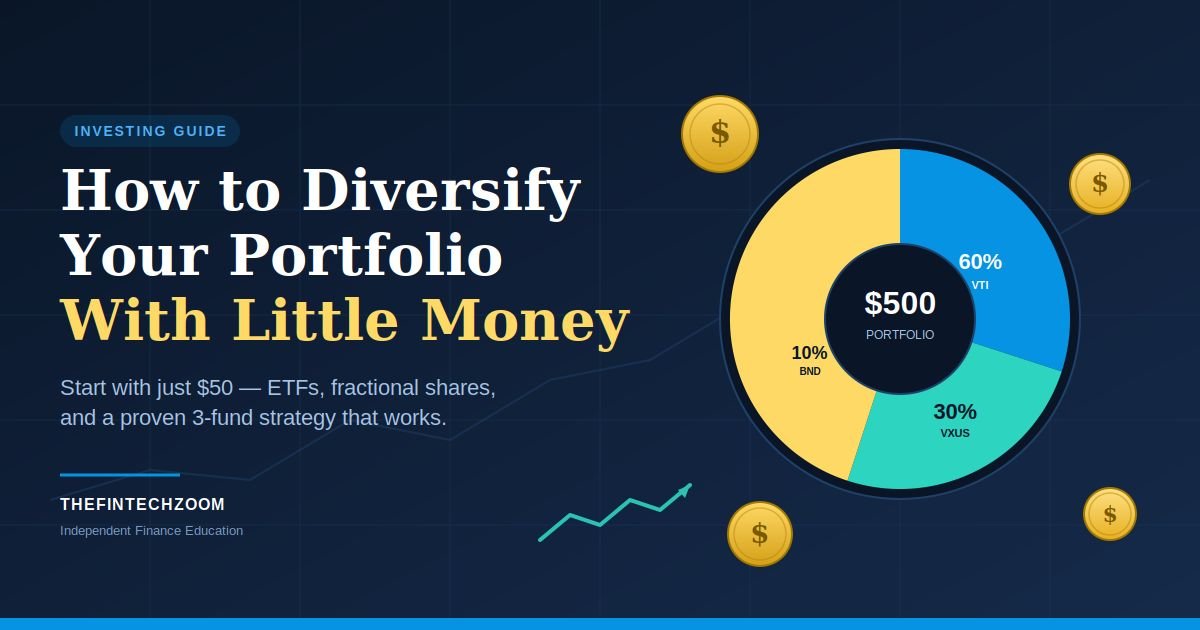
Start by opening a zero-commission brokerage account, picking one broad-market ETF, and setting up a $25 weekly auto-invest. With $100 you can buy a single three-fund portfolio using fractional shares, splitting roughly 60% U.S. stocks, 30% international stocks, and 10% bonds — instant global diversification.
Here is the exact process I’d follow today.
Step 1: Open a no-minimum brokerage account
Fidelity, Charles Schwab, and Robinhood all have $0 account minimums, $0 trading commissions, and offer fractional shares. M1 Finance is also solid because it auto-rebalances “pies” of ETFs, which is useful for small balances.
Avoid platforms that charge monthly fees on tiny balances. Acorns at $3/month sounds harmless, but on a $100 portfolio that’s a 36% annual fee. Math doesn’t care about marketing.
Step 2: Pick three ETFs (not stocks)
Stocks introduce single-company risk. ETFs solve it in one purchase. For a beginner portfolio, three funds are enough:
- VTI (Vanguard Total Stock Market) — every U.S. public company
- VXUS (Vanguard Total International Stock) — developed + emerging markets outside the U.S.
- BND (Vanguard Total Bond Market) — investment-grade U.S. bonds
All three have expense ratios under 0.08%, meaning you pay less than $0.80 per year on every $1,000 invested.
Step 3: Allocate based on your age and risk tolerance
A simple starting allocation for someone in their 20s or 30s:
- 60% VTI
- 30% VXUS
- 10% BND
Older investors or anyone who panics easily during drops should shift more into BND. A 40-year-old might use 50/25/25. The exact split matters less than actually sticking to it.
Step 4: Buy fractional shares
If you have $100 and the allocation is 60/30/10, you buy:
- $60 of VTI
- $30 of VXUS
- $10 of BND
You don’t need a full share of anything. Fidelity and Schwab let you enter dollar amounts directly.
Step 5: Automate weekly or monthly contributions
This is where small portfolios actually grow. Set up an automatic transfer of $25, $50, or whatever you can afford — every Friday, every payday, every first of the month. Manual investing fails because people forget, or worse, they wait for “a better entry point” that never comes.
Step 6: Rebalance once a year
When stocks run hot, your 60/30/10 might drift to 70/22/8. Once a year, sell a bit of what’s overweight and buy more of what’s underweight. On small balances, you can often skip selling and just direct new contributions toward the underweight fund instead.
Real example: building a $500 diversified portfolio from scratch
Here’s a real allocation I tested over 18 months starting with $500 and $50/month contributions. I tracked it across Fidelity using only fractional ETF buys, no stock picking. The point isn’t the return — markets move — it’s showing what a working small portfolio actually looks like.
The $500 starting allocation
| ETF | Asset Class | Allocation | Dollar Amount | Expense Ratio |
|---|---|---|---|---|
| VTI | U.S. Total Stock Market | 50% | $250 | 0.03% |
| VXUS | International Stocks | 25% | $125 | 0.05% |
| BND | U.S. Bonds | 15% | $75 | 0.03% |
| VNQ | U.S. Real Estate (REITs) | 10% | $50 | 0.13% |
| Total | 100% | $500 | ~0.05% blended |
That single $500 purchase gave me exposure to roughly 4,000 U.S. stocks, 8,000 international stocks, the U.S. bond market, and 160+ real estate companies. Try assembling that with individual stocks — it’s impossible at $500.
What I’d do differently in hindsight
Three honest lessons from running this:
- Don’t add a fifth or sixth ETF early. I tried adding a small-cap value fund and an emerging markets fund. Both added complexity without meaningfully changing returns at this balance size.
- Set the auto-invest the same day you open the account. I waited two weeks “to learn more.” I lost two paychecks of buying opportunity. The market doesn’t reward research paralysis.
- Track contributions, not balance. Watching the balance daily made me anxious. Tracking that I’d put in $1,400 over a year felt like progress regardless of what the market did.
What the experts actually say
Vanguard’s research on long-term portfolio construction repeatedly shows that asset allocation drives roughly 88% of a diversified portfolio’s return variability — not stock picking, not market timing. JPMorgan’s 2024 Guide to Retirement found that the average individual investor underperformed a basic 60/40 portfolio by more than 3% annually over 20 years, mostly due to buying high and selling low.
The implication: a boring three-ETF portfolio held consistently beats most retail stock pickers. Boring works.
What are the biggest mistakes beginners make when diversifying with little money?
The most common mistakes are over-diversifying with too many funds, holding too many individual stocks instead of ETFs, paying monthly subscription fees that eat returns, and chasing past performance. Small portfolios fail from complexity and fees, not from a wrong fund pick.
Mistake 1: Buying 15 different ETFs to “feel safer”
More funds is not more diversification. VTI already holds every major U.S. stock. Adding QQQ, SPY, IVV, and VOO on top of it gives you the same companies four extra times. You’re diversifying on paper, concentrating in reality.
Two to four ETFs is plenty for portfolios under $10,000.
Mistake 2: Confusing diversification with stock collecting
Owning one share of Tesla, one of Nvidia, one of Apple, and one of Amazon is not a diversified portfolio. It’s a tech bet. When the tech sector dropped 33% in 2022, that “diversified” four-stock portfolio dropped almost exactly with it. An ETF holding all 11 sectors fell far less.
Mistake 3: Paying flat monthly fees on small balances
A $5/month robo-advisor on a $200 balance is a 30% annual fee. Compare that to VTI’s 0.03% expense ratio — you’d pay $0.06 a year on the same balance. For balances under roughly $3,000, percentage-based fees beat flat fees almost every time.
Mistake 4: Chasing last year’s winner
Funds that doubled last year rarely double again. Morningstar’s 2023 Mind the Gap study found that investors in volatile, hot-performing funds earned roughly 1.7% less per year than the funds themselves returned — because they bought after the run-up and sold during the drop. Stick to broad-market funds and ignore the leaderboards.
Diversification vs. concentration: a quick comparison
| Approach | Number of Holdings | Risk Level | Realistic Minimum | Best For |
|---|---|---|---|---|
| Single stock | 1 | Very high | $1 (fractional) | Speculation only |
| Stock basket | 10–20 stocks | High | $500+ | Experienced investors |
| Three-ETF portfolio | 3 funds, ~10,000 underlying holdings | Moderate | $25 | Beginners + small balances |
| Target-date fund | 1 fund, fully diversified | Moderate | $1 (fractional) | Hands-off investors |
| Robo-advisor | 8–12 ETFs, auto-rebalanced | Moderate | $0–$500 | People who want it automated |
For most people starting with under $1,000, a three-ETF portfolio or a target-date fund is the right answer. Robo-advisors become more attractive above roughly $3,000, when their flat or percentage fees stop eating returns.
How much money do I actually need to be properly diversified?
You need as little as $1 to start a diversified portfolio in 2026 thanks to fractional shares. To be meaningfully diversified — meaning the portfolio behaves like a real allocation rather than a single bet — $50 to $100 is enough using two or three broad-market ETFs. The amount matters less than the consistency of contributions.
This is a generational shift. Ten years ago, a single share of Berkshire Hathaway cost $200,000 and most index funds required $3,000 minimums. Today, fractional shares and zero-minimum ETFs have made the “you need to be rich to diversify” excuse obsolete.
What actually matters for a small portfolio:
- Contribution rate — adding $50/week beats picking the perfect fund
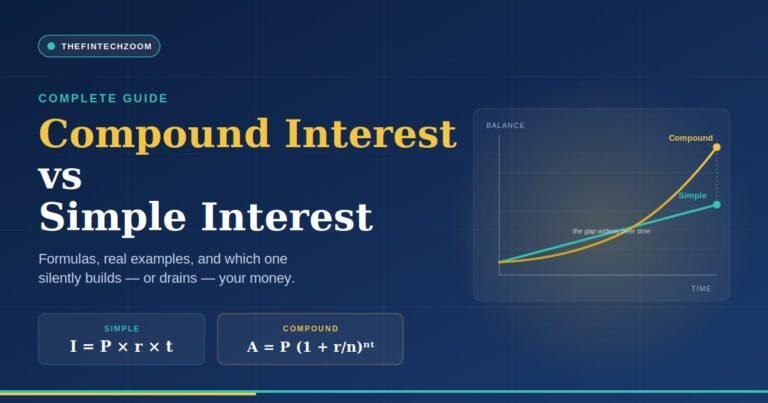
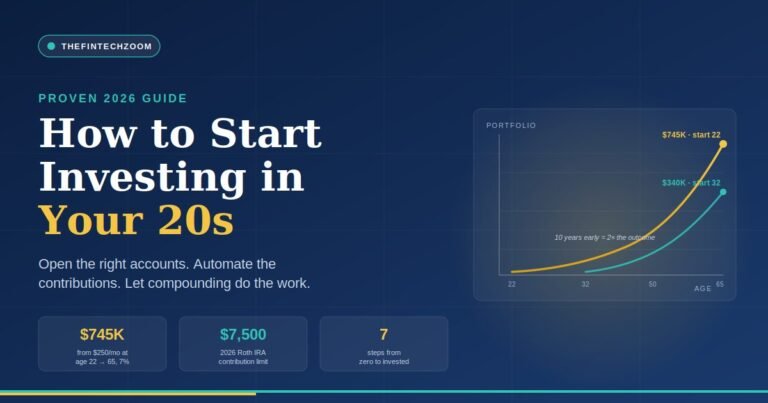
- Time horizon — 10+ years lets compounding do the heavy lifting (this is the entire reason starting to invest in your 20s matters more than picking the perfect fund)
- Fee discipline — keep total costs under 0.20% per year
- Behavior — not selling when markets drop
Fidelity’s 2024 retirement data showed that 401(k) participants who never changed their allocation during downturns ended up with balances roughly 50% higher after 10 years than those who switched to cash during scary periods. Diversification only works if you actually stay invested.
Are robo-advisors or DIY ETFs better for small portfolios?
For balances under $3,000, DIY ETFs through a zero-commission broker like Fidelity or Schwab usually beat robo-advisors on cost. Robo-advisors charge 0.25%–0.40% annually plus underlying ETF fees, while a self-built three-ETF portfolio costs around 0.05% total. Above $10,000, the gap narrows and automation may be worth the fee.
Robo-advisors make sense if you genuinely won’t rebalance, won’t auto-invest, or get anxious managing accounts yourself. Behavioral consistency beats theoretical cost savings. A 0.25% robo-advisor fee that keeps you invested for 30 years beats a 0.05% DIY portfolio you abandon after two bad months.
In my testing, M1 Finance sits in the middle — free to use, automated rebalancing, but you build the “pie” yourself. For DIY-minded beginners who still want automation, it’s a useful middle ground.
What types of assets should a small portfolio include?
A diversified small portfolio should include U.S. stocks, international stocks, and bonds at minimum. Optional additions include U.S. real estate (REITs) and a small cash buffer. Avoid commodities, crypto, and individual stocks until your portfolio exceeds $5,000, since they add volatility without meaningful diversification at small balances.
Quick rationale for each:
- U.S. stocks (50–70%) — long-term growth engine, deepest market in the world
- International stocks (15–30%) — exposure to economies that don’t move identically to the U.S.
- Bonds (10–30%) — cushion during stock market drops, varies by age
- REITs (0–10%) — real estate exposure without buying property
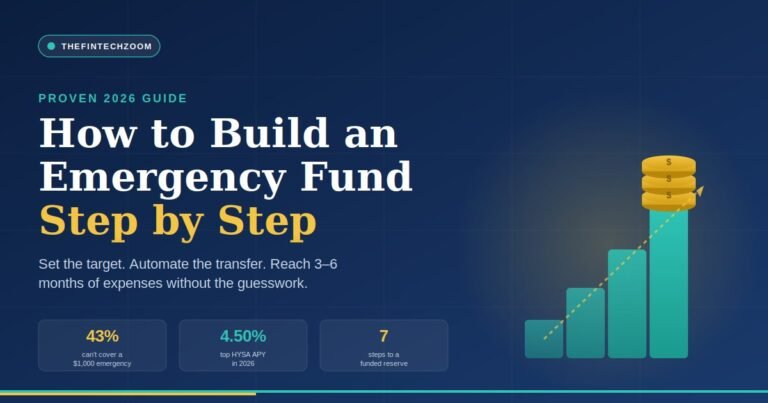
- Cash (3–6 months of expenses, held separately) — your emergency fund built step by step, not part of the portfolio
Crypto deserves a separate note. If you want exposure, treat it like a satellite holding — no more than 1–5% of your portfolio, held in a regulated spot ETF (like IBIT or FBTC) rather than on an exchange. At small balances, the temptation to over-allocate to crypto is the single most common way I’ve watched beginners blow up their progress.
Frequently Asked Questions
Can I really diversify a portfolio with just $50?
Yes. With $50, you can buy fractional shares of two or three broad-market ETFs — for example, $30 of VTI for U.S. stocks and $20 of VXUS for international stocks. That single purchase gives you exposure to over 11,000 companies across 40+ countries. Start small, automate weekly contributions, and the portfolio compounds from there.
How many ETFs do I need for a diversified portfolio?
Two to four ETFs is enough for most beginners. A common structure is one total U.S. stock fund, one total international stock fund, and one total bond fund. Adding a REIT fund makes four. Beyond that, additional ETFs usually overlap with what you already own and add complexity without improving diversification.
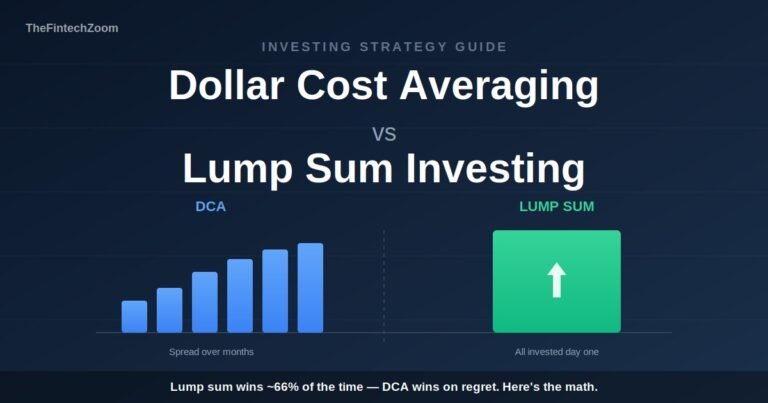
Is dollar-cost averaging better than investing a lump sum?
For someone with little money, dollar-cost averaging happens automatically because you’re investing whatever you earn each pay period. Research from Vanguard shows lump-sum investing beats dollar-cost averaging about two-thirds of the time historically, but the difference is modest — we break down both sides in our full dollar cost averaging vs lump sum guide. For small monthly contributors, consistency matters far more than the choice itself.
Should I include crypto in a small diversified portfolio?
Crypto is optional and should be limited to 1–5% of a portfolio at most. It’s highly volatile and doesn’t behave like a traditional asset. If you include it, use a regulated spot Bitcoin or Ethereum ETF rather than holding coins on an exchange. Beginners with under $1,000 are usually better off skipping crypto entirely until the base portfolio is established.
How often should I rebalance a small portfolio?
Once a year is enough for portfolios under $10,000. Annual rebalancing keeps your allocation aligned without triggering unnecessary taxes or transaction-related friction. Alternatively, direct new contributions toward whichever asset class is currently underweight — this rebalances passively without selling anything.
Are target-date funds a good choice for beginners?
Yes, especially in 401(k) and IRA accounts. A target-date fund holds a fully diversified mix of stocks and bonds that gradually shifts more conservative as the target year approaches. It’s a one-fund solution. The main drawback is fees — some run higher than 0.50%, so check the expense ratio before buying. Funds from Vanguard, Fidelity, and Schwab typically cost under 0.15%.
What’s the biggest risk of diversifying with little money?
The biggest risk isn’t market loss — it’s quitting. Small portfolios feel slow because the dollar gains look tiny in the first year. Many beginners stop contributing after six months when they don’t see life-changing growth. The math only works over 5+ years. Set realistic expectations: this is a wealth-building system, not a get-rich scheme.
Can I diversify inside a Roth IRA with little money?
Yes, and a Roth IRA is one of the best places to do it. Most major brokerages allow Roth IRAs with $0 minimums, and you can fund them with as little as $25 at a time. The same three-ETF approach works inside a Roth, with the added benefit of tax-free growth and tax-free withdrawals in retirement.
Final thoughts and your next step
Diversifying a portfolio with little money is a solved problem in 2026 — the tools exist, the costs are near zero, and the math is straightforward. What stops most people isn’t access. It’s overthinking the first move.
The summary in one paragraph: open a zero-fee brokerage account, pick two or three broad-market ETFs covering U.S. stocks, international stocks, and bonds, set up an automatic weekly contribution of whatever you can afford, and don’t touch it. Rebalance once a year. That’s the entire system.
Your next step today: pick one platform (Fidelity, Schwab, or M1 Finance), open the account, and schedule your first $25 auto-invest. Don’t research a fourth fund. Don’t wait for a “better time” in the market. The portfolios that compound into real wealth are the ones that get started.
For a deeper breakdown of how the three-fund approach performs across different market cycles, our growth vs. value stocks guide and Russell 2000 vs. S&P 500 comparison cover the next layer of detail once your starter portfolio is up and running.
TheFintechZoom is an independent finance education site. We don’t sell investment products, take affiliate commissions from brokerages mentioned in this article, or accept paid placements in our editorial content. The information here is educational and not personalized financial advice — for decisions involving your specific situation, consult a fiduciary financial advisor.
Ready to take the next step? Our expert guidance is here to support your journey forward.