If you have $50,000 sitting in a savings account and the stock market is near all-time highs, what do you actually do? Invest it all today, or spread it over twelve months to feel safer? That single decision can mean tens of thousands of dollars over a lifetime — and most blogs answer it badly.
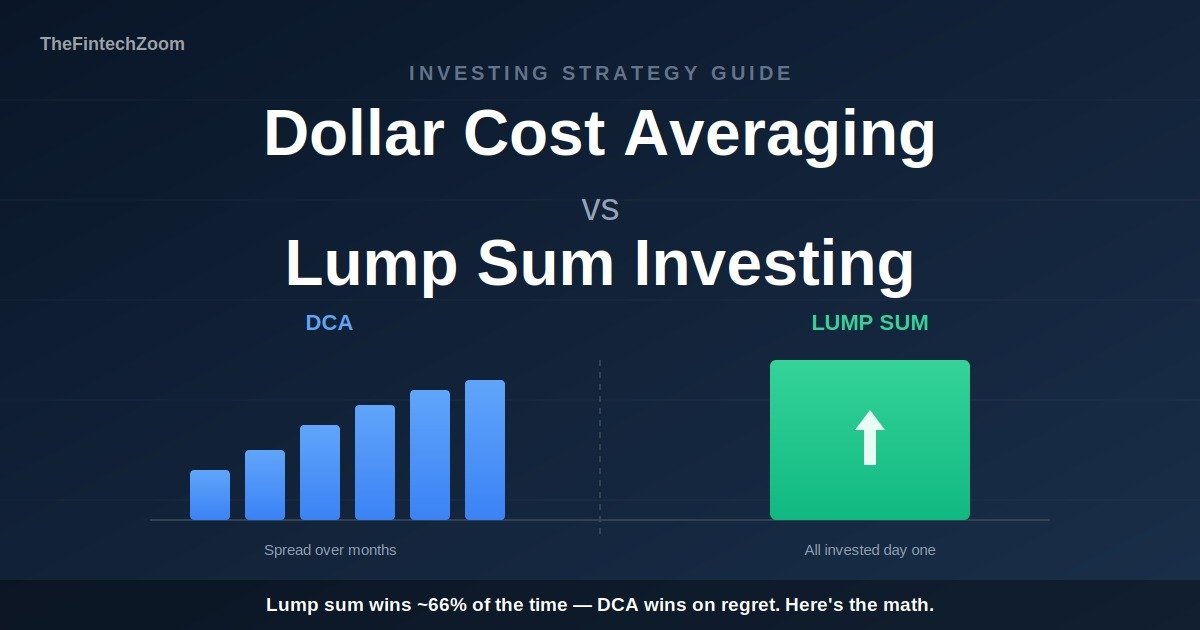
Here is the honest version. Lump sum investing wins about two-thirds of the time historically. Dollar cost averaging wins on regret, not on returns. This guide breaks down the math, the Vanguard data, when each strategy actually makes sense, and the mistakes I see investors make every week. No fluff, no hedging — just what the evidence says.
What Is Dollar Cost Averaging vs Lump Sum Investing?
Dollar cost averaging (DCA) means investing a fixed amount at fixed intervals — for example, $5,000 every month for ten months. Lump sum investing (LS) means deploying the entire amount immediately. The two strategies answer the same question differently: when you already have the cash, how fast should it enter the market?
DCA is often confused with regular paycheck investing. They are not the same. If you invest 10% of every paycheck into an index fund, you are not “DCA-ing” — you are simply investing money as you earn it. True DCA is a choice to hold cash you already have and feed it into the market gradually.
That distinction matters because the entire debate only applies when you have a lump sum on hand: a bonus, a tax refund, a 401(k) rollover, an inheritance, the sale of a property, or a maturing CD. The question is whether to delay deployment, and what that delay actually costs you.
Which Strategy Actually Wins Over Time?
Lump sum investing beats dollar cost averaging roughly two-thirds of the time across major markets. Vanguard’s landmark research analyzed rolling 10-year periods in the US, UK, and Australia and found lump sum outperformed DCA in about 66% of cases, with an average advantage of around 2.3% in the first year alone. The reason is simple: markets trend up more often than down, so cash on the sidelines is cash missing growth.
The intuition most people have — “I’ll wait for a dip” — runs straight into a structural fact about equity markets. The S&P 500 has finished higher in roughly 73% of calendar years since 1928. Bond markets and broad global equity indexes show similar (if weaker) upward bias. When you DCA, you are effectively betting against that base rate.
The Math Behind the Result
Here is a simplified example I use when explaining this to first-time investors. Imagine you have $120,000 to deploy on January 1.
- Lump sum path: Invest all $120,000 on day one. If the market rises 10% that year, you finish with $132,000.
- DCA path: Invest $10,000 per month for 12 months. On average, your money is only in the market for six months, so you capture roughly half the year’s return — about $6,000 in gains on the deployed average, finishing closer to $126,000.
That $6,000 gap is the opportunity cost of holding cash. In a flat year the gap shrinks. In a falling year, DCA wins. But across most rolling periods, the upward drift of markets — combined with how compound interest builds wealth over decades — means lump sum pulls ahead.
The Comparison at a Glance
| Factor | Lump Sum Investing | Dollar Cost Averaging |
|---|---|---|
| Average return (historical) | Higher (~2.3% advantage in year one) | Lower |
| Win rate over 10 years | ~66% | ~34% |
| Time horizon required | Long (5+ years ideal) | Any |
| Emotional difficulty | High — feels risky | Low — feels safer |
| Best for | Confident long-term investors | Nervous or first-time investors |
| Worst case | Buying right before a crash | Missing a strong bull run |
| Cash drag | None | Yes — money sits in cash earning less |
| Behavioral risk | Panic selling after a drop | Pausing contributions in a downturn |
The table makes the tradeoff explicit. Lump sum is the higher-expected-value choice. DCA is the lower-variance choice. Which one is “right” depends entirely on whether you can stomach watching a 20% drawdown without selling.
How Do You Decide Between DCA and Lump Sum?
Use this five-step framework. It removes most of the guesswork by forcing you to be honest about your timeline, your emotions, and the size of the money relative to your overall portfolio. I have walked through this with friends sitting on five-figure bonuses, and it usually settles the decision in under twenty minutes.
Step 1: Define Your Time Horizon
Anything under three years is not “investing” — it is short-term saving. If you need this money within three years, neither DCA nor lump sum into equities is appropriate. Use a high-yield savings account or Treasury bills. The DCA vs LS debate only meaningfully applies to money you can leave alone for five years or more.
Step 2: Measure the Cash Against Your Net Worth
If the lump sum is less than 10% of your investable net worth, just deploy it. The behavioral risk is tiny because the amount cannot meaningfully blow up your plan. If it is 25% or more of your net worth — say, a $200,000 inheritance for someone with $500,000 already invested — the psychological stakes are different, and DCA becomes a defensible behavioral hedge.
Step 3: Stress-Test Your Reaction
Ask yourself one question: if I invest this lump sum today and the market drops 30% in the next six months, will I sell? If the honest answer is yes, you cannot lump sum. The worst outcome is not DCA underperforming — it is panic-selling at the bottom and locking in losses. DCA’s real value is keeping you in the market by lowering the emotional cost of entry.
Step 4: Set a Maximum DCA Window
If you choose DCA, cap it at 6 to 12 months. Vanguard’s data shows that longer DCA windows make the cash drag worse without meaningfully reducing volatility risk. A 24-month DCA plan is not a strategy — it is procrastination dressed up as discipline.
Step 5: Automate and Forget
Whichever path you pick, automate it. Set up the lump sum transfer for tomorrow morning, or set up automatic monthly buys for the DCA window. Manual investing creates room for second-guessing, and second-guessing is where most investors lose money — not in the strategy itself, but in deviating from it under stress.
When Does Dollar Cost Averaging Actually Beat Lump Sum?
DCA outperforms lump sum in three specific situations: when markets are flat or falling during the deployment window, when valuations are historically extreme, and when the investor’s psychological capacity to hold through a drawdown is genuinely low. Outside these cases, lump sum wins on math.
The first case is straightforward. If the S&P 500 falls 15% over the next six months, a DCA investor buys progressively cheaper shares while the lump sum investor sits on an unrealized loss. The 2008 financial crisis and the early-2022 drawdown are real examples where DCA beat lump sum on rolling 12-month windows.
The Valuation Question
The second case — extreme valuations — is more controversial. Some advisors argue that when the Shiller CAPE ratio is in the top decile of its historical range (above ~35), the case for DCA strengthens because forward returns tend to be lower and drawdown risk higher. This is supported by research from Robert Shiller and others, but it has not been a reliable timing signal. Markets stayed expensive for years in the late 1990s and again from 2017 onward.
The honest takeaway: valuations matter for long-term expected returns, not for one-year timing. Do not use CAPE to decide whether to lump sum today.
The Behavioral Case
The third case is the strongest argument for DCA, and it has nothing to do with returns. If splitting the deployment is the only way you will actually invest the money — instead of leaving it in a checking account for two years debating — then DCA is correct for you. A worse expected return that gets executed beats a better expected return that never happens.
I have seen this pattern repeatedly with readers who inherited money. The lump sum was the “right” answer mathematically, but they could not pull the trigger. DCA broke the paralysis. That counts for something even if the academic finance community shrugs at it.
What Are the Biggest Mistakes Investors Make?
Most DCA vs lump sum mistakes are not about picking the wrong strategy — they are about executing either strategy badly. These are the five I see most often, in roughly the order they cost investors money.
Mistake 1: Calling Paycheck Investing “DCA”
If you are investing your monthly paycheck into a 401(k) or index fund, you are not doing DCA versus lump sum — you are doing the only thing you can do, which is invest as money arrives. There is no lump sum alternative for income you have not earned yet. Stop framing it as a strategy choice and just keep contributing — this is the exact pattern we recommend in our guide on how to start investing in your 20s.
Mistake 2: Stretching DCA Beyond 12 Months
A 24-month or 36-month DCA plan is almost always worse than a 6-month plan. The longer your money sits in cash, the more growth you forfeit, and the academic research on this is unambiguous. If you genuinely cannot deploy a lump sum within a year, the real problem is risk tolerance, not strategy — and you may belong in a more conservative portfolio overall.
Mistake 3: Stopping DCA During a Drawdown
This is the dark mirror of lump sum panic-selling. Investors set up a 12-month DCA plan, the market drops 20% in month three, and they pause contributions “until things stabilize.” That is exactly when DCA is doing its job — buying cheaper shares. Stopping mid-plan turns DCA into market timing, which is the worst of both worlds.
Mistake 4: Ignoring Taxes and Account Type
In a taxable brokerage account, lump sum vs DCA has tax implications most investors miss. Each DCA purchase creates a separate cost basis, which complicates tax-loss harvesting and rebalancing. In a tax-advantaged account (IRA, 401(k), Roth), this matters less. If you are deploying a large lump sum in a taxable account, talk to a tax professional before splitting it across many small purchases.
Mistake 5: Confusing DCA with Diversification
DCA reduces timing risk. It does not reduce asset risk. If you DCA $100,000 into a single stock over twelve months, you still own a single stock at the end. Drip-feeding a concentrated position does not make it diversified — for the actual asset-level fix, see our guide on how to diversify a portfolio with little money. The strategy is about when you invest, not what you invest in — and the “what” matters far more for long-term outcomes.
A Real Example: The $100,000 Decision
Consider an investor I will call Maya — a composite based on common reader situations. In early 2023, Maya inherited $100,000. She was 34, had $40,000 already in a Roth IRA, no debt, and a 25-year time horizon. She froze for four months trying to decide between DCA and lump sum.
Had she lump-summed into a total US stock market index fund on the day she received the inheritance, she would have caught most of 2023’s roughly 26% S&P 500 gain. Had she done a 12-month DCA, she would have captured roughly half of that. The difference in her first year was approximately $13,000 in foregone gains — more than her annual Roth IRA contribution limit.
The lesson is not that DCA was wrong in principle. The lesson is that her four-month paralysis cost her more than either strategy ever could. Indecision is itself a decision — and usually the most expensive one.
Dollar Cost Averaging vs Lump Sum: Frequently Asked Questions
Is dollar cost averaging or lump sum better for beginners?
Lump sum is mathematically better, but DCA is psychologically easier — and for beginners, psychology usually wins. If you are investing for the first time and watching markets daily, DCA over 6 to 12 months reduces the chance you will panic-sell after an early drop. As confidence grows, switch to lump sum for future windfalls.
Does DCA work in a bear market?
Yes — bear markets are exactly where DCA outperforms lump sum. By spreading purchases across falling prices, DCA lowers your average cost basis. This is the one scenario where the math actively favors DCA. The catch: nobody knows in advance whether the next six months are a bear market or a continuation rally, so you cannot reliably time it.
How long should a DCA window be?
Cap your DCA window at 6 to 12 months. Vanguard and Morningstar research both show that windows longer than a year increase cash drag without meaningfully improving downside protection. A six-month DCA balances behavioral comfort with the historical reality that delaying deployment usually costs returns over longer periods.
What about DCA into Bitcoin or volatile assets?
DCA has a stronger case for highly volatile assets like Bitcoin because single-day price swings can exceed 10%. Spreading purchases reduces the regret risk of buying at a local top. However, the underlying asset volatility does not disappear — DCA into Bitcoin still leaves you holding Bitcoin. Size the position accordingly.
Should I lump sum into the market at all-time highs?
Historically, yes. Research from JPMorgan and others shows that investing at all-time highs has produced returns very similar to investing on average days, because markets spend a lot of time at or near new highs during bull runs. “Waiting for a dip” sounds prudent but has cost investors significantly more than it has saved over multi-decade periods.
Does DCA reduce risk?
DCA reduces timing risk — the chance you invest right before a crash. It does not reduce market risk, asset risk, or inflation risk. Once your money is fully deployed, you face exactly the same risks as a lump sum investor. Calling DCA a “lower risk” strategy is misleading; it is a lower-regret strategy, which is not the same thing.
Can I combine DCA and lump sum?
Yes, and it is often the most practical answer. Deploy 50% as a lump sum today, then DCA the remaining 50% over six months. This captures most of the expected-return advantage of lump sum while keeping a behavioral cushion. It is the approach I most often suggest to readers who are genuinely torn between the two.
Is DCA the same as investing my paycheck monthly?
No. Investing your paycheck monthly is periodic investing of new income — you have no choice, because the money does not exist until you earn it. True DCA means choosing to hold a lump sum in cash and feed it into the market gradually. Conflating the two is one of the most common errors in personal finance writing.
The Bottom Line
Lump sum investing wins on math about two-thirds of the time, with an average return advantage of roughly 2.3% in the first year. Dollar cost averaging wins on behavior — it makes it easier to actually invest money you might otherwise leave sitting in cash. Neither is universally “right.”
If your time horizon is over five years, the cash is less than a quarter of your net worth, and you can honestly hold through a 30% drawdown without selling, lump sum is the better default. If any of those conditions fail, a 6-to-12-month DCA window is a defensible behavioral hedge — but stretch it longer than that and you are paying real money for diminishing emotional returns.
The biggest mistake is not picking the “wrong” strategy. The biggest mistake is staying in cash for months or years debating which is optimal. The market does not wait for you to feel ready.
Your next step: Open your brokerage app this week, look at the cash you have been sitting on, and decide tonight — lump sum tomorrow, or a six-month automated DCA starting tomorrow. Either is a winning move. Indecision is the only losing one.
TheFintechZoom is an independent finance education site. This article is for informational purposes only and is not personalized investment advice. Consult a licensed financial advisor before making investment decisions.
Ready to take the next step? Our expert guidance is here to support your journey forward.