A stablecoin is a type of cryptocurrency designed to hold a steady price — almost always $1 — by backing each token with real-world reserves like cash and short-term U.S. Treasury bills. Unlike Bitcoin, which swings 5–10% in a normal week, a stablecoin like USDT or USDC should always trade at roughly one dollar.
That sounds boring on purpose. The whole point is to be the calm part of crypto.
I’ve been writing about digital assets since 2020, and stablecoins are the single category readers ask me about most — usually because someone told them it’s “safe” without explaining what that means. This guide breaks down exactly how stablecoins stay pegged, the four main types, where the real risks hide (yes, even in the big ones), and what the GENIUS Act of 2025 changed for U.S. holders. No jargon, no hype.
What is a stablecoin in plain English?
A stablecoin is a digital token that runs on a blockchain but is engineered to keep a stable price by being backed by reserves or controlled by an algorithm. Most are pegged 1-to-1 to the U.S. dollar, meaning one token should always be redeemable for one dollar. That stability is what makes them usable as digital cash.
Think of it like a casino chip. Inside the casino, the chip works as money. You can trade it, spend it, hand it to a friend. But the chip itself isn’t valuable — it’s only worth $1 because the casino agrees to swap it back for $1 whenever you ask.
Stablecoins work the same way. The issuer — a company like Tether or Circle — promises that every token you hold is backed by one dollar (or a dollar’s worth of safe assets) sitting in a bank account. As long as that backing holds and the issuer honors redemptions, the token holds its price.
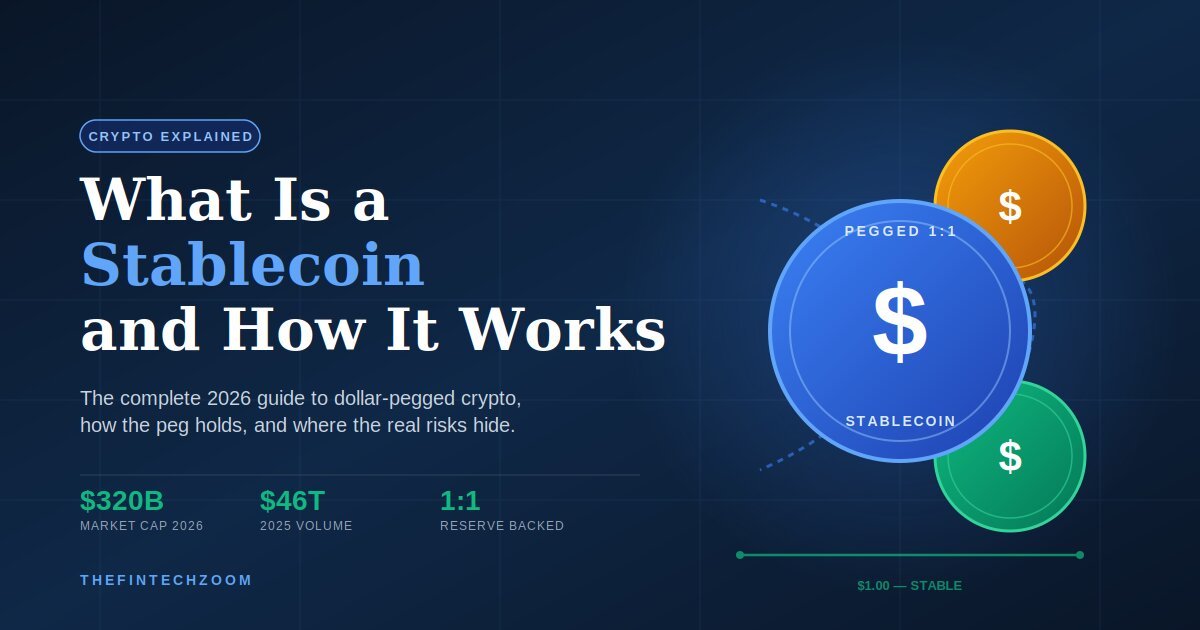
The stablecoin market reached roughly $320 billion in total supply by May 2026, with USDT alone making up about 58% of that. Stablecoins also processed an estimated $46 trillion in transactions during 2025 — more than 20x PayPal’s annual volume and nearly 3x Visa’s, according to industry data.
That scale is the real story. Stablecoins are no longer a crypto-trader tool. They’re becoming part of how money actually moves.
How does a stablecoin actually work, step by step?
A stablecoin works by tying its market price to a reserve of real-world assets and using a mint-and-redeem system to keep supply in balance with demand. When you buy a stablecoin, the issuer creates new tokens backed by dollars you sent in. When you redeem one, the issuer destroys the token and gives the dollars back.
Here’s what actually happens behind the scenes when you buy one USDC:
- You send $1 to Circle (the company that issues USDC), either directly or through an exchange.
- Circle holds that dollar in a regulated U.S. bank account or invests it in short-term Treasury bills.
- Circle “mints” one new USDC token on a blockchain like Ethereum or Solana and sends it to your wallet.
- You can now use that USDC anywhere on-chain — trading, payments, lending, sending to another country.
- When you redeem, Circle takes the USDC back, “burns” it (removes it from circulation), and wires you the dollar.
The peg holds because of arbitrage. If USDC ever drops to $0.98 on an exchange, professional traders buy it cheap, redeem it with Circle for a full $1, and pocket the difference. That buying pressure pushes the price back toward $1 fast. If USDC ever climbs to $1.02, the reverse happens — traders mint new USDC at $1, sell at $1.02, and the supply increase pulls the price back down.
That arbitrage loop is the engine. It only works as long as redemptions actually function and the reserves actually exist. When either of those breaks — and it has broken — the peg breaks with it.
The other piece is the blockchain. Stablecoins live on networks like Ethereum, Tron, Solana, and BNB Chain. Ethereum alone holds about $170 billion in stablecoins, roughly 60% of global supply. Tron holds about $87 billion, and over 97% of that is USDT. Where the token lives matters because it affects transfer speed, fees, and which apps can use it.
What are the main types of stablecoins?
There are four types of stablecoins, separated by what backs them: fiat-collateralized, crypto-collateralized, commodity-backed, and algorithmic. Fiat-backed coins like USDT and USDC dominate the market, while algorithmic stablecoins are the riskiest category — one of them (Terra’s UST) collapsed and wiped out $40 billion in 2022.
Here’s how they compare:
| Type | How It’s Backed | Examples | Stability | Main Risk |
|---|---|---|---|---|
| Fiat-collateralized | Cash + T-bills in a bank | USDT, USDC, PYUSD, RLUSD | Strongest | Issuer fails or freezes redemptions |
| Crypto-collateralized | Over-collateralized with crypto | DAI, sDAI | Strong | Collateral crash forces liquidations |
| Commodity-backed | Gold or other commodities | PAXG, XAUT | Moderate | Commodity price moves; storage risk |
| Algorithmic | Code-driven supply control | Frax (hybrid), former UST | Weakest | Death spirals during sell-offs |
A few notes from sitting with these for a few years:
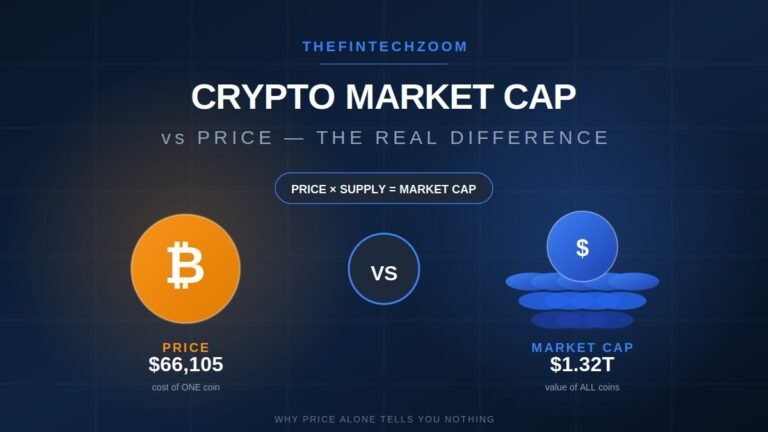
Fiat-backed is the simplest model and the one regulators understand. USDT and USDC together control more than 95% of fiat-backed supply, with USDT at roughly $186 billion and USDC near $75 billion as of mid-2026 — numbers that look very different once you understand the difference between market cap and price. Both publish reserve attestations — USDC is now attested by Deloitte and regulated across more than 20 chains.
Crypto-backed coins like DAI use over-collateralization. To mint $100 of DAI, you have to lock up around $150–$170 of Ethereum or other crypto as collateral. If that collateral drops too low, the system auto-liquidates it to keep DAI solvent. It’s elegant in theory and works well — until a fast crash overwhelms the liquidation system.
Algorithmic stablecoins are the dangerous group. They try to hold their peg purely through code, with no real assets behind them. Terra’s UST collapsed in May 2022 in what’s now a textbook case study: a small sell-off triggered an arbitrage loop that destroyed both UST and its sister token LUNA in less than a week. About $40 billion in value vanished. After that, almost every serious algorithmic project either added real collateral or shut down.
What are stablecoins actually used for?
Stablecoins are used for crypto trading, cross-border payments, savings in unstable currencies, DeFi lending, and increasingly, business settlements. The core appeal is moving dollar value anywhere in the world in minutes, without a bank, at almost zero cost — something traditional finance simply cannot match for international transfers.
The use cases that matter, ranked by how much volume they actually drive:
1. Trading and exchange liquidity. This is still the biggest use. About 75% of all crypto trading volume in Q1 2026 was settled in stablecoins. Traders park funds in USDT or USDC between trades instead of cashing out to fiat.
2. Cross-border payments and remittances. A worker in Dubai can send USDT to family in Karachi in under a minute, for cents in fees, 24/7. Traditional remittance services charge 5–7% and take days. This is why stablecoin adoption in emerging markets has exploded — and why USDT’s supply grew over 9% in the first half of 2025, driven largely by Asia and Africa.
3. Saving in unstable currencies. People in countries hit by high inflation — Argentina, Turkey, Nigeria, Lebanon, parts of Pakistan — use stablecoins as a digital savings account in dollars. They’re not gambling on crypto. They’re escaping a collapsing local currency.
4. DeFi (decentralized finance). Stablecoins are the base layer of lending protocols like Aave, Compound, and Morpho. You can deposit USDC and earn yield, or borrow against crypto without selling it. This is where the “digital dollar” really shows what it can do.
5. Business payments. This is the fastest-growing use in 2026. Stripe, PayPal, Visa, and Mastercard have all built stablecoin rails. Companies are using stablecoins for supplier payments, payroll for international contractors, and B2B settlement. PayPal even launched its own stablecoin, PYUSD, in 2023, and it now operates on Solana for faster settlement.
A real example from earlier this year: a freelancer client of a friend of mine in the Philippines was getting paid in USDC from a U.S. agency. The transfer landed in his wallet in about 12 seconds and cost roughly $0.02 on Base (Coinbase’s Layer-2). A bank wire would have taken 3 business days and lost him 4% to fees and FX spread. Multiply that across millions of freelancers globally and you start to see why this is more than a crypto story.
What are the biggest risks of stablecoins?
The four biggest stablecoin risks are de-pegging, issuer insolvency, regulatory action, and smart contract failure. Stablecoins are not bank accounts and they are not FDIC insured. Even the largest ones have temporarily broken their peg, and at least one major stablecoin — Terra’s UST — collapsed completely and never recovered.
The hard truth is that “stable” describes the design goal, not the guarantee. Three real cases worth knowing:
Terra/UST collapse — May 2022. UST was algorithmic, backed only by code and a sister token (LUNA). When confidence cracked, the peg broke, the algorithm couldn’t restore it, and the entire $40 billion ecosystem unwound in days. Anyone holding UST as “savings” lost almost everything. The lesson: the type of backing matters more than the marketing.
USDC depeg — March 2023. USDC briefly traded as low as $0.87 when Circle disclosed that $3.3 billion of its reserves were held at Silicon Valley Bank, which had just failed. Once the U.S. government guaranteed SVB deposits, USDC restored its peg within a few days. But it showed that even the most reputable, audited stablecoin has banking dependencies that can break the peg overnight.
Tether transparency questions — ongoing. Tether has settled with the New York Attorney General and CFTC over past disclosures about its reserves. The company now publishes attestations and is profitable, but it has never had a full audit by a Big Four accounting firm. For many users, that’s a comfort gap. For others, including most large funds, it’s the reason they prefer USDC.
A few risks people underestimate:
- Issuers can freeze your wallet. USDT and USDC can blacklist addresses at the contract level. Both have done it — usually for sanctioned addresses or hack proceeds, but the capability is real and absolute. A truly decentralized stablecoin (like DAI to a large degree) can’t do this. A centralized one can.
- Smart contract bugs. Even if the stablecoin itself is fine, the DeFi protocol you put it into may not be. Billions have been lost in protocol exploits where the stablecoin was healthy but the platform was hacked.
- Yield is not “interest.” When a platform offers you 8% on USDC, that yield comes from somewhere — usually lending it out. If the borrower defaults or the platform fails, your stablecoin is gone. This is not the same as a savings account.
How did the GENIUS Act change stablecoins in 2025?
The GENIUS Act, signed into U.S. law on July 18, 2025, is the first major federal stablecoin legislation. It requires every payment stablecoin issuer to hold 1-to-1 reserves in cash or short-term Treasuries, undergo regular audits, and operate under federal or state licensing. Implementation rules are being finalized through 2026.
The full name is the Guiding and Establishing National Innovation for U.S. Stablecoins Act. The big things it actually does:
- Mandates 1:1 reserve backing. Every stablecoin in circulation must be matched by one dollar of permitted reserves — cash, insured deposits, or short-dated U.S. Treasury bills. No backing with risky assets, no fractional reserves.
- Requires licensing. Issuers must be either a federally regulated entity (bank, OCC-supervised nonbank) or a state-qualified issuer if under $10 billion in outstanding supply.
- Forces audits for large issuers. Stablecoin issuers exceeding $50 billion in supply must undergo annual audits, raising transparency for USDT and USDC dramatically.
- Guarantees redemption rights. Customers have a clear legal right to redeem stablecoins at face value, with fees disclosed and capped.
- Brings stablecoins under BSA/AML rules. Treasury and FinCEN are issuing rules treating stablecoin issuers as financial institutions for anti-money-laundering and sanctions purposes.
What this means for normal users: stablecoins are moving from a gray-zone product to a licensed, audited financial instrument. That’s good news for safety. It may also mean some smaller stablecoins disappear or get acquired, and that foreign-issued stablecoins (notably USDT) face new restrictions on how they can be sold to U.S. customers.
The EU has its own framework, the Markets in Crypto-Assets (MiCA) regulation, which has been in force since late 2024 and applies similar reserve and disclosure rules across the bloc. Between MiCA and the GENIUS Act, the world’s two biggest economies now have real stablecoin rules — which is a genuinely big shift from where things stood even two years ago.
Common myths and mistakes beginners make
Most stablecoin mistakes come from one belief: that “stable” means “safe like a bank.” It doesn’t. Stablecoins are private digital tokens with real but different risks. Understanding the difference between a fiat-backed coin, a crypto-backed coin, and an algorithmic one prevents almost every serious beginner mistake.
The myths I see most often, with the actual reality:
Myth 1: “Stablecoins are FDIC insured.” No. The reserves a stablecoin issuer holds in a bank may be FDIC insured up to standard limits, but your stablecoin itself is not. If Circle or Tether failed, you’d be an unsecured creditor in a bankruptcy, not a protected depositor.
Myth 2: “All stablecoins are basically the same.” They are not. USDT and UST sounded alike. UST went to zero. Always check what backs a stablecoin before holding more than pocket money.
Myth 3: “If I leave my stablecoins on an exchange, it’s the same as in a wallet.” No. On an exchange, the exchange owns the stablecoin — you have a claim against the exchange. FTX users learned this the hard way. Stablecoins held in your own self-custody wallet are yours; stablecoins on an exchange are an IOU from that exchange.
Myth 4: “Bigger market cap means safer.” Mostly true, but not always. Size brings liquidity and redemption depth, which helps. But it also brings regulatory and banking concentration risk. The USDC depeg in March 2023 happened to the second-largest stablecoin precisely because of bank concentration.
Myth 5: “I should earn yield on my stablecoins.” You can — but every yield has a source. Onshore, regulated yield products are now emerging (especially post-GENIUS Act). Offshore high-yield products often hide leverage, lending, or counterparty risk. If you can’t explain where the yield comes from in one sentence, don’t take it.
The biggest practical mistake: putting life savings into a single stablecoin on a single platform. Even with the safest options, basic diversification — across at least two reputable stablecoins, and between self-custody and a regulated venue — eliminates most of the catastrophic risk.
Frequently asked questions
Is a stablecoin the same as a CBDC?
No. A stablecoin is issued by a private company and runs on a public blockchain. A CBDC (central bank digital currency) is issued directly by a central bank and is a legal liability of the state. The U.S. has not issued a CBDC, and the GENIUS Act explicitly favors private stablecoins over a federal CBDC for retail use.
Can a stablecoin lose its peg permanently?
Yes. Algorithmic stablecoins have lost their peg permanently — Terra’s UST being the clearest case, with about $40 billion in value wiped out in May 2022. Fiat-backed stablecoins like USDT and USDC have briefly de-pegged but recovered. Permanent loss is rare for fully reserved coins, but not impossible if the issuer fails.
Which is the safest stablecoin in 2026?
USDC is generally considered the most transparent and regulator-friendly major stablecoin, with monthly attestations now performed by Deloitte and full compliance with the GENIUS Act and EU’s MiCA. USDT remains the most liquid and widely used, especially in emerging markets, but has less complete audit history. For most beginners, USDC is the safer starting point.
Do stablecoins pay interest?
The stablecoin itself does not pay interest. However, lending platforms, regulated yield products, and DeFi protocols offer yield on deposited stablecoins, typically ranging from 2% to 8% in 2026 depending on risk. Yield is not guaranteed and always involves counterparty risk — it is not equivalent to bank deposit interest.
Are stablecoins legal in the U.S.?
Yes. Stablecoins are legal in the U.S. under the GENIUS Act, signed July 18, 2025, which creates a federal framework for issuance and use. Most major exchanges offer compliant stablecoins like USDC, PYUSD, and RLUSD. Restrictions apply to some foreign-issued stablecoins, and full implementation of the law continues through 2026.
What happens to my stablecoins if the issuer goes bankrupt?
If a stablecoin issuer fails, holders become creditors in the bankruptcy and may recover funds from the reserve assets — but only after legal proceedings, which can take years. The GENIUS Act prioritizes stablecoin holders’ claims, which improves recovery prospects, but does not guarantee a 1:1 return or quick access.
Can I send a stablecoin to a regular bank account?
Not directly. To move a stablecoin to a bank account, you need to convert it to fiat through a regulated exchange or off-ramp service like Coinbase, Kraken, or Binance, then withdraw to your bank. Conversion is usually instant; bank settlement takes anywhere from minutes (via instant payment rails) to a few business days.
The bottom line
A stablecoin is dollar-pegged crypto designed to combine the speed of a blockchain with the price stability of cash. It works through real reserves, mint-and-redeem mechanics, and arbitrage that keeps the price near $1. The fiat-backed model (USDT, USDC) dominates, the crypto-backed model (DAI) has a smaller but durable niche, and the algorithmic model has largely failed.
The risks are real but knowable: issuer trust, banking dependencies, regulatory shifts, and platform risk if you chase yield. The GENIUS Act of 2025 addresses most of the structural issues by mandating 1:1 reserves and audits — a meaningful upgrade in safety for U.S. users.
If you’re starting out, the practical move is simple: pick a regulated, fully reserved stablecoin (USDC is the cleanest entry point for most beginners), use a reputable exchange or self-custody wallet — ideally a cold one for larger amounts, start with an amount you’re willing to test with, and never put money into a yield product you can’t explain in one sentence.
Stablecoins aren’t a get-rich product. They’re infrastructure. Treating them like that — boring, useful, well-understood — is how you actually benefit from them.
For deeper guides on specific stablecoins and how to use them safely, explore our finance education library at TheFintechZoom.