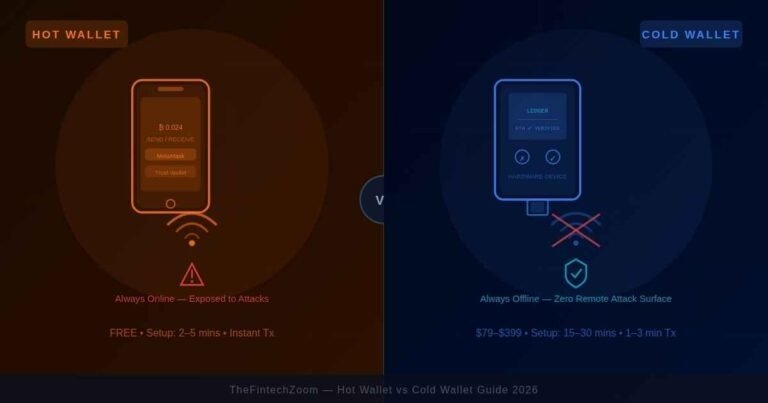
If you hold any crypto, the wallet you choose decides one thing: who actually controls your money. A custodial wallet means a company holds your private keys for you. A non custodial wallet means you hold them yourself. That single difference shapes your security, your recovery options, and what happens if the platform fails.
After testing wallets across both categories since 2019 — and watching FTX users lose around $8 billion in custodial funds overnight — I’ve learned the choice isn’t about which is “better.” It’s about which tradeoffs you can live with.
This guide breaks down how each wallet type works, the real risks of both, a side-by-side comparison, and the exact rules I use to decide where my crypto sits. By the end, you’ll know which option fits your situation and how to avoid the mistakes that cost beginners thousands.
What is the difference between custodial and non custodial wallets?
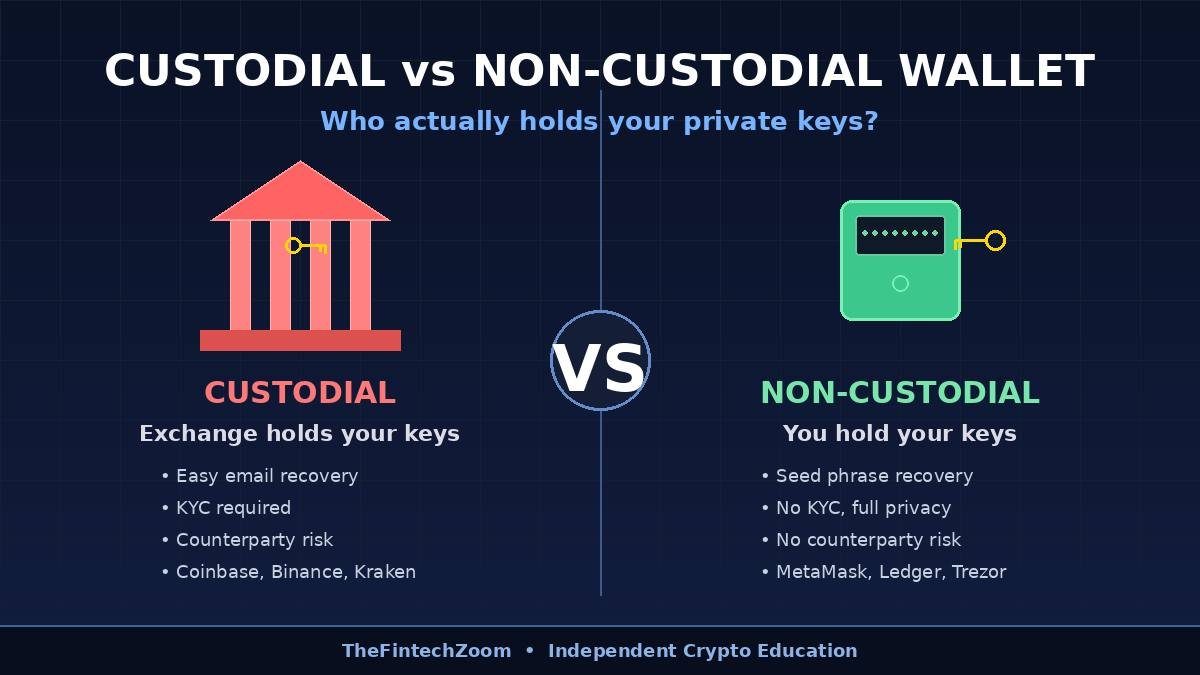
A custodial wallet is a crypto wallet where a third party — usually an exchange like Coinbase or Binance — holds your private keys and controls access to your funds. A non custodial wallet gives you full ownership of your private keys, meaning no company can freeze, lose, or restrict your crypto.
The technical difference comes down to one piece of data: the private key. This is the cryptographic string that proves you own the coins at a specific blockchain address. Whoever holds the private key controls the funds — full stop.
With a custodial wallet, the exchange stores that key on its servers. You log in with a username and password, just like online banking. With a non custodial wallet, the key lives on your device or hardware wallet, and you back it up using a 12 or 24-word seed phrase.
This is what Bitcoin educator Andreas Antonopoulos famously summarized as “not your keys, not your coins.” If you don’t hold the keys, you don’t truly hold the crypto — you hold a claim on it.
How does a custodial wallet actually work?
A custodial wallet works like a traditional bank account: you deposit crypto with a platform, the platform records your balance in its internal database, and you withdraw when needed. The actual coins sit in the company’s wallets — usually a mix of cold storage and hot wallets — not yours.
Here’s the typical flow:
- Sign up with an exchange like Coinbase, Binance, or Kraken using email and ID verification (KYC).
- Buy or deposit crypto through fiat rails or another wallet transfer.
- The platform credits your account balance in its internal ledger.
- The actual coins are pooled with other users’ funds in the exchange’s master wallets.
- Request withdrawals when you want to move funds out, subject to platform limits and approval.
The convenience is real. If you forget your password, customer support can help. If you send to a wrong address inside the same exchange, it can sometimes be reversed. There’s no seed phrase to lose.
But the platform can also freeze your account, delay withdrawals, get hacked, or — as FTX customers discovered in November 2022 — file for bankruptcy with your funds inside. Reuters and Chainalysis reporting put customer losses around $8 billion at collapse, with partial recoveries taking years through court proceedings.
How does a non custodial wallet actually work?
A non custodial wallet generates and stores your private keys directly on your device. When you create the wallet, the software produces a 12-24 word seed phrase that mathematically derives every key and address. You sign every transaction yourself, and no company has access to your funds.
The setup looks like this:
- Download a wallet app (MetaMask, Trust Wallet, Phantom) or buy a hardware wallet (Ledger, Trezor).
- Generate a new wallet — the app creates a seed phrase you must write down.
- Back up the seed phrase offline, on paper or metal — never as a screenshot or cloud file.
- Receive funds by sharing your public address.
- Sign transactions locally; the wallet broadcasts them to the blockchain.
In my testing, the friction is mostly upfront. The first hour with a hardware wallet feels intimidating. But once the seed phrase is backed up properly, daily use is straightforward — and there’s no platform between you and your money.
The catch: if you lose the seed phrase and your device, the funds are gone forever. No support team can recover them. Chainalysis has estimated that roughly 20% of all Bitcoin in existence is lost or stranded, much of it sitting in non custodial wallets whose owners lost access years ago.
Custodial vs non custodial wallet: full side-by-side comparison
Both wallet types secure crypto, but they trade off in opposite directions. Custodial wallets prioritize convenience and recovery; non custodial wallets prioritize ownership and privacy. The table below shows how that plays out across the factors that actually matter when you’re choosing one.
| Factor | Custodial Wallet | Non Custodial Wallet |
|---|---|---|
| Who holds private keys | Exchange / platform | You only |
| Account recovery | Email + password reset | Seed phrase only — no recovery if lost |
| KYC required | Yes (ID verification) | No |
| Best for beginners | Yes — easy onboarding | Steeper learning curve |
| Hack risk | Platform-wide attacks (Mt. Gox, FTX) | Personal device attacks, phishing |
| Counterparty risk | High — platform can fail | None |
| Withdrawal limits | Yes, set by platform | None |
| Transaction speed | Instant internal transfers | Blockchain speed only |
| DeFi / Web3 access | Limited or none | Full access (DEXs, NFTs, staking) |
| Insurance | Sometimes (FDIC covers USD only, not crypto) | None |
| Cost | Trading fees, withdrawal fees | Network gas fees only |
| Examples | Coinbase, Binance, Kraken, Gemini | MetaMask, Ledger, Trezor, Phantom |
The pattern is clear: custodial wallets trade self-sovereignty for convenience. Non custodial wallets do the opposite. There is no third option that gives you both — though as you’ll see below, using both in combination is a common solution.
Which wallet should you actually use?
Use a custodial wallet if you’re new to crypto, trade frequently, or hold small amounts. Use a non custodial wallet if you hold long-term, value privacy, want DeFi access, or have enough crypto that a single platform’s collapse would damage your finances. Most experienced holders use both, in layers.
Here’s the three-tier setup I use after six years in the space:
- Active trading capital → custodial. Anything under a few hundred dollars that I’m actively trading sits on a reputable exchange. The convenience matters more than the theoretical risk at that size.
- Long-term holdings → non custodial, ideally hardware. Anything I’m not touching for 6+ months goes to a Ledger or Trezor — see our full hot wallet vs cold wallet comparison for the right split. The seed phrase is on stamped metal in two physical locations.
- DeFi and on-chain activity → non custodial software wallet. MetaMask or Rabby for Ethereum, Phantom for Solana. Only the amount I’m actively using sits in these — never the full portfolio.
This setup balances day-to-day usability with protection against the catastrophic outcomes — exchange failure, personal hack, or hardware loss — that have wiped out crypto holders in every cycle since 2014.
Common mistakes people make with custodial and non custodial wallets
Most crypto losses don’t come from sophisticated attacks. They come from a small set of avoidable mistakes that repeat across every market cycle. Here are the ones I see most often, drawn from forum threads, recovery requests, and people I’ve personally helped — successfully or unsuccessfully — recover funds.
Mistake 1: Treating an exchange like a savings account. Coinbase is not a bank. Your USDC or BTC balance is not protected the way US dollars are under FDIC. The 2022 collapses of Celsius, Voyager, and FTX showed how fast “your” custodial crypto can become a creditor claim in bankruptcy court.
Mistake 2: Screenshotting the seed phrase. This destroys more wallets than any other single error. Cloud-synced photos get scraped by malware and sold on dark-web markets. Write the phrase on paper first, then move it to metal once you trust the wallet.
Mistake 3: Splitting the seed phrase across digital locations. “Four words in Notes, four in email, four in Telegram” sounds clever and is actually worse than one location. You’ve just multiplied your attack surface across three accounts that can each be breached.
Mistake 4: Trusting “wallet support” DMs. No legitimate non custodial wallet has support agents who DM users on Twitter, Discord, or Telegram. Every single one of those messages is a phishing attempt. MetaMask, Phantom, and Ledger do not have help desks that know your seed phrase.
Mistake 5: Leaving DeFi approvals open indefinitely. When you interact with a smart contract, you often grant unlimited spending approval to that contract. Tools like Revoke.cash let you audit and cancel old approvals — a step almost nobody takes until after they’ve been drained.
Are custodial wallets safer than non custodial wallets?
Neither is universally safer — the risks are different in kind, not degree. Custodial wallets protect you from personal mistakes like losing a seed phrase but expose you to counterparty risk: exchange hacks, frozen accounts, and platform bankruptcy. Non custodial wallets eliminate counterparty risk but make you responsible for every aspect of security.
The historical record is clear about where the largest single losses have come from. Mt. Gox lost roughly 850,000 BTC in 2014 — a custodial failure. FTX lost an estimated $8 billion in customer assets in 2022 — custodial. The Bybit exploit reported in early 2025 ran into the billions — custodial again.
On the non custodial side, losses are more scattered: individual phishing, lost seed phrases, malicious smart contract approvals, and a handful of hardware wallet supply-chain incidents. The aggregate is large, but no single event takes out millions of users at once.
Practically: a custodial wallet is “safer” against your own mistakes; a non custodial wallet is “safer” against systemic platform failure. The right answer depends on which risk category you find more likely in your situation.
Frequently Asked Questions
Can I lose my crypto in a non custodial wallet?
Yes — but only through your own mistakes, not platform failure. If you lose your seed phrase and your device fails, the crypto is permanently inaccessible. Phishing attacks, malicious smart contract approvals, and clipboard malware can also drain funds. The platform itself cannot lose your crypto because no platform holds it.
Is Coinbase a custodial or non custodial wallet?
Coinbase’s main exchange account is custodial — Coinbase holds your keys. However, the separate Coinbase Wallet app (a different product) is non custodial, meaning you control the seed phrase. People often confuse the two. If you use coinbase.com or the standard Coinbase app, that’s custodial. The Coinbase Wallet extension and app are non custodial.
Are hardware wallets always non custodial?
Yes, all major hardware wallets — Ledger, Trezor, Coldcard, BitBox — are non custodial. The private keys are generated and stored inside the device’s secure chip and never leave it. You sign transactions on the device itself. The manufacturer cannot access your funds even if their servers are hacked, because they never had your keys.
Do I need to verify ID for a non custodial wallet?
No, non custodial wallets do not require KYC or identity verification. You can download MetaMask or Trust Wallet and create an address in under two minutes with no email, phone number, or ID. This is one of the core reasons many users prefer non custodial — financial privacy. Custodial exchanges almost always require full KYC.
What happens to my custodial wallet if the exchange shuts down?
You become an unsecured creditor in bankruptcy proceedings, and recovery depends on remaining assets and the court process. FTX users waited over two years before partial repayments began. Some smaller exchange failures have returned little or nothing. This is the core reason long-term holders move significant balances off custodial platforms.
Can I move crypto from a custodial to a non custodial wallet?
Yes, and it’s straightforward. From your exchange account, click withdraw, paste your non custodial wallet’s public address, confirm the network (Ethereum, Bitcoin, Solana, etc.), and send. Always test with a small amount first. Network fees apply, but the transfer usually completes in minutes to an hour depending on the chain.
Which is better for DeFi: custodial or non custodial?
Non custodial wallets are essentially required for DeFi. Protocols like Uniswap, Aave, and Compound need to connect directly to a wallet that can sign smart contract transactions — something custodial accounts cannot do. If you want to swap on decentralized exchanges, provide liquidity, or stake on-chain, you need MetaMask, Rabby, Phantom, or a similar self-custody wallet.
Are non custodial wallets free?
Software non custodial wallets like MetaMask, Trust Wallet, and Phantom are free to download and use. You only pay network gas fees when transacting on-chain. Hardware wallets are paid devices — Ledger and Trezor models typically range from $60 to $250 depending on features. There are no monthly fees or account costs in either case.
The bottom line on custodial vs non custodial wallets
The decision isn’t ideological — it’s practical. Custodial wallets are right for new users, active traders, and small balances where convenience outweighs counterparty risk. Non custodial wallets are right for long-term holdings, larger sums, privacy-focused users, and anyone serious about DeFi or self-sovereignty.
If you’re still figuring out which side you sit on, start here: keep your trading capital on a regulated, reputable exchange. Move anything you plan to hold for more than six months into a non custodial hardware wallet. Back up the seed phrase on metal, not paper, and store it somewhere only you can access.
That single move — getting long-term funds off exchanges — would have prevented the majority of the catastrophic crypto losses of the last decade. Make it this week, not after the next exchange collapse hits headlines.
This guide is published as independent crypto education. TheFintechZoom is not affiliated with any wallet provider or exchange mentioned. Nothing here is financial advice — verify wallet choices against your own security needs and jurisdiction before moving funds.