Search “FintechZoom Asian markets today” and you’ll find a pile of near-identical articles, each frozen on a different date, showing numbers that were true for one afternoon months ago. So here’s the honest starting point. FintechZoom Asian Markets Today is a news section that reports on Asian stock indices like Japan’s Nikkei 225 and Hong Kong’s Hang Seng. It’s not a broker or an exchange, and no static article can show you today’s live prices.
This guide explains what that coverage actually is, where the major Asian markets stood most recently, what moves them, whether the site is safe to trust, and how to get genuinely live data. It’s an independent guide. I’m not affiliated with FintechZoom.
What is FintechZoom Asian Markets Today?
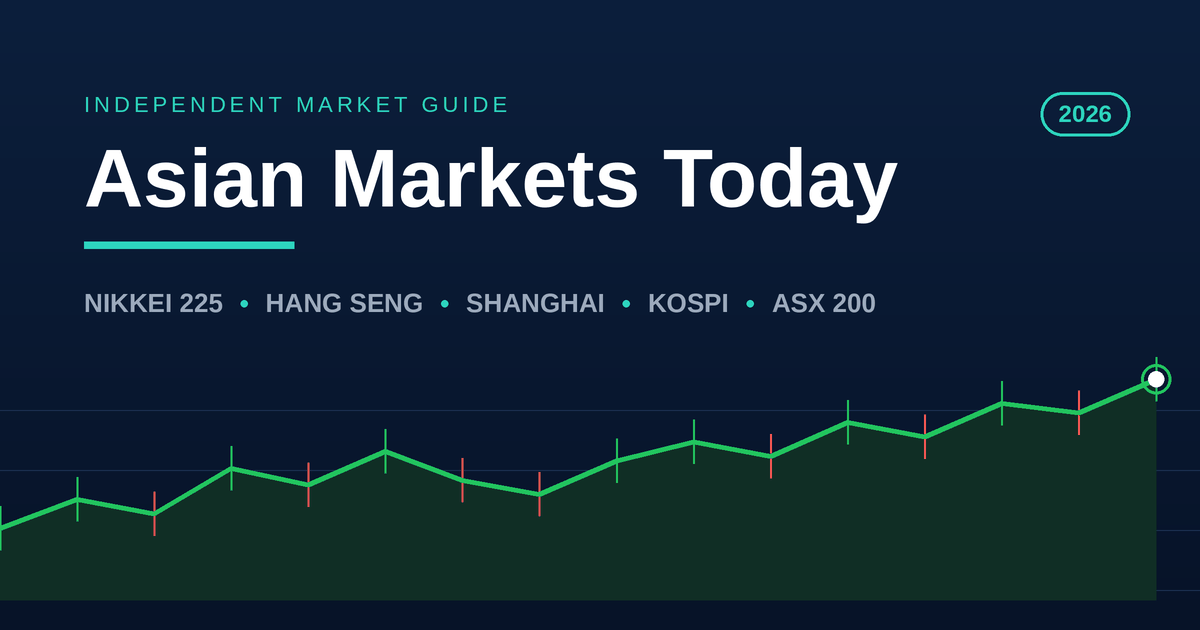
FintechZoom Asian Markets Today is the Asia-Pacific section of FintechZoom, a finance and technology news site. It reports daily moves in indices like the Nikkei 225, Hang Seng, China’s CSI 300, South Korea’s KOSPI, and Australia’s ASX 200. It’s a place to read market news, not a platform to trade. There’s no FintechZoom brokerage or exchange.
The phrase itself trips people up, because “Asian markets” isn’t one thing. It’s a group of separate stock exchanges across different countries and time zones, each with its own index. The main ones you’ll see quoted are Japan (Nikkei 225), Hong Kong (Hang Seng), mainland China (Shanghai Composite and CSI 300), South Korea (KOSPI), Australia (S&P/ASX 200), India (Sensex and Nifty 50), Taiwan (TAIEX), and Singapore (Straits Times).
FintechZoom writes about how those indices moved and why. That’s the whole service here: reporting and commentary. The actual price data comes from market feeds that the site aggregates, the same way many finance blogs do.
One reason “today” matters so much for this topic: Asian markets trade while the US sleeps. They react to the previous Wall Street close and often set the tone for what European and US markets do next. A published article, though, is a snapshot. It freezes on the day it was written, which is exactly why so many “Asian markets today” pages are misleading by the time you read them.
What are Asian markets doing today?
Asian markets change every trading day, so no fixed article can give you live figures. For reference, here’s roughly where the major indices stood in late August 2026. Treat this as an example of how the region trades, not as today’s number, and check a live source for the current level before you act on anything.
| Index | Market | Level (late Aug 2026) |
|---|---|---|
| Nikkei 225 | Japan | ~65,900 |
| Hang Seng | Hong Kong | ~25,900 |
| KOSPI | South Korea | ~6,740 |
| S&P/ASX 200 | Australia | ~9,165 |
| CSI 300 | China | ~4,552 |
Those figures come from market reporting around August 21–24, 2026, including CNBC and regional market coverage. Singapore’s Straits Times sat near 5,664 in the same stretch, and India’s Sensex and Nifty were trading actively as two of the region’s largest markets.
The mood that week was cautious. Most indices were heading for weekly losses as global bond markets stayed under stress and US Treasury yields climbed again. Oil prices pushed to one-month highs on Gulf tensions, which pressured import-dependent economies like Japan and stoked inflation worries across the region.
There were crosscurrents too. South Korea’s KOSPI outperformed at points on improving China demand signals, while Japan’s rate-sensitive tech and property stocks lagged as yields rose. This is normal: on any given day, some Asian markets rise while others fall, because each one trades on its own mix of local and global news.
To see what Asian markets are doing right now, don’t rely on a dated article. Open a live source instead:
- Google or Yahoo Finance for a fast quote on any index (search “Nikkei 225” or “Hang Seng”).
- The official exchange sites, like the Japan Exchange Group (JPX) or Hong Kong Exchanges (HKEX), for authoritative data.
- TradingView or Investing.com for live charts across multiple Asian indices at once.
- Established news outlets like CNBC, Reuters, or Bloomberg for the “why” behind the moves.
What moves Asian markets, and why do they matter?
Asian markets move on a blend of US interest rates, China’s economy, currency shifts, oil prices, and regional politics. They matter because they trade first in the global cycle, reacting to Wall Street’s last close and signaling how the rest of the day may unfold. Weakness in Asia often carries into Europe and the US.
The single biggest external driver is usually the US. When Treasury yields climb or the Federal Reserve signals higher rates, rate-sensitive Asian sectors like technology and real estate tend to fall. When US markets rally, Asia often follows the next morning.
China is the regional anchor. Data on Chinese growth, consumer demand, and government stimulus moves not just mainland indices but also Hong Kong, and export-heavy economies like South Korea and Taiwan that sell heavily into China.
Currencies matter more here than many beginners expect. A weaker Japanese yen tends to lift the Nikkei, because it helps big exporters like Toyota and Sony earn more when they convert overseas sales. A sharp currency swing can move an entire market.
Then there’s oil and geopolitics. Most Asian economies import energy, so rising oil prices squeeze margins and raise inflation. Trade policy, tariffs, and regional tensions can all trigger sharp, fast moves, as they did during the late-August 2026 stretch above.
Regional differences are real, so it helps not to lump the whole continent together. Japan trades on the yen and exporters. China and Hong Kong trade on policy and growth. Korea and Taiwan trade on the global tech and chip cycle. India trades more on domestic demand. One down day in Tokyo tells you little about Mumbai.
Is FintechZoom Asian Markets Today reliable and safe to use?
Treat it as casual reading, not a source of truth. Several website-safety scanners have flagged fintechzoom.com and its lookalike domains with low trust scores, and much of the content reads as AI-generated. Skimming a market recap is fine. It’s not a place to log in, deposit money, or make decisions without confirming the numbers elsewhere.
Here’s what the safety checkers say. ScamAdviser has warned that fintechzoom.com “may be a scam” and urged caution. Gridinsoft gave the domain a very low trust score and flagged heavy AI-generated content. Scam Detector rated a related domain “questionable” and “flagged.” These are automated scores that lean on signals like finance keywords, AI-written text, and shared hosting, so they’re a caution flag rather than a final verdict. But when this many independent checkers agree on a finance site, keep your stakes near zero.
The bigger issue for this topic is staleness dressed up as “today.” Many of these pages, across a swarm of similar domains, publish a single day’s snapshot and leave it up for months. A reader who lands later sees old numbers labeled as current. Even one FintechZoom-branded site admits its price data is only “reliable for orientation and awareness” and tells readers to cross-reference an exchange or broker before acting. That’s the right instinct, and worth following.
The copycat swarm is the other problem. Search the brand and you’ll find fintechzoom.com, fintechzoomdaily.com, finteckzoom.com, fintechzzoom.com, fintechzom.com, and more, each with its own quality and none clearly official. On a money topic, that ambiguity is what scammers exploit.
[AUTHOR — optional: if you’ve genuinely used FintechZoom’s Asian markets page yourself, add one or two honest sentences here about what you found useful or frustrating. Real first-hand experience is the strongest trust signal you can add. Don’t invent it.]
My honest read, after years of reviewing sites like this: a market recap is cheap to copy and quick to go stale, so it’s been copied endlessly and rarely updated. Read it for a feel of the narrative. Confirm every number that matters on a live source.
How can you tell if a FintechZoom site is fake?
The fastest checks are the domain, the date, and what the site wants from you. A safe markets site shows a clear timestamp, never asks for a broker login or deposit, uses one consistent official domain, and publishes real, edited reporting. Copycats usually fail more than one of these.
Before you trust any site using the FintechZoom name, run through this checklist:
- Check the exact domain. Copycats swap a letter or a suffix, like finteckzoom.com or fintechzzoom.com instead of fintechzoom.com. If it doesn’t match exactly, close the tab.
- Find the timestamp. For anything labeled “today,” look for a clear date and time. No date, or an old one, means the numbers can’t be trusted as current.
- Watch for login or deposit prompts. A news site has no reason to ask for your broker password or a payment. That request alone means leave.
- Be wary of paid “signals.” Guaranteed picks and upgrade pressure on a “news” site are traps, not features.
- Judge the writing. Generic, repetitive, keyword-stuffed text that never says anything specific points to mass-produced AI content.
- Scan the domain and check ownership. A ten-second look on ScamAdviser often surfaces warnings, and real publishers say clearly who they are.
If a page fails even one of the first three, don’t give it anything. The domain, the timestamp, and any request for money or logins are what separate useful reading from a costly mistake.
How should you track Asian markets, and what’s better than FintechZoom?
For live data, skip aggregated recaps and go to a real feed. Official exchange sites, Google or Yahoo Finance, TradingView, and Investing.com all show current Asian index levels for free. Use established news outlets for context, and a regulated broker if you actually want to invest.
A sensible workflow looks like this:
- Check a live quote on Google Finance, Yahoo Finance, or an exchange site before trusting any recap’s number.
- Use TradingView or Investing.com to watch several Asian indices and their charts together.
- Read CNBC, Reuters, or Bloomberg for why the markets moved.
- To invest in Asian markets, use a regulated broker, usually through an index fund or ETF rather than buying foreign shares directly.
- Never enter a broker login, card number, or “verification” details into a news or recap site.
Here’s how FintechZoom compares with the tools most people should use:
| Tool | Best for | Data you can trust? | Cost | Watch out for |
|---|---|---|---|---|
| FintechZoom (Asia page) | Casual market recap | Not as a primary source | Free | Copycats, AI content, stale “today” snapshots |
| Exchange sites (JPX, HKEX) | Official index data | Yes, from the source | Free | Less beginner-friendly |
| Yahoo / Google Finance | Quick quotes and charts | Yes | Free | Ad clutter |
| TradingView / Investing.com | Live multi-index charts | Yes, real feeds | Free tier + paid | Feature overload |
| Regulated broker (Fidelity, Schwab) | Investing via Asia ETFs | Yes | Free to open | Use only licensed firms |
| Established news (CNBC, Reuters, Bloomberg) | The “why” behind moves | N/A (news, not a feed) | Mostly free | Opinion isn’t advice |
The takeaway is simple. FintechZoom can be an okay narrative read, but for live numbers and real decisions, it sits at the bottom of this list.
Common mistakes and myths about FintechZoom Asian Markets Today
The biggest mistake is trusting a dated recap as live data. FintechZoom Asian Markets Today is for reading market narrative, not for real-time numbers, trading, or investing. Most of the trouble comes from a few myths these lookalike sites encourage.
Myth: The numbers on the page are today’s live prices. Often they aren’t. Many of these articles freeze on their publish date. Always confirm the current level on a live source.
Myth: You can invest in Asian markets through FintechZoom. You can’t. It’s a news section with no brokerage. To invest, you need a regulated broker, usually via an ETF that tracks an Asian index.
Myth: All the fintechzoom domains are the same trusted company. They’re not. The brand is scattered across many similar domains of varying quality, and scanners flag several of them.
Myth: A daily recap is enough to time trades. One session’s move rarely predicts the next, and Asian indices often diverge from each other. Recaps give context, not a trading edge.
Myth: A “review” or “analysis” there is independent research. A lot of the content reads as AI-generated and search-optimized, not tested or reported.
The practical mistakes to avoid: acting on stale numbers, treating one country’s move as the whole region’s, entering broker credentials near this brand, and mistaking market commentary for personal financial advice.
FintechZoom Asian Markets Today FAQ
Is FintechZoom a legit website?
FintechZoom presents itself as a real finance news site, and its main domain has existed for years. That said, several safety scanners flag it and its copycats with low trust scores, and much of the content looks AI-generated. Read it for casual news only, and never enter money or login details.
What are the main Asian stock market indices?
The major ones are Japan’s Nikkei 225, Hong Kong’s Hang Seng, mainland China’s Shanghai Composite and CSI 300, South Korea’s KOSPI, Australia’s S&P/ASX 200, India’s Sensex and Nifty 50, Taiwan’s TAIEX, and Singapore’s Straits Times. Each tracks a different national market and trades on its own drivers.
Can I get today’s live Asian market prices from FintechZoom?
Not reliably. A published article is a snapshot that freezes on its date, so numbers there may be old. For genuinely live levels, use Google Finance, Yahoo Finance, an official exchange site, TradingView, or Investing.com, all of which update in real time and are free.
Why are Asian markets important for US investors?
Asian markets trade while the US is closed, reacting to the prior Wall Street session and often signaling the day’s tone. Weakness or strength in Asia can carry into European and US trading. They also offer diversification, since they respond to different local drivers than US stocks.
What moves the Nikkei and Hang Seng the most?
The Nikkei 225 moves heavily on the Japanese yen and big exporters; a weaker yen usually lifts it. The Hang Seng moves on China’s economy, policy signals, and global risk sentiment. Both also react to US interest rates and broad shifts in investor appetite for risk.
Is FintechZoom free to use?
Yes, reading the site is free, since it runs on ads and affiliate links rather than subscriptions. But free doesn’t mean accurate or current, and some copycat domains push paid tiers. Free access is never a reason to trust a page with your money or your broker login.
The bottom line on FintechZoom Asian Markets Today
FintechZoom Asian Markets Today is a news recap, not a live data feed and not a broker. It can give you a feel for how Tokyo, Hong Kong, and Seoul traded, but the numbers may be stale, the brand is spread across copycat domains that safety scanners have flagged, and you can’t invest through it. Read it for context. Verify everything that matters.
Your next step is simple. Bookmark one live source (Google Finance or an exchange site), pick one regulated broker if you plan to invest in Asian markets, and treat any login prompt or “premium signals” pitch using this brand as a hard stop. Do that, and you get the narrative without the risk buried in the name.