I’ve watched too many friends buy a coin just because “it’s only $0.0001 — imagine if it hits $1.” That single sentence has lost real people real money. The confusion behind it is simple: most beginners think a coin’s price tells them whether it’s cheap or expensive. It doesn’t.
The crypto market cap vs price difference is the single most useful concept new investors miss. Price tells you the cost of one unit. Market cap tells you what the entire project is worth. They move together, but they answer completely different questions.
This guide breaks it down in plain English: what each number actually means, how to calculate market cap, why a $0.000005 token can be “more expensive” than a $66,000 one, and the mistakes I see beginners repeat every cycle. By the end, you’ll read any coin’s data the way an analyst does.
What’s the Real Difference Between Crypto Market Cap and Price?
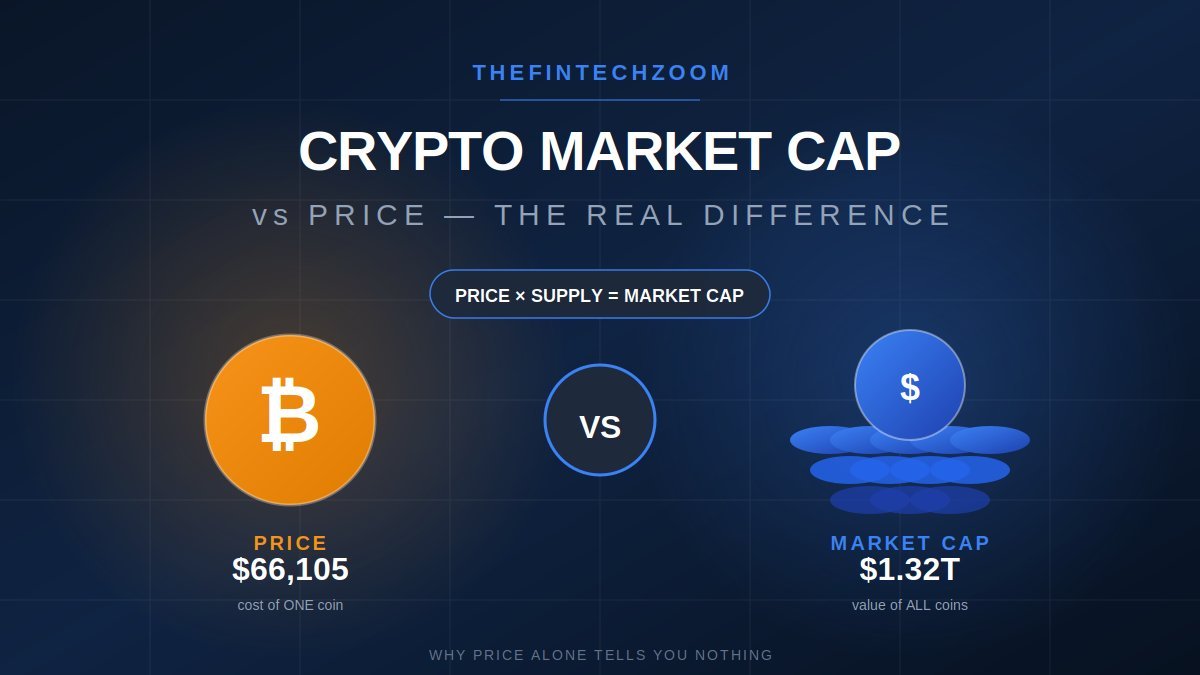
The difference between crypto market cap and price is simple. Price is the cost of one coin right now. Market cap is the total dollar value of every coin currently in circulation. Price reflects a single unit. Market cap reflects the entire project’s market valuation. You cannot judge a coin’s size or risk by price alone — only market cap shows the full picture.
Think of it like comparing companies. Apple’s share price is not the same as Apple’s total worth. A single share might cost $200, but the company is worth trillions because billions of shares exist. Crypto works the same way.
Two coins can have the exact same price but completely different market caps, depending on how many tokens exist. That is why “cheap” and “expensive” mean almost nothing in crypto until you check the supply behind the number.
When I’m screening a new project, I never look at price first. I look at three numbers in this order: market cap, circulating supply, and fully diluted valuation. Price is the last thing I check, because price is mostly a function of the other three. If you flip that order, you’ll keep falling for “low-price equals high-upside” traps that cost portfolios billions every cycle.
The Mental Model That Actually Works
Picture a pizza. The price of a slice tells you nothing about the size of the whole pizza. A massive pizza cut into 1,000 tiny slices will have a cheap slice price but a high total value. A small pizza cut into 4 slices will have an expensive slice price but a low total value. Market cap is the whole pizza. Price is just one slice. You buy the pizza, not the slice.
How Do You Calculate Crypto Market Cap Step by Step?
Crypto market cap is calculated by multiplying a coin’s current price by its circulating supply. The formula is straightforward: Market Cap = Current Price × Circulating Supply. It measures the total market value of all coins currently in circulation. It does not measure the project’s revenue, treasury, or future potential.
Here’s how to do it yourself in under 60 seconds:
- Find the current price. Use a trusted aggregator like CoinGecko or CoinMarketCap, not the price shown inside an exchange order book that may include spread or fees.
- Find the circulating supply. This is the number of coins actually available on the market — not the total minted, and not the maximum that will ever exist.
- Multiply them. That number is the market cap.
- Check the fully diluted valuation (FDV). Multiply the price by the maximum supply. If FDV is far higher than the current market cap, future token unlocks could dilute holders.
- Compare against direct peers. A $500 million project competing with $10 billion leaders is a very different bet than a $50 billion project doing the same thing.
Real example using live data from this week: Bitcoin trades around $66,105 with a circulating supply of about 20.04 million coins, giving it a market cap near $1.32 trillion. The math: $66,105 × 20,043,356 ≈ $1.32T. The same formula applies to every single coin in the market — Bitcoin, Ethereum, Solana, a meme coin you saw on Twitter yesterday. Same equation, every time.
One caveat. Circulating supply is not always honest. Some projects exclude locked team tokens or treasury reserves to make supply look smaller. Always verify whether the supply number you’re using matches what is actually liquid and tradable on the market right now.
Why Can a $0.000005 Coin Be Worth More Than a $66,000 Coin?
A low-priced coin can have a higher project valuation than a high-priced one when its circulating supply is massive. Price per unit does not equal project value — supply does the heavy lifting. A coin at $0.000005 with 589 trillion tokens in circulation is worth billions in market cap, just spread across more units. Unit price is the most misleading number in crypto.
This is where most beginners get burned. Let me show you with real, live numbers pulled this week.
Bitcoin (BTC) trades around $66,105 with about 20.04 million coins in circulation, giving it a market cap near $1.32 trillion.
Shiba Inu (SHIB) trades around $0.000005 with a circulating supply of roughly 589 trillion tokens and a market cap near $2.93 billion.
One BTC could buy you over 13 billion SHIB tokens at current prices. But Bitcoin’s project is over 450 times more valuable than Shiba Inu by market cap. The unit price difference between the two tells you almost nothing useful about which project is “bigger” or “cheaper.”
Here’s a direct comparison that usually clears the confusion instantly:
Live Comparison: Price vs Market Cap (June 2026)
| Metric | Bitcoin (BTC) | Shiba Inu (SHIB) | Dogecoin (DOGE) |
|---|---|---|---|
| Price per coin | ~$66,105 | ~$0.000005 | ~$0.09 |
| Circulating supply | ~20.04 million | ~589 trillion | ~150 billion |
| Market cap | ~$1.32 trillion | ~$2.93 billion | ~$13.5 billion |
| Max supply | 21 million | 589.55 trillion | No cap |
| Market rank | #1 | #29 | #9 |
Look closely at the numbers. SHIB’s price is millions of times smaller than Bitcoin’s, but its market cap is only about 450x smaller. Dogecoin’s price is over 700,000x smaller than Bitcoin’s, but its market cap is only about 100x smaller. The “cheap coin” illusion disappears the moment you account for supply.
Here’s the math that breaks dreams. For Shiba Inu to reach just $0.01 per token, its market cap would need to hit roughly $5.8 trillion — about double the entire global crypto market’s all-time peak. That is not a price prediction. That is basic multiplication. Once you internalize this, you stop chasing fractions-of-a-penny coins as lottery tickets.
What This Means for Your Decisions
When someone tells you a coin is “the next Bitcoin because it’s only $0.0001,” ask one question: what would its market cap have to be at $1? If the answer is larger than the entire crypto market, you have your reality check. This single habit will filter out most retail-bait projects before they touch your wallet.
What Mistakes Do Beginners Make With Market Cap vs Price?
Beginners consistently confuse low price with cheap value, ignore supply schedules, and chase “the next Bitcoin” by hunting for fractions of a penny. The truth is harder: price alone is meaningless without context. Smart investors evaluate market cap, circulating supply, fully diluted valuation, and project fundamentals together — never one number in isolation.
Here are the most expensive mistakes I see traders repeat every single cycle:
Mistake 1: Believing a Low-Priced Coin Has More “Room to Grow”
A coin at $0.0001 does not have more upside than one at $100. Upside depends on whether the project’s market cap can realistically grow — not whether the unit price looks small. A $50 billion project doubling to $100 billion is the exact same percentage return as a $0.0001 coin doubling to $0.0002. The math doesn’t care which one feels cheaper.
Mistake 2: Ignoring Circulating Supply Entirely
Two coins both priced at $1 can have wildly different valuations. One with 10 million tokens has a $10 million market cap. One with 100 billion tokens has a $100 billion market cap. They are not comparable investments, no matter how similar the price tag looks on a chart.
Mistake 3: Confusing Market Cap With Money Invested
Market cap is not the amount of capital flowing into a project. It’s a paper valuation calculated from the last traded price. If 1% of holders try to sell at once, the realized value collapses far below the listed cap. Market cap is a snapshot, not a bank balance — and definitely not a guarantee anyone can actually exit at that valuation.
Mistake 4: Forgetting Fully Diluted Valuation
A coin with a $500 million circulating market cap might have $5 billion in tokens locked and scheduled to unlock over the next 24 months. When those unlock, supply rises and price almost always falls under the pressure. Always check FDV before committing capital to any project under two years old.
Mistake 5: Using Market Cap as the Only Filter
A high market cap means an established project. It does not guarantee survival, utility, or returns. TTokens have lost 80–90% from large-cap status before — Terra Luna (a failed algorithmic stablecoin), FTT, and dozens of others. Market cap is a starting filter, not a verdict on quality.
Mistake 6: Comparing Crypto Market Cap to Stock Market Cap Directly
Stocks have audited share counts, regulated disclosures, and verifiable earnings. Crypto market cap can include locked tokens, exclude lost coins (Bitcoin’s anonymous creator alone is estimated to hold over 1 million BTC, untouched since 2010), and ignore liquidity reality. The number is useful but should never be trusted blindly against traditional finance metrics.
Mistake 7: Trusting Market Cap on Low-Liquidity Coins
If a coin has $50 million in market cap but only $200,000 in daily trading volume, that “cap” is a fantasy. A single seller can collapse the price 50% in minutes. Always pair market cap with the 24-hour volume figure. A healthy ratio is at least 5–10% volume-to-cap. Below 1% is a warning sign.
Frequently Asked Questions
Is market cap more important than price in crypto?
Yes, market cap is more important than price for evaluating a cryptocurrency’s size, stability, and growth potential. Price alone tells you nothing without supply context. A coin worth $0.01 with 100 billion tokens is a $1 billion project — bigger than many “expensive” coins. Always lead with market cap, then use price for entry timing.
What does it mean when a crypto has a low price but high market cap?
A low price with high market cap means the project has an enormous circulating supply. Shiba Inu is the textbook example: each token costs a fraction of a cent, but with hundreds of trillions in circulation, the total project is worth billions. The low unit price reflects supply mathematics, not weakness, undervaluation, or hidden upside.
Can a cryptocurrency’s market cap be manipulated?
Yes, market cap can be misleading because it’s calculated from the last traded price multiplied by reported circulating supply. Low-liquidity coins can show inflated caps based on tiny trade volumes. Projects can also exclude locked or team-held tokens to make supply look smaller. Always check 24-hour volume and supply transparency before trusting the number.
What is fully diluted market cap and why does it matter?
Fully diluted market cap (FDV) shows what a project would be worth if every possible token were already in circulation. It matters because future token unlocks dilute existing holders. If FDV is 10x the current market cap, expect significant supply pressure ahead. Compare both numbers before investing in any project under three years old.
Does a higher market cap mean a safer investment?
Higher market cap generally means more liquidity, broader adoption, and lower volatility — but not safety. Even Bitcoin, the largest cap, has dropped over 70% in past cycles. Large caps reduce certain risks like rug pulls and illiquidity, but market and project risks always remain. Market cap is one signal, never a complete safety guarantee.
Why does Bitcoin dominate the total crypto market cap?
Bitcoin dominance currently sits around 56% of the total cryptocurrency market cap, which today stands near $2.34 trillion. This dominance comes from Bitcoin’s longest track record, highest institutional adoption through spot ETFs, and most liquid markets globally. Dominance shifts over cycles — when altcoins rally hard, Bitcoin’s share temporarily falls before usually recovering.
How do I find the real circulating supply of a coin?
Check multiple sources side by side: CoinGecko, CoinMarketCap, and the project’s official documentation. Cross-reference with on-chain data through block explorers like Etherscan for ERC-20 tokens or Solscan for Solana tokens. Be skeptical when supply numbers differ across sources by more than a few percent — that gap usually hides locked or undisclosed tokens.
Can a coin’s price go up while its market cap goes down?
Technically yes, but it’s rare and almost always tied to token burns. If a project burns enough supply, price per token can rise while total market cap shrinks because fewer tokens exist overall. Outside of deliberate burns, price and market cap move in the same direction since circulating supply changes slowly day-to-day — new coins enter the network gradually through mining or staking rewards.
The Bottom Line
Price is what you pay. Market cap is what you’re actually buying into. Every successful crypto investor I know reads market cap first, supply second, and price last — because price without those two is just a number on a screen that means nothing.
Your action step for today: pick any three coins on your watchlist. Write down their current price, circulating supply, market cap, and fully diluted valuation side by side in a notes app. The picture you see will look completely different from the one your eyes give you when you only stare at price.
Build this habit on five coins, then ten, then every project you touch. Within a month, you’ll catch yourself ignoring price-based hype on Twitter that used to feel exciting. That is the moment you start investing like an analyst instead of a tourist.
If you found this useful, read our breakdown of growth vs value stocks and our Bitcoin halving guide next — both apply the same valuation discipline to different markets.
About TheFintechZoom: We’re an independent finance education site. We don’t sell coins, run an exchange, or take affiliate money from token issuers. Our job is to make the math behind finance and crypto readable for people who weren’t taught it in school. No hype. No price predictions. Just the numbers that matter.