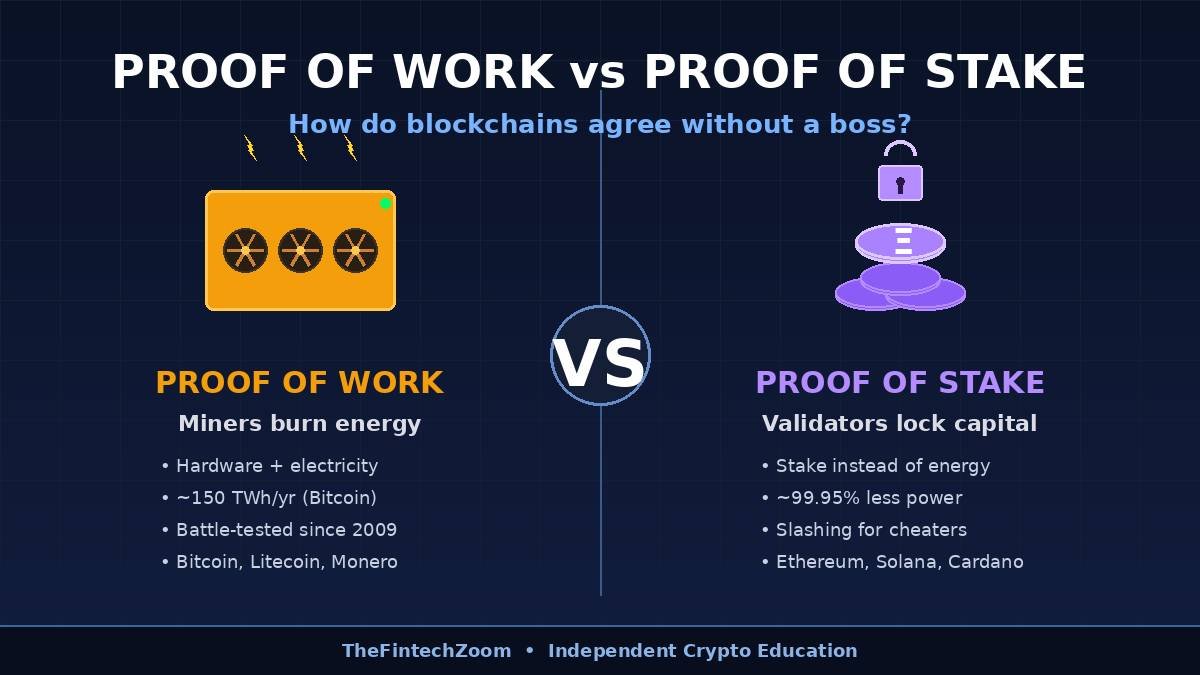
If you’ve ever wondered why Bitcoin burns through more electricity than a mid-sized country while Ethereum barely uses any, the answer comes down to one design choice: proof of work vs proof of stake. These are the two main consensus mechanisms that keep blockchains running without a central authority.
I’ve been writing about and using both since 2018 — through Ethereum’s transition from proof of work to proof of stake in September 2022 (called “The Merge”), through the 2021 China mining ban, and through every “Bitcoin will fail because of energy” headline since. The actual differences are simpler than most articles make them sound.
This guide explains how each mechanism works in plain language, the real tradeoffs around energy, security, and decentralization, and which one is winning in 2026. By the end, you’ll understand what’s happening under the hood when you send a transaction — and why the choice matters for the future of crypto.
What is the difference between proof of work and proof of stake?
Proof of work (PoW) is a consensus mechanism where computers compete to solve hard math puzzles, and the winner adds the next block to the blockchain. Proof of stake (PoS) replaces that race with a lottery — validators lock up cryptocurrency as collateral, and the network randomly picks one to add each block.
Both systems exist to solve the same problem: how do thousands of strangers running independent computers agree on the same version of a shared ledger, with no boss in charge? PoW solves it with electricity and hardware. PoS solves it with money put at risk.
Bitcoin still uses proof of work and probably always will. Ethereum used proof of work from 2015 until September 15, 2022, when it switched to proof of stake. Most newer blockchains — Solana, Cardano, Avalanche, BNB Chain, Polkadot — launched as proof of stake from day one.
How does proof of work actually work?
Proof of work secures a blockchain by forcing computers (“miners”) to spend real-world electricity solving cryptographic puzzles. The first miner to find a valid solution gets to add the next block of transactions and receives a reward in cryptocurrency. The “work” is the proof — you can’t fake it without spending the energy.
Here’s the step-by-step:
- Transactions are broadcast to the network and pooled in something called the mempool.
- Miners assemble candidate blocks from the mempool.
- Miners hash the block repeatedly, changing a number called a “nonce” trillions of times per second.
- A miner finds a hash below a target value — this is the puzzle solution.
- The miner broadcasts the block, other nodes verify it instantly, and it’s added to the chain.
- The miner receives a block reward (currently 3.125 BTC per block on Bitcoin, plus transaction fees).
The math puzzle has no shortcut. The only way to win more often is to run more or faster hardware — specialized chips called ASICs that do nothing but hash. As of 2026, the Bitcoin network runs at over 700 exahashes per second collectively, meaning miners try roughly 700 quintillion guesses per second across the whole network.
This is why proof of work uses so much energy. The Cambridge Centre for Alternative Finance estimates Bitcoin’s annual electricity consumption at around 150 TWh — roughly comparable to a mid-sized country. Defenders argue this energy spend is exactly what makes Bitcoin secure: attacking it would require buying enough hardware and electricity to out-mine the entire honest network, which costs billions.
How does proof of stake actually work?
Proof of stake secures a blockchain by requiring validators to lock up cryptocurrency as a security deposit. Instead of competing on computing power, validators are randomly chosen to propose blocks in proportion to how much they’ve staked. If they cheat or go offline, the network destroys part of their stake — a process called slashing.
Here’s how a single block gets produced on Ethereum:
- A validator deposits 32 ETH (about $80,000 at current prices) into the deposit contract.
- The protocol randomly selects one validator from the active set to propose the next block.
- A committee of other validators is selected to vote on whether the block is valid.
- If approved, the block is added to the chain and the proposer earns a small reward in ETH.
- If the proposer tries to cheat — signing two conflicting blocks, for example — the network slashes their stake, taking some or all of their 32 ETH.
There’s no electricity race because there’s no puzzle to solve. The “cost” of attacking the network isn’t electricity — it’s the value of the stake you’d lose. On Ethereum, attacking the chain would require controlling roughly 33% of all staked ETH (currently worth tens of billions of dollars) and accepting that the network can burn it.
Ethereum’s energy use dropped roughly 99.95% when it switched from proof of work to proof of stake in The Merge, according to the Ethereum Foundation. The chain now uses about as much electricity as a few thousand US homes.
Proof of work vs proof of stake: full comparison
Both mechanisms can secure billion-dollar networks. They just do it with completely different economics. The table below shows how the tradeoffs line up across the factors that actually matter — energy, security model, hardware needs, and decentralization.
| Factor | Proof of Work (PoW) | Proof of Stake (PoS) |
|---|---|---|
| What secures the network | Electricity + hardware | Locked-up cryptocurrency |
| Block producers called | Miners | Validators |
| Energy use (network-wide) | Very high (~150 TWh/yr for Bitcoin) | Very low (~0.01% of PoW) |
| Hardware required | Specialized ASIC rigs | Any regular computer |
| Entry cost (solo participant) | $5,000+ for mining rig + electricity | 32 ETH (~$80k) on Ethereum |
| Reward distribution | Winner-takes-all per block | Proportional to stake |
| 51% attack cost | Buy/rent majority of global hashrate | Acquire 33-51% of staked supply |
| Punishment for cheating | None (wasted electricity only) | Slashing — loses staked funds |
| Transaction finality | Probabilistic (wait for confirmations) | Near-instant economic finality |
| Decentralization risk | Mining pool concentration | Wealth concentration |
| Examples | Bitcoin, Litecoin, Dogecoin, Monero | Ethereum, Solana, Cardano, Avalanche |
| Issuance trend | Halving every 4 years (deflationary) | Variable, often slightly inflationary |
Looking at this side by side, there isn’t a “winner” in absolute terms. PoW is physical — security backed by real-world resources. PoS is financial — security backed by capital at risk. Each has held up in production for years against well-funded attackers.
Which is better: proof of work or proof of stake?
Neither is universally better — they optimize for different things. Proof of work is better for maximum censorship resistance, physical-world anchoring, and conservative monetary properties. Proof of stake is better for energy efficiency, faster finality, and scalability. The “right” answer depends on what the network is trying to be.
In practice, the split looks like this:
- Bitcoin uses PoW because Bitcoin’s job is to be hard, slow, and unchanging. Energy use is the feature, not a bug — it’s what physically grounds the security. Bitcoin maximalists argue PoS introduces social trust assumptions that PoW eliminates.
- Ethereum switched to PoS because Ethereum’s job is to be a flexible application platform. Lower energy costs, faster finality, and the ability to scale through staking-based mechanisms (like rollups and sharding) matter more for smart contracts than maximum physical anchoring.
- New chains launch as PoS because the engineering tradeoffs favor it for general-purpose blockchains — lower barriers to validation, faster block times, less environmental criticism.
So if you’re asking “which one should I hold?” — that’s a separate question about asset fundamentals, not consensus. Both Bitcoin and Ethereum are top assets despite using opposite mechanisms.
Common myths about proof of work vs proof of stake
The PoW vs PoS debate gets tribal fast, and most of what circulates on Twitter is wrong in both directions. Here are the myths I see repeated most often, with what’s actually true.
Myth 1: “Proof of work is wasted energy.” Not quite. The energy secures the network — every joule spent makes attacks more expensive. Whether that tradeoff is worth it is a values question. But calling it “wasted” assumes the security has no value, which the $1+ trillion market cap sitting in Bitcoin suggests is wrong.
Myth 2: “Proof of stake means the rich get richer.” Partly true, partly misleading. Validators earn proportional to their stake, but so do PoW miners proportional to their hashrate — and ASIC hardware is far more concentrated than ETH ownership. Both systems reward existing capital; PoS just makes the math more visible.
Myth 3: “Ethereum’s Merge made it centralized.” The Merge didn’t change Ethereum’s centralization profile dramatically — large staking services like Lido and Coinbase do hold significant validator shares, but solo staking is still possible and growing. The bigger centralization risks (MEV, relay concentration) existed under PoW too.
Myth 4: “Proof of stake has never been attacked, so it’s untested.” Ethereum’s PoS chain has secured hundreds of billions of dollars for years without a successful 33% attack. Smaller PoS chains have been attacked (mostly through validator collusion), and slashing has worked as designed in every documented case.
Myth 5: “Bitcoin will switch to proof of stake eventually.” Almost certainly not. Bitcoin’s social consensus around PoW is unusually strong — even more so than the technical case. A switch would require coordinated agreement from miners, node operators, exchanges, and holders, and there’s no constituency pushing for it.
Is proof of stake actually secure?
Proof of stake has secured Ethereum (currently holding hundreds of billions in value) since September 2022 without a successful attack. The security model is mathematically different from proof of work but not obviously weaker — it replaces “you can’t fake the electricity” with “you can’t fake the bond, and we’ll burn it if you cheat.”
The main academic concerns about PoS — the “nothing at stake” problem, long-range attacks, and validator collusion — have all been addressed by specific protocol design choices. Slashing penalizes equivocation. Checkpointing prevents long-range rewrites. Random validator selection limits collusion windows.
The honest answer is that proof of stake’s track record at scale is younger than proof of work’s. Bitcoin has run on PoW since 2009. Ethereum’s PoS has been live since 2022. Both have held up so far, but PoW has more battle-testing simply because it’s been around longer.
What this means practically: if your priority is “the most battle-tested consensus mechanism on the largest network,” that’s still proof of work on Bitcoin. If your priority is “modern consensus that doesn’t burn industrial-scale energy,” that’s proof of stake on Ethereum and most newer chains.
Frequently Asked Questions
Why did Ethereum switch from proof of work to proof of stake?
Ethereum switched to reduce energy consumption (down ~99.95%), enable future scaling through sharding, and improve economic security. The transition — called The Merge — happened on September 15, 2022, after nearly seven years of research and testing. The switch let Ethereum issue less ETH per year, which makes it deflationary under high network activity.
Can Bitcoin switch to proof of stake?
Technically yes, practically no. Changing Bitcoin’s consensus mechanism would require near-unanimous agreement from miners, node operators, developers, exchanges, and holders. There’s no organized effort pushing for it, and Bitcoin’s culture treats proof of work as a non-negotiable feature. Most Bitcoin advocates view a PoS switch as something that would fundamentally change what Bitcoin is.
Which is more decentralized: proof of work or proof of stake?
Both have concentration risks but in different forms. Proof of work concentrates around mining pools and ASIC manufacturers — currently 2–3 pools produce most Bitcoin blocks. Proof of stake concentrates around staking services like Lido and major exchanges. Solo participation is technically easier in PoS (no hardware needed) but financially harder (32 ETH minimum on Ethereum).
Does proof of stake require less hardware than proof of work?
Yes, dramatically less. Running an Ethereum validator needs only a standard computer with a stable internet connection — roughly the same as running any home server. Bitcoin mining requires specialized ASIC rigs costing thousands of dollars, plus industrial-scale electricity. This hardware difference is the main reason PoS uses about 99.95% less energy.
What is slashing in proof of stake?
Slashing is when the network destroys part of a validator’s staked funds as punishment for cheating or severe negligence. The two main slashable offenses on Ethereum are signing two conflicting blocks (equivocation) and getting many other validators to attest to invalid blocks. Slashing penalties range from minor (1 ETH) to losing the full 32 ETH stake.
Is mining still profitable in proof of work?
It depends entirely on your electricity cost and the price of the coin you’re mining. Industrial Bitcoin mining with cheap electricity (under $0.05/kWh) is still profitable in 2026. Home mining with standard residential electricity is rarely profitable — you’d lose money on power even before hardware costs. Mining profitability also drops sharply after each Bitcoin halving.
Are proof of stake rewards considered income?
In most jurisdictions, yes — staking rewards are typically taxed as ordinary income at the time you receive them, then as capital gains when you sell. The IRS classified staking rewards as taxable income in 2023. Tax rules vary by country, so check local regulations before staking large amounts. This applies whether you stake directly or through custodial services like Lido or Coinbase.
Which uses more electricity: proof of work or proof of stake?
Proof of work uses vastly more electricity. Bitcoin’s annual energy consumption is roughly 150 TWh — comparable to mid-sized countries like Poland or Argentina, according to the Cambridge Centre for Alternative Finance. Ethereum’s proof of stake network uses roughly 0.01% of that — comparable to a few thousand US households. This is the largest practical difference between the two mechanisms.
The bottom line on proof of work vs proof of stake
Proof of work and proof of stake are two answers to the same question: how do you secure a decentralized network without a central authority? PoW does it with electricity and hardware. PoS does it with capital at risk. Both work. Both have secured massive networks for years without falling.
If you’re new to crypto, you don’t need to pick a side. You should understand that Bitcoin uses one model and most of the rest of crypto (including Ethereum) uses the other, and that this is a deliberate design choice, not a sign that one is failing.
For long-term thinkers, the more interesting question isn’t “which wins?” but “which jobs does each do best?” Proof of work is winning at being unchangeable, censorship-resistant digital gold. Proof of stake is winning at being a flexible, low-cost platform for everything else. There’s room for both — and the market, so far, agrees.
This guide is published as independent crypto education. TheFintechZoom is not affiliated with Bitcoin, Ethereum, or any project mentioned. Nothing here is financial advice — research consensus mechanisms and assets against your own risk tolerance before investing.